
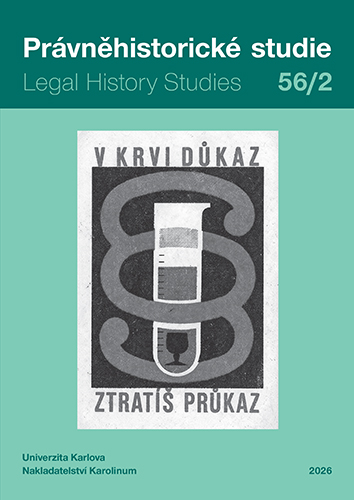
Právněhistorické studie (dále jen PHS) jsou odborným časopisem zařazeným do prestižní mezinárodní databáze SCOPUS, vydávaným Univerzitou Karlovou za vědecké garance Katedry právních dějin Právnické fakulty UK v univerzitním nakladatelství Karolinum. PHS jsou časopisem zaměřujícím se na obor právních dějin a témata, která s nimi souvisejí.
První číslo časopisu vyšlo v Nakladatelství Československé akademie věd v červnu roku 1955. Časopis byl nejprve vydáván Kabinetem právních dějin ČSAV, později Ústavem státu a práva ČSAV a poté Ústavem právních dějin Právnické fakulty Univerzity Karlovy.
PHS vycházejí třikrát ročně v dubnu, srpnu a prosinci a otiskují původní vědecké práce, vedle nich i recenze, anotace a zprávy z vědeckého života z oboru právních dějin. Přinášejí rovněž komentované materiály právněhistorické povahy. PHS přijímají příspěvky od domácích i zahraničních autorů. Příspěvky zahraničních autorů jsou uveřejňovány v původním jazyku, a to v angličtině, slovenštině, němčině, francouzštině, italštině nebo polštině.
Časopis Právněhistorické studie (ISSN 0079-4929) je evidován v Českém národním středisku ISSN (vedena Státní technickou knihovnou). Časopis je evidován Ministerstvem kultury ČR podle zákona č. 46/2000 Sb., o právech a povinnostech při vydávání periodického tisku a o změně některých dalších zákonů (tiskový zákon), a má přiděleno evidenční číslo periodického tisku MK E 18813.
Časopis Právněhistorické studie je tzv. otevřeným časopisem a zajišťuje otevřený přístup k vědeckým informacím (Open Access). Veškerý obsah od čísla 48/2 je zveřejněn na webových stránkách časopisu (studie od čísla 43/2013), přičemž přístup k němu mají všichni bezplatně.
Časopis Právněhistorické studie využívá licenci Creative Commons: CC BY 4.0.
Dlouhodobou archivaci digitálního obsahu časopisu zajišťuje Portico.
PRÁVNĚHISTORICKÉ STUDIE, Vol 32 No 1 (1992), 37–51
ArticlePostavení a činnost sacra scrinia za dominátu
[The Position and Activities of sacra scrinia during the Dominate]
Michal Skřejpek
DOI: https://doi.org/10.14712/2464689X.2026.767
zveřejněno: 19. 08. 2020
Abstract
The imperial administrative underwent far-reaching changes during the Dominate. Only a limited number of administrative departments may be recognised as the continuation of the former departments of the Principate. They are mostly the imperial departments – the auxiliary administrative bodies of the emperor that are called sacra scrinia. However their position in the imperial administrative changed considerably. Originally they helped the emperor directly, but later they were only one of many palatine offices, albeit with a specific position. Officers working in the scrinia were under judicial and organizational supervision of the magister officiorum but they were almost exclusively responsible for tasks set by the quaestor sacri palatii. As scriniarii closely cooperated with the quaestor and performed specific duties they became one of the pillars of the system of law of the late Roman Empire. Magistri scriniorum formally at the head of the scrinia were not their real chiefs. The chiefs of the personnel were proximi, magistri only chose assistants from among them. It even seems probable that the magistri scriniorum were directly under the emperor’s supervision. In attempting to specify the contents of duties of individual scrinia during the Dominate it is important to differentiate whether their officers were engaged in the services of the quaestor or in the services of the relevant magister scriniorum. The personnel of the scrinia in the services of the quaestor sacri palatii all engaged in attending to private requests called processes. One task was however common for all the scrinia as information from all parts of the Roman State in the field of administration flowed into the hands of the personnel of these departments, they in fact, together with the body agentes in rebus, inspected the whole administration of the Empire. In this paper when I speak about the contents of the tasks of each scrinia, it is not fully justified as scrinia as a body never functioned, the specific duties were fulfilled only by its individual members. scrinium epistolarum – The personnel of this scrinium who worked for the quaestor, were charged with the making out of the consultationes, leges dictandae, and finally they also made out letters of appointment for senior officers called probatoria. Epistolares working for the magister officiorum attended to the agenda connected with diplomatic activities. Magister epistolarum most probably engaged in the traditional sphere of duties, he took care of the emperor’s correspondence. In the eastern part of the Empire there existed the magister Graecarum, who was concerned with the Greek correspondence. scrinium libellorum – Quaestor sacri palatii made use of “his” libellenses for the making out of the probatoria for junior officers. Under the magister’s supervision they prepared cases held before the emperor and therefore engaged mostly in attending to appeals – supplicationes. scrinium memoriae – This scrinium retained its former exceptional position among other departments as it was the case during the Principate. Four members of the personnel called antiquarii carried out the duties of the central archives under supervision of the magister. Other members of the personnel performed other smaller tasks as e.g. they reported on students in Rome. The personnel in the services of the quaestor issued probatoria and made out adnotationes – replies to requests that required only a short answer from the emperor. scrinium dispositionum – The character of this office was very close to that of the departments functioning during the Principáte. However, there is not available any direct analogy from that period. The organizational structure of this scrinium also differed from other scrinia as it was supervised by magister officiorum. Moreover, at the beginning it was directed only by the primicerius. This scrinium formed the emperor’s mobile secretariat that performed regular office duties and took care of his official programme.
Published by the Karolinum Press. For permission to use please write to journals@karolinum.cz.
170 x 240 mm
vychází: 3 x ročně
cena tištěného čísla: 250 Kč
ISSN: 0079-4929
E-ISSN: 2464-689X