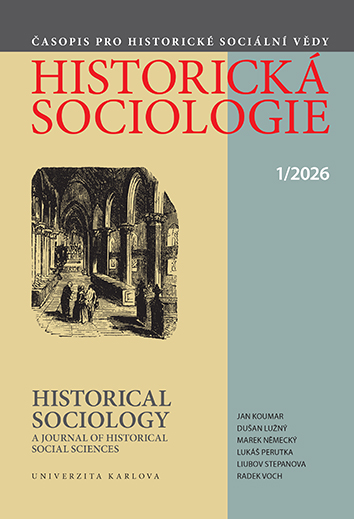
Interdisciplinární časopis se zaměřuje především ze sociologického, politologického a historického hlediska na problematiku dlouhodobých sociálních procesů a trendů, modernizace, globalizačních tendencí a vlivů. Časopis vytváří širší platformu pro badatele v historických sociálních vědách. Epistemologické pole časopisu není striktně ohraničené a počítá s přesahy do civilizacionistiky, kulturní sociologie a dalších spřízněných oblastí.
Časopis vydává nakladatelství Univerzity Karlovy v Praze Karolinum ve spolupráci s Fakultou humanitních studií Univerzity Karlovy v Praze.
Historická sociologie je vědecký časopis s otevřeným přístupem, což znamená, že veškerý obsah je volně k dispozici bez poplatku pro uživatele nebo instituci. Uživatelé mohou číst, stahovat, kopírovat, distribuovat, tisknout, vyhledávat nebo odkazovat na plné texty článků v tomto časopise, aniž by potřebovali předchozí povolení od vydavatele nebo autora.
Recenzovaný vědecký časopis vychází dvakrát ročně, v červnu a v prosinci.
Časopis je abstraktován a indexován v CEEOL, CEJSH, DOAJ, EBSCO, Emerging Sources Citation Index, ERIH PLUS, OAJI, recensio.net, Scopus, SSOAR, Ulrichsweb.
Dlouhodobou archivaci elektronického obsahu časopisu zajišťuje Portico.
HISTORICKÁ SOCIOLOGIE, Vol 18 No 1 (2026), 45–70
ArticlePražský strukturalismus jako základ eurasijství
[Prague Structuralism as the Foundation of Eurasianism]
Liubov Stepanova
DOI: https://doi.org/10.14712/23363525.2026.4
zveřejněno: 21. 07. 2026
Abstract
The article analyzes the Prague phase of the Eurasian movement (1921–1938) as an epistemological experiment applying structural linguistics to questions of civilizational identity and geopolitics. The premise is that Eurasianism was not merely a political manifesto of Russian émigré intellectuals, but a complex scholarly theory shaped in dialogue with the Prague Linguistic Circle. Through analysis of three key thinkers – Nikolai Trubetzkoy, Petr Savitsky, and Lev Karsavin – the article reconstructs the mechanism of transfer of the structural method from language to civilization (geostructuralism) and identifies its epistemological limits: the conflation of descriptive and normative claims, the reproduction of Orientalist asymmetry despite proclaimed anti-universalism, and the postulation of a civilizational subject without the voices of those it claimed to represent. Braudel’s longue durée and concepts of postcolonial theory (Said, Spivak) serve as comparative frameworks. The article concludes that the lasting contribution of the Eurasian legacy lies not in its political programme, but in its epistemological gesture: conceiving space as an active formative force shaping culture, language, and identity.
klíčová slova: Eurasianism; Prague structuralism; geostructuralism; mestorazvitiye; postcolonial theory
reference (45)
1. Alexejev, Nikolaj N. [2003]. Na putjach k buduščemu Rossii: izbrannyje statji. Sankt-Petěrburg: Izd. SPbU.
2. Andersen, Henning [2010]. From morphologization to demorphologization. In: The Continuum Companion to Historical Linguistics. London: Continuum, s. 117-146.
3. Anderson, Benedict [1983]. Imagined Communities. Imaginární společenství. Praha: Karolinum, 2008.
4. Andreyev, Catherine - Savický, Ivan [2004]. Rusko v exilu. Praha: Academia.
5. Bassin, Mark [2015]. The Gumilev Mystique. Ithaca: Cornell University Press.
6. Berďajev, Nikolaj A. [1928]. Utopičeskij etatizm jevrazijcev. Puť, č. 8.
7. Bhabha, Homi K. [1994]. The Location of Culture. London: Routledge.
8. Braudel, Fernand [1949]. Středomoří a středomořský svět za éry Filipa II. Praha: Argo, 1999.
9. Brubaker, Rogers [1996]. Nationalism Reframed: Nationhood and the national question in the New Europe. Cambridge: CUP.
10. Castells, Manuel [1997]. The Power of Identity. Moc identity. Praha: Karolinum, 2001.
11. Eisenstadt, Shmuel N. [2000]. Multiple Modernities. New Brunswick: Transaction, 2002.
12. Florovskij, Georgij V. [1928]. Jevrazijskij soblazn. Sovremennyje zapiski, č. 34.
13. Florovskij, Georgij V. [1937]. Puti russkogo bogoslovija. Vilnius: Pravoslavnaja obščina, 1991.
14. Frankopan, Peter [2015]. Hedvábné stezky: Nová historie světa. Praha: Vyšehrad, 2021.
15. Glebov, Sergey [2017]. From Empire to Eurasia. DeKalb: NIU Press.
16. Gökalp, Ziya [1920]. The Principles of Turkism. Leiden: Brill, 1968.
17. Harvey, David [1989]. The Condition of Postmodernity. Oxford: Blackwell.
18. Hobsbawm, Eric J. [1994]. Věk extrémů. Krátké 20. století 1914-1991. Praha: Argo, 1998.
19. Husserl, Edmund [1936]. Krize evropských věd a transcendentální fenomenologie. Praha: Academia, 1996.
20. Chakrabarty, Dipesh [2000]. Provincializing Europe. Princeton: Princeton University Press.
21. Jakobson, Roman O. [1931]. K charakteristike evrazijskogo jazykovogo sojuza. Praha.
22. Karsavin, Lev P. [1923]. Filosofija istorii. Sankt-Petěrburg: Komplekt, 1993.
23. Khalid, Adeeb [1998]. The Politics of Muslim Cultural Reform: Jadidism in Central Asia. Berkeley: University of California Press.
24. Laruelle, Marlène [2008]. Russian Eurasianism: An Ideology of Empire. Washington: Wilson Center Press.
25. Mackinder, Halford J. [1919]. Democratic Ideals and Reality: A Study in the Politics of Reconstruction. London: Constable and Company.
26. Mannheim, Karl [1929]. Ideologie a utopie. Praha: Orion, 1991.
27. Mignolo, Walter D. [2011]. The Darker Side of Western Modernity. Durham: Duke University Press.
28. Popper, Karl R. [1945]. Otevřená společnost a její nepřátelé. Praha: Oikoymenh, 1994.
29. Raeff, Marc [1990]. Russia Abroad: A Cultural History of the Russian Emigration, 1919-1939. New York: Oxford University Press.
30. Ratzel, Friedrich [1897]. Politische Geographie. München: Oldenbourg.
31. Said, Edward W. [1978]. Orientalismus. Praha: Paseka, 2008.
32. Saussure, Ferdinand de [1916]. Kurs obecné lingvistiky. Praha: Academia, 1996.
33. Savickij, Pjotr N. [1927]. Kontinent Jevrazija. Moskva: Agraf, 1997.
34. Sériot, Patrick [1999]. Structure et totalité. Les origines intellectuelles du structuralisme en Europe centrale et orientale. Paris: Presses universitaires de France.
35. Sériot, Patrick [2014]. Structure and the Whole. Struktura a celek. Praha: Academia.
36. Shekhovtsov, Anton - Umland, Andreas [2009]. Is Aleksandr Dugin a Traditionalist? "Neo-Eurasianism" and Perennial Philosophy. Russian Review 68 (4): 662-678. CrossRef
37. Spengler, Oswald [1918]. Zánik Západu. Praha: Academia, 2010.
38. Spivak, Gayatri C. [1988]. Can the Subaltern Speak? In. Nelson, Cary - Grossberg, Lawrence (eds.). Marxism and the Interpretation of Culture. Chicago: University of Illinois Press, s. 271-313.
39. Tlostanova, Madina [2012]. What Does It Mean to Be Post-Soviet? Rotterdam: Sense Publishers.
40. Toman, Jindřich [1995]. The Magic of a Common Language. Cambridge: MIT Press.
41. Trubeckoj, Nikolaj S. [1920]. Jevropa i čelověčestvo. Sofija.
42. Trubeckoj, Nikolaj S. [1939]. Grundzüge der Phonologie. Praha: CLP.
43. Voráček, Emil [2004]. Eurasijství v ruském politickém myšlení. Osudy jednoho z porevolučních ideových směrů ruské meziválečné emigrace. Praha: Set Out.
44. Weber, Max [1919]. Věda jako povolání. In. Metodologie, sociologie a politika. Praha: Oikoymenh, 1998.
45. Zimonyi, István [2010]. The Steppe as a Bridge between Civilizations. In. Studies on the Turkic World. Budapest, s. 1-22.

Pražský strukturalismus jako základ eurasijství is licensed under a Creative Commons Attribution 4.0 International License.
157 x 230 mm
vychází: 2 x ročně
cena tištěného čísla: 120 Kč
ISSN: 1804-0616
E-ISSN: 2336-3525