
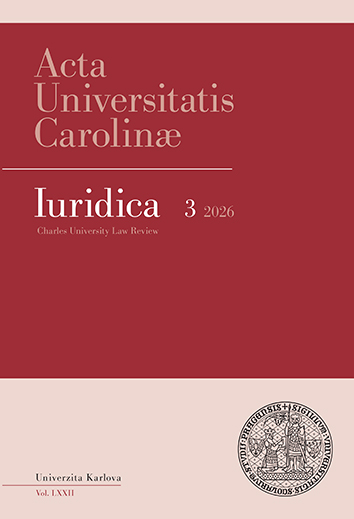
Acta Universitatis Carolinae Iuridica (dále jen AUCI) je hlavním časopisem Právnické fakulty UK. Vychází od roku 1954, patří tak mezi tradiční právnické časopisy teoretického zaměření.
Jako obecný právnický časopis přináší delší studie i kratší články o jakýchkoli relevantních otázkách v právní teorii i mezinárodním, evropském a vnitrostátním právu. AUCI také publikuje materiály vztahující se k aktuálním otázkám legislativy. AUCI je recenzovaný časopis a přijímá příspěvky od českých i zahraničních autorů. Příspěvky zahraničních autorů jsou zveřejňovány v původním jazyku – slovenštině, angličtině, němčině, francouzštině.
AUCI je teoretický časopis pro otázky státu a práva. Jeho vydavatelem je Univerzita Karlova v Praze, Právnická fakulta, prostřednictvím nakladatelství Karolinum. Vychází čtyřikrát ročně, termíny vydání časopisu naleznete zde.
Články uveřejněné v časopise AUCI procházejí nezávislým recenzním řízením (peer review), které je oboustranně anonymní. Posuzovatelé z daného oboru vyjadřují své stanovisko k vědecké kvalitě příspěvku a vhodnosti publikace v časopisu. V případě připomínek je stanovisko zasíláno zpět autorovi s možností přepracování textu (blíže viz Pokyny pro autory – Průběh recenzního řízení).
Časopis AUCI (ISSN 0323-0619) je evidován v České národní bibliografii (vedena Národní knihovnou ČR) a v Index to Foreign Legal Periodicals (veden American Association of Law Libraries). AUCI má přiděleno evidenční číslo periodického tisku e. č. MK E 18585.
V r. 2021 byl jako první časopis Právnické fakulty Univerzity Karlovy zařazen do prestižní mezinárodní databáze Scopus. Tato databáze společnosti Elsevier je největší abstraktovou a citační databází recenzované literatury na světě. Od zařazení do elitní databáze Scopus si redakce časopisu slibuje nejen zvýšení čtenosti časopisu, ale také nárůst zájmu o publikaci příspěvků jak českých, tak zahraničních autorů.
AUCI je tzv. časopisem otevřeným a veškerý jeho obsah je zveřejňován jak na webu fakulty, tak na webových stránkách nakladatelství Karolinum. Přístup k němu je bezplatný. Domovská stránka časopisu AUCI je na webových stránkách Nakladatelství Karolinum.
Časopis AUCI využívá licenci Creative Commons: CC BY 4.0.
Dlouhodobou archivaci digitálního obsahu časopisu zajišťuje Portico.
AUC IURIDICA, Vol 72 No 3 (2026), 45–60
ArticleConfiscation of Unexplained Wealth in EU Context – Conceptual Considerations
Jan Provazník
DOI: https://doi.org/10.14712/23366478.2026.104
zveřejněno: 01. 09. 2026
Abstract
This article examines the concept of confiscation of unexplained wealth (CUW) as introduced into EU law by Art. 16 of Directive (EU) 2024/1260 on asset recovery and confiscation. CUW enables the confiscation of assets suspected of deriving from organised crime without any prior criminal conviction, representing a significant departure from the conviction-based paradigm dominant in continental legal systems. The article first maps the necessary theoretical background, legal texts and case-law. After that, it analyses the relevant case-law, mapping the permissible boundaries of CUW under EU primary law and the Convention for the Protection of Human Rights and Fundamental Freedoms. The subsequent critical analysis evaluates the principal objections to CUW – including its selectivity relative to other domains of criminal law – and engages with the pragmatic arguments advanced in its defence. The article concludes that, while the transposition of Art. 16 is legally obligatory and consistent with existing supranational case-law, the preferable conceptual solution would be to frame CUW explicitly as a civil law instrument and develops theoretical grounding for this position alongside proposals for addressing the pragmatic obstacles to such an approach.
klíčová slova: confiscation of unexplained wealth; non-conviction-based confiscation; asset recovery; Directive 2024/1260; presumption of innocence; organised crime; in rem proceedings; EU criminal law
reference (52)
1. BARTELS, L. Unexplained Wealth Laws in Australia. Trends & Issues in Crime and Criminal Justice. 2010, No. 395, pp. 1-6. CrossRef
2. BIKELIS, S. Chasing Criminal Wealth: Broken Expectations for the Criminalization of Illicit Enrichment in Lithuania. Journal of Money Laundering Control. 2022, Vol. 25, No. 1, pp. 95-108. CrossRef
3. BOGGESS, K. - ZAGARIS, B. Money Laundering, Bank Secrecy, and Transparency. International Enforcement Law Reporter. 2024, Vol. 40, No. 4.
4. BORLINI, L. - ROSE, C. The Normative Development of Laws on Asset Preservation and Confiscation: An Examination of Emerging Best Practices. International Journal of Constitutional Law. 2024, Vol. 22, No. 2, pp. 514-537. CrossRef
5. CAMPBELL, L. - CLANCY, Á. The Principled and Practical Limits to Unexplained Wealth Orders. University of Western Australia Law Review. 2024, Vol. 52, No. 1, pp. 29-52.
6. CLANCY, Á. Unexplained Wealth Orders and the UK's Anti-Corruption Regime. Oxford: Oxford University Press, 2025. CrossRef
7. Decision of the Commision of 15 March 1991, case M. v. Italy, app. No. 12386/86.
8. Decision of the ECHR of 4 April 2001, case Riela v. Italy, app. No. 52439/99.
9. Decision of the ECHR of 10 April 2003, case Yildirim v. Italy, app. No. 38602/02.
10. Decision of the ECHR of 27 June 2002, Butler v. the United Kingdom, app. No. 41661/98, Reports of Judgments and Decisions 2002-IV.
11. DEWI, D. A. S. et al. Asset Seizure Regulations Against Public Officials with Unexplained Wealth (A Comparative Study of the Philippines and Australia). Jurnal Pembangunan Hukum Indonesia [Indonesian Journal of Legal Development]. 2025, Vol. 7, No. 3, pp. 377-404. CrossRef
12. DORNBIERER, A. Targeting Unexplained Wealth: Implications of the Eu's 2024 Directiveon Asset Recovery. Policy Brief 14. International Centre for Asset Recovery, 2025. CrossRef
13. GLOVER, J. Trusts at the Intersection of Tax and Criminal Laws: Unpaid Tax, "Unexplained Wealth Orders" and the Proceeds of Crime Act 2002. Australian Tax Forum. 2021, Vol. 36, No. 1, pp. 33-51.
14. Judgment of the CJEU of 5 March 1996, joint cases C-46/93 and C-48/93, Brasserie du Pêcheur SA v. The Federal Republic of Germany and The Queen v. The Secretary of State for Transport.
15. Judgment of the CJEU of 5 October 2000, case C-367/98, Federal Republic of Germany v European Parliament and Council of the European Union.
16. Judgment of the CJEU of 5 September 2019, case C-377/18, criminal proceedings against AB and Others.
17. Judgment of the CJEU of 8 June 2010, case C-58/08, The Queen v. Secretary of State for Business, Enterprise and Regulatory Reform.
18. Judgment of the CJEU of 8 March 2001, joint cases C-397/98 and C-410/98, Metallgesellschaft Ltd. and others.
19. Judgment of the CJEU of 9 March 1999, Centros Ltd. V Erhvervs. Og Selskabsstyrelsen, case C-212/97.
20. Judgment of the CJEU of 10 December 2002, case C-491/01, The Queen v Secretary of State for Health.
21. Judgment of the CJEU of 10 November 2022, case C-203/21, criminal proceedings against DELTA STROY 2003.
22. Judgment of the CJEU of 12 December 2024, case C-419/23, CN v. Nemzeti Földügyi Központ.
23. Judgment of the CJEU of 13 July 2006, Vincenzo Manfredi v. Lloyd Adriatico Assicurazioni SpA and others, joint cases C-295/04, C-296/04, C-297/04 and C-298/04.
24. Judgment of the CJEU of 15 June 2023, case C-520/21, Arkadiusz Szcześniak v. Bank M. SA.
25. Judgment of the CJEU of 19 March 2020, case C-234/18, Komisia za protivodeystvie na koruptsiyata i za otnemane na nezakonno pridobitoto imushtestvo v. BP and Others.
26. Judgment of the CJEU of 19 November 1991, joint cases C-6/90 and C-9/90, Francovich.
27. Judgment of the CJEU of 21 October 2021, joined cases C-845/19 and C-863/19, criminal proceedings against DR and TS.
28. Judgment of the ECHR of 3 March 2015, case Dimitrovi v. Bulgaria, app. No. 12655/09.
29. Judgment of the ECHR of 5 July 2001, case Phillips v United Kingdom, app. No. 41087/98.
30. Judgment of the ECHR of 10 April 2012, case Silickiene v. Lithuania, app. No. 20496/02.
31. Judgment of the ECHR of 12 May 2015, case Gogitidze and others v. Georgia, app. No. 36862/05, § 107.
32. Judgment of the ECHR of 15 January 2015, case Rummi v. Estonia, app. No. 63362/09.
33. Judgment of the ECHR of 15 January 2015, case Veits v. Estonia, app. No. 12951/11.
34. Judgment of the ECHR of 22 February 1994, case Raimondo v. Italy, app. No. 12954/87.
35. Judgment of the ECHR of 24 October 1986, case Agosi v. The United Kingdom, app. No. 9118/80.
36. Judgment of the ECHR of 26 June 2018, case Telbis and Viziteu v. Romania, app. No. 47911/15.
37. Judgment of the ECHR of 26 September 2023, case Yordanov and others v. Bulgaria, apps. No. 265/17 and 26473/18.
38. Judgment of the Grand chamber of the ECHR of 28 June 2018, case G.I.E.M. S.R.L. and Others v Italy, app. Nos. 1828/06 and 19029/11.
39. KOLAROV, T. Challenges in Settling Non Conviction Based Civil Confiscation of Unexplained Wealth. Journal of Money Laundering Control. 2021, Vol. 24, No. 3, pp. 483-490. CrossRef
40. LOVEJOY, M. Unexplained Wealth Orders and the Right Not to Self-Incriminate [Pre-Print Chapter for Book]. Analysing Organised Crime, Financial Crime and Criminal Justice: Theoretical Concepts and Challenges [online]. Routledge Spring, 2021 [cit. 2026-04-10]. Available at: https://osf.io/preprints/lawarxiv/mbtdr_v1.
41. MCINTYRE, J. L. - ASLETT, D. - BUITENDAG, N. Implementing Unexplained Wealth Orders in South Africa - What Are the Options? Journal of Money Laundering Control. 2023, Vol. 26, No. 7, pp. 85-98. CrossRef
42. MOISEIENKO, A. The Limitations of Unexplained Wealth Orders. Criminal Law Review. 2022, No. 3, pp. 230-241.
43. MUJUZI, J. D. Relying on Foreign Convictions from Non European Economic Area States to Investigate Unexplained Wealth for the Purpose of Combating Money Laundering in the United Kingdom. European Criminal Law Review. 2019, Vol. 9, No. 1, pp. 120-132.
44. OCHNIO, A. H. Recent Developments in EU Anti Corruption Strategy: The Missing Element of the Return of Corrupt Assets to "Victim Countries". Journal of Money Laundering Control. 2024, Vol. 27, No. 7, pp. 1-12. CrossRef
45. PRASETYO, W. The Nominee Scheme Through the Lens of Neutral Self-Mentality and Unexplained Wealth. Jurnal Studi Akuntansi dan Keuangan. 2025, Vol. 8, No. 3, pp. 313-330. CrossRef
46. RAOF, N. A. - AIMAN SULAIMAN, N. M. Show Me the Money! Unexplained Wealth and Civil Forfeiture in Malaysia. IIUM Law Journal. 2023, Vol. 31, No. 2, pp. 127-154. CrossRef
47. Report from the Commission to the European Parliament and to the Council: Asset Recovery and Confiscation: Ensuring That Crime Does Not Pay, COM(2020) 217 final [online]. Brussels, 2. 6. 2020 [cit. 2026-05-11]. Available at: https://eur-lex.europa.eu/legal-content/EN/TXT/HTML/?uri=CELEX:52020DC0217.
48. RODRÍGUEZ PINEAU, E. Article 81 [Judicial Cooperation in Civil Matters]. In: BLANKE, H. J. - MANGIAMELI, S. (eds.). Treaty on the Functioning of the European Union - A Commentary. Cham: Springer, 2021, p. 49.
49. SAKELLARAKI, A. EU Asset Recovery and Confiscation Regime - Quo Vadis? A First Assessment ofthe Commission's Proposal to Further Harmonise the EU Asset Recovery and Confiscation Laws. A Step in the Right Direction? New Journal of European Criminal Law. 2022, Vol. 13, No. 4, pp. 478-501. CrossRef
50. SALWA, A. M. The Future of Asset Confiscation in Indonesia Through the Unexplained Wealth Order (UWO): A Comparative Study with the United Kingdom. Jurist Diction. 2026, Vol. 9, No. 1, pp. 153-172. CrossRef
51. SMITH, M. - SMITH, R. G. Procedural Impediments to Effective Unexplained Wealth Legislation in Australia. Trends & Issues in Crime and Criminal Justice. 2016, No. 523, p. 1 ff. CrossRef
52. THOMAS, J. D. Unexplained Wealth Orders in the Criminal Finances Bill: A Suitable Measure to Tackle Unaccountable Wealth in the UK? Journal of Financial Crime. 2017, Vol. 24, No. 2, p. 178 ff.

Confiscation of Unexplained Wealth in EU Context – Conceptual Considerations is licensed under a Creative Commons Attribution 4.0 International License.
157 x 230 mm
vychází: 4 x ročně
cena tištěného čísla: 65 Kč
ISSN: 0323-0619
E-ISSN: 2336-6478