
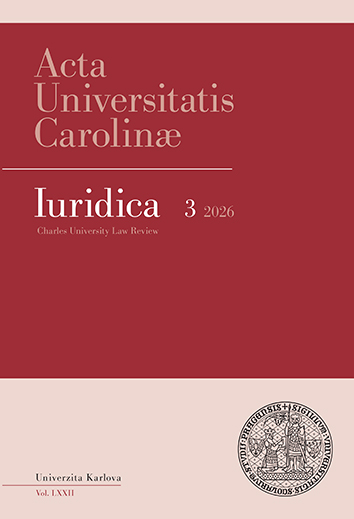
Acta Universitatis Carolinae Iuridica (dále jen AUCI) je hlavním časopisem Právnické fakulty UK. Vychází od roku 1954, patří tak mezi tradiční právnické časopisy teoretického zaměření.
Jako obecný právnický časopis přináší delší studie i kratší články o jakýchkoli relevantních otázkách v právní teorii i mezinárodním, evropském a vnitrostátním právu. AUCI také publikuje materiály vztahující se k aktuálním otázkám legislativy. AUCI je recenzovaný časopis a přijímá příspěvky od českých i zahraničních autorů. Příspěvky zahraničních autorů jsou zveřejňovány v původním jazyku – slovenštině, angličtině, němčině, francouzštině.
AUCI je teoretický časopis pro otázky státu a práva. Jeho vydavatelem je Univerzita Karlova v Praze, Právnická fakulta, prostřednictvím nakladatelství Karolinum. Vychází čtyřikrát ročně, termíny vydání časopisu naleznete zde.
Články uveřejněné v časopise AUCI procházejí nezávislým recenzním řízením (peer review), které je oboustranně anonymní. Posuzovatelé z daného oboru vyjadřují své stanovisko k vědecké kvalitě příspěvku a vhodnosti publikace v časopisu. V případě připomínek je stanovisko zasíláno zpět autorovi s možností přepracování textu (blíže viz Pokyny pro autory – Průběh recenzního řízení).
Časopis AUCI (ISSN 0323-0619) je evidován v České národní bibliografii (vedena Národní knihovnou ČR) a v Index to Foreign Legal Periodicals (veden American Association of Law Libraries). AUCI má přiděleno evidenční číslo periodického tisku e. č. MK E 18585.
V r. 2021 byl jako první časopis Právnické fakulty Univerzity Karlovy zařazen do prestižní mezinárodní databáze Scopus. Tato databáze společnosti Elsevier je největší abstraktovou a citační databází recenzované literatury na světě. Od zařazení do elitní databáze Scopus si redakce časopisu slibuje nejen zvýšení čtenosti časopisu, ale také nárůst zájmu o publikaci příspěvků jak českých, tak zahraničních autorů.
AUCI je tzv. časopisem otevřeným a veškerý jeho obsah je zveřejňován jak na webu fakulty, tak na webových stránkách nakladatelství Karolinum. Přístup k němu je bezplatný. Domovská stránka časopisu AUCI je na webových stránkách Nakladatelství Karolinum.
Časopis AUCI využívá licenci Creative Commons: CC BY 4.0.
Dlouhodobou archivaci digitálního obsahu časopisu zajišťuje Portico.
AUC IURIDICA, Vol 13 No 1 (1966), 3–36
ArticleProcesní podmínky a jejich zjišťování
[The Procedural Conditions and Their Ascertainment]
František Štajgr
DOI: https://doi.org/10.14712/23366478.2025.767
zveřejněno: 10. 02. 2021
Abstract
The article in question deals with procedural conditions and their ascertainment in civil proceedings. Are considered as constituting procedural conditions the conditions of the admissibility of the procedure itself and of the decision which has to be taken in the matter. The conditions in question are the jurisdiction and the competence of the court, the capacity of the subjects appearing as participants in the procedure to be participants and their procedural capacity, the authorization of the legal representative and of the appointed representative, the opening of the procedure and finally the fact whether there exists some obstacle of litispendance or of rei iudicatae Are not considered as procedural conditions in the above mentioned sense e disinterestedness of the judge and the correct composition of the court because' these facts constitute conditions not only of the procedure and the decision to be: taken, but also conditions of the procedure concerning the existence of the procedural conditions themselves. The answer to the question whether in a concrete procedure all the procedural conditions exist or not, eventually which of them exist and which not, constitutes a juridical conclusion drawn from facts. Because of the fact that the procedural conditions constitute an institution of the procedural law, this juridical conclusion is always itself a procedural conclusion, drawn from facts decisive from the point of view of the procedural law. It is obvious that these facts differ, as far as their content is concerned, according to the different involved procedural conditions. Besides that, they differ also because of the fact that in some cases they constitute juridical facts only from the point of view of the provisions of the procedural law, whereas in other cases they constitute juridical facts also from the standpoint of view of the material law. The consequences of these differences are reflected also in the method by which their existence in a civil procedure is verified. These metho s are in fact also different. The article analyses and elaborates in detail all these matters. In the final part of the article are outlined the proceedings of the court in the case when the court has ascertained that some of the procedural conditions is missing. Even here differences exist, depending on the one hand on the fact whether in the concrete case the lack is a removable or an unremovable one, on the other hand on the fact whether the lack consists in the existence of a certain and which obstacle to the procedure or in the lack of a certain positive procedural condition.

Procesní podmínky a jejich zjišťování is licensed under a Creative Commons Attribution 4.0 International License.
157 x 230 mm
vychází: 4 x ročně
cena tištěného čísla: 65 Kč
ISSN: 0323-0619
E-ISSN: 2336-6478