
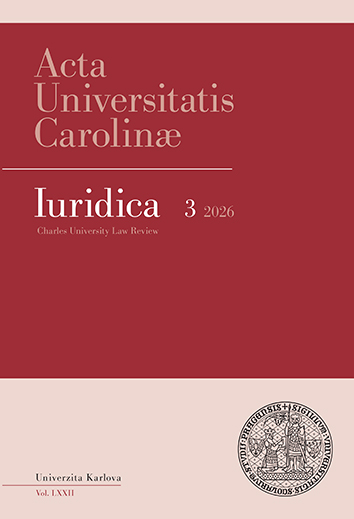
Acta Universitatis Carolinae Iuridica (dále jen AUCI) je hlavním časopisem Právnické fakulty UK. Vychází od roku 1954, patří tak mezi tradiční právnické časopisy teoretického zaměření.
Jako obecný právnický časopis přináší delší studie i kratší články o jakýchkoli relevantních otázkách v právní teorii i mezinárodním, evropském a vnitrostátním právu. AUCI také publikuje materiály vztahující se k aktuálním otázkám legislativy. AUCI je recenzovaný časopis a přijímá příspěvky od českých i zahraničních autorů. Příspěvky zahraničních autorů jsou zveřejňovány v původním jazyku – slovenštině, angličtině, němčině, francouzštině.
AUCI je teoretický časopis pro otázky státu a práva. Jeho vydavatelem je Univerzita Karlova v Praze, Právnická fakulta, prostřednictvím nakladatelství Karolinum. Vychází čtyřikrát ročně, termíny vydání časopisu naleznete zde.
Články uveřejněné v časopise AUCI procházejí nezávislým recenzním řízením (peer review), které je oboustranně anonymní. Posuzovatelé z daného oboru vyjadřují své stanovisko k vědecké kvalitě příspěvku a vhodnosti publikace v časopisu. V případě připomínek je stanovisko zasíláno zpět autorovi s možností přepracování textu (blíže viz Pokyny pro autory – Průběh recenzního řízení).
Časopis AUCI (ISSN 0323-0619) je evidován v České národní bibliografii (vedena Národní knihovnou ČR) a v Index to Foreign Legal Periodicals (veden American Association of Law Libraries). AUCI má přiděleno evidenční číslo periodického tisku e. č. MK E 18585.
V r. 2021 byl jako první časopis Právnické fakulty Univerzity Karlovy zařazen do prestižní mezinárodní databáze Scopus. Tato databáze společnosti Elsevier je největší abstraktovou a citační databází recenzované literatury na světě. Od zařazení do elitní databáze Scopus si redakce časopisu slibuje nejen zvýšení čtenosti časopisu, ale také nárůst zájmu o publikaci příspěvků jak českých, tak zahraničních autorů.
AUCI je tzv. časopisem otevřeným a veškerý jeho obsah je zveřejňován jak na webu fakulty, tak na webových stránkách nakladatelství Karolinum. Přístup k němu je bezplatný. Domovská stránka časopisu AUCI je na webových stránkách Nakladatelství Karolinum.
Časopis AUCI využívá licenci Creative Commons: CC BY 4.0.
Dlouhodobou archivaci digitálního obsahu časopisu zajišťuje Portico.
AUC IURIDICA, Vol 13 No 1 (1966), 37–59
ArticleVztah občanského procesu k občanskému a rodinnému právu
[The Relationship Between the Civil Procedure and the Civil and Family Law]
Zdeněk Češka
DOI: https://doi.org/10.14712/23366478.2025.768
zveřejněno: 10. 02. 2021
Abstract
The article concerning the relationship existing between the civil procedure and the civil and family law intends to demonstrate the proper task of the civil procedure as far as the protection and the enforcement of the subjective rights of citizens and socialist organizations are concerned, which result from relations based on civil, event, family law. The civil and the family law on the one hand and the civil procedure on the other hand represent independent juridical branches, which however are closely connected and which complete each other. Without material law, procedure would be an aim in itself and material law would loose in fact, without the procedure, the character of law, the characteristic feature of which, differentiating it, for instance, from ethics, is precisely the possibility of enforcing the behaviour, foreseen by the law, by means of the State machinery. The civil procedure constitutes, as far as the domain of civil and family law is concerned, the enforcement by the State which can be applied if the subjective right of a citizen or of a socialist organisation is endangered or violated. The method of enforcement by the State, which will be applied if the rules of civil or family law are violated, is usually not quite as obvious from the rules in question, as for instance is obvious the enforcement from the rules of penal law. The reason for it consists in the fact that the rules of the civil and the family law stipulate certain rights and certain duties resulting from the juridical relations in question, but that they do not contain usually any stipulation of the consequences which will have to support the person who does not comply with his duty or, otherwise said, who violates the right resulting from the juridical relation in question. In fact, as far as the rules of civil and family law are concerned, the sanction is not expressed. As far as the traditional conception of civil law is concerned, the civil sanctions are mentioned in connection with the responsibility for the caused damage, for defects, for delay and for the enrichment without valid cause. It is supposed 'that the sanction is constituted by the origin of a relationship of responsibility as a consequence of a certain behaviour contrary to the law. The author of the article shares the opinion that in this case this is not a “sanction” in the proper sense of the word. We can use the term of sanction in such a case only if we consider as sanction every consequence of a behaviour contrary to the law. The origin of the relationship of responsibility represents such a consequence. According to the opinion of the author, one should consider as a sanction, that means as a structural element of the juridical rule, only the threat of an enforcement by the State, which can be applied in cases foreseen by the law, as it is f. i. the case as far as the rules of penal law are concerned. It is impossible to speak about the sanction in this sense as far as the reparation of damage and the responsibility for defects, for delay and for enrichment without valid cause are concerned. In those cases only obligations are fixed, not different from other obligations, resulting f. i. from the contract of purchase or from other contracts. The unique difference is that one sort of the mentioned obligations is constituted by those which are the consequence of an act contrary to the law, whereas the other sort of obligations is constituted by those which are the consequence of legal acts. In both cases however the law does not mention normally the method to be applied as far as their enforcement is concerned, provided those obligations are not accomplished voluntarily. This is however not necessary, because it is known that anybody can claim his right resulting from a certain civil or family juridical relation, that means that anybody can realize the enforcement of a legal duty by invoking his right before the court; the Civil code expresses this in fact explicitly in the general rule of the article 4, but also in other provisions, so, for instance, in the provision of section 132. The civil procedure represents in fact, in the domain of the civil and family law, the main instrument of enforcement by the State, the aim of which is to secure the realization of the rights, based on civil and family juridical relations. The feature of an act of enforcement by the State is naturally the most apparent where the execution of the decision is concerned, but one must consider as constituting an enforcement by the State even already the proceedings and the decision concerning the matter, non-obstant the fact that their coercive function is not apparent at first sight. The proceedings and the decision on the matter represent the first phase of the coercion exercised by the State; they constitute the necessary condition for the application of the second phase, the judicial enforcement. It may happen that the enforcement of a concrete juridical duty is obtained already during the first phase, if the obliged person submits to the judicial decision, so that the application of the measure of enforcement is, in such a case, not necessary. That even the proceedings and the decision must be considered as constituting a form of the coercion exercised by the State, is proved also by the existence of a series of provisions of the Code of civil procedure, imposing upon the parties in the procedure a number of enforceable obligations, as for instance the duty to appear before the Court (with the possibility of bringing up the persons in question) a. s. o. The appreciation of the problem concerning the right to sue depends on the described relation between the civil procedure on the one hand and the civil and family law on the other hand. The author of the article belongs to those who share the opinion that the right to sue represents an independent procedural right to apply to the court, independent of the asserted subjective material law; this right is a consequence of the civil right, guaranteed by the Constitution, to address the representative assemblies and the other State organs and to file proposals, suggestions and complaints. The author considers as unnecessary the creation of the notion of a “right to sue in the material sense”, which is sometimes considered as constituting a phase of the development of the subjective right in question. The author considers that the fact that an action can be brought before the court on the ground of a subjective right, that means that a subjective right can be judicially enforced, represents a trait of the law in question, without which this law would cease to be the law; this is true non-obstant the fact that this right can be enforced only after the fulfilment of certain preliminary conditions, f. i. only after the claim is due. A consequence of this procedural conception of the right to sue, independent of the existence of the asserted subjective right, is also the procedural conception and solution of the question who are, in the concrete case, the participants in the procedure. The question concerning the quality of participants in the procedure has to be solved independently of the material capacity of the participants; this applies as well to the procedure opened on a motion, as to the procedure opened without such a motion. The civil procedure also does not cover the same extent as the civil and family law do. Within the frame of the civil procedure, protection is secured also to rights based on labour law, cooperative law and other relations and on the contrary the civil procedure is not the unique instrument applied to the protection of the rights based on civil and family juridical relations; the Civil code, as well as the Family code, take in certain cases into account, as far as this protection is concerned also other organs, f. i. the national committees. The rules of the civil law and those of the Procedural law differ also by the fact that the rules of civil law have mostly the character of dispositive rules whereas the procedural rules have an obligatory character. It is precisely this obligatory character of the procedural rules, the fact that the prescribed procedure must be respected as far as the protection of civil and family rights is concerned which constitutes one of the efficacious guarantees of the protection in question.

Vztah občanského procesu k občanskému a rodinnému právu is licensed under a Creative Commons Attribution 4.0 International License.
157 x 230 mm
vychází: 4 x ročně
cena tištěného čísla: 65 Kč
ISSN: 0323-0619
E-ISSN: 2336-6478