
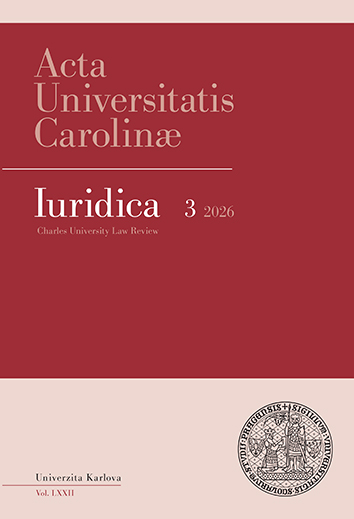
Acta Universitatis Carolinae Iuridica (dále jen AUCI) je hlavním časopisem Právnické fakulty UK. Vychází od roku 1954, patří tak mezi tradiční právnické časopisy teoretického zaměření.
Jako obecný právnický časopis přináší delší studie i kratší články o jakýchkoli relevantních otázkách v právní teorii i mezinárodním, evropském a vnitrostátním právu. AUCI také publikuje materiály vztahující se k aktuálním otázkám legislativy. AUCI je recenzovaný časopis a přijímá příspěvky od českých i zahraničních autorů. Příspěvky zahraničních autorů jsou zveřejňovány v původním jazyku – slovenštině, angličtině, němčině, francouzštině.
AUCI je teoretický časopis pro otázky státu a práva. Jeho vydavatelem je Univerzita Karlova v Praze, Právnická fakulta, prostřednictvím nakladatelství Karolinum. Vychází čtyřikrát ročně, termíny vydání časopisu naleznete zde.
Články uveřejněné v časopise AUCI procházejí nezávislým recenzním řízením (peer review), které je oboustranně anonymní. Posuzovatelé z daného oboru vyjadřují své stanovisko k vědecké kvalitě příspěvku a vhodnosti publikace v časopisu. V případě připomínek je stanovisko zasíláno zpět autorovi s možností přepracování textu (blíže viz Pokyny pro autory – Průběh recenzního řízení).
Časopis AUCI (ISSN 0323-0619) je evidován v České národní bibliografii (vedena Národní knihovnou ČR) a v Index to Foreign Legal Periodicals (veden American Association of Law Libraries). AUCI má přiděleno evidenční číslo periodického tisku e. č. MK E 18585.
V r. 2021 byl jako první časopis Právnické fakulty Univerzity Karlovy zařazen do prestižní mezinárodní databáze Scopus. Tato databáze společnosti Elsevier je největší abstraktovou a citační databází recenzované literatury na světě. Od zařazení do elitní databáze Scopus si redakce časopisu slibuje nejen zvýšení čtenosti časopisu, ale také nárůst zájmu o publikaci příspěvků jak českých, tak zahraničních autorů.
AUCI je tzv. časopisem otevřeným a veškerý jeho obsah je zveřejňován jak na webu fakulty, tak na webových stránkách nakladatelství Karolinum. Přístup k němu je bezplatný. Domovská stránka časopisu AUCI je na webových stránkách Nakladatelství Karolinum.
Časopis AUCI využívá licenci Creative Commons: CC BY 4.0.
Dlouhodobou archivaci digitálního obsahu časopisu zajišťuje Portico.
AUC IURIDICA, Vol 11 No 4 (1964), 75–96
ArticleOprava důvodů rozhodnutí
[The Amendment of the Grouds of a Decision]
Jindřich Hrdlička
DOI: https://doi.org/10.14712/23366478.2025.755
zveřejněno: 11. 02. 2021
Abstract
The article deals with the problems concerning a legal remedy newly introduced in the Czechoslovak civil procedure, the amendment of the grounds of a judicial decision. The essence of this legal remedy consists in the fact that the court amends on the proposal of the party the grounds of a judicial decision, insofar as the grounds are not based on established facts of the case. The author asks in the beginning, whether the aim pursued by the new provision, that means the protection of justified interests of the party, infringed only by the grounds of the judgement, would not be better secured by the remedies given in the soviet civil procedure and based on the principles of civil procedure, which consist in the admission of a separate appeal, against the grounds of a decision. The author demonstrates the incorrect theoretical basis on which is founded the provision of the article 39 of the mentioned Principles, insofar it stipulates the binding character of facts established by a legally valid decision and insofar this implicates the admissibility of a separate appeal against the grounds of the judgement under the form of an appeal for cassation. The author points out the different function and importance of the sentence itself and of the grounds of a decision, both these components constituting however a dialectical unity which can’t be infringed by the admission of a separate verification only of one of them. He points further to the fact that the binding character of the sentence Is of a different nature and has other consequences than the binding character of the grounds, especially insofar as the facts stated in them are concerned, fixed by norms. This binding character of the grounds, based on norms, creates in reality only a presumption of their conformity with facts, a presumption which is however of little utility and may even be harmful, if the consequence of it is the binding character of facts which are incorrect. He shows on examples to what sort of undesirable consequences can lead the binding character of established facts contained in the grounds of a legally valid decision. The author points to the unsatisfactory consequences of the mentioned principles even as far as the procedure on legal remedies is concerned, where for Instance a protest against an Incorrect formulation of the grounds involves also the stay of the execution of the decision in question, the solution of which is otherwise accepted by all the affected parties, or where such an unconsidered protest directed only against the grounds can lead to a change of the decision to the detriment of the person who lodged the protest. The author assents therefore to the solution adopted by the legislator who did not adopt the soviet solution of this question. As far as the proper subject of the article is concerned, the author mentions first of all the reasons which led to the introduction of this legal remedy, these reasons having been the protests of the working people who could not realize that they remained without protection in cases, where the grounds of a decision considerably infringed their justified interests. After that, the author examines the cases where the party is unable to secure the protection of its justified interests by means of a discretionary remedy, because of the fact that even according to the new Code of Civil Procedure the grounds of the decision don’t acquire legal validity and an appeal lodged only against the grounds of the decision is inadmissible. He examines afterwards the conditions under which the amendment of a judicial decision is admissible. As far as the capacity to file the motion for the amendment of a decision is concerned, without which it is impossible to proceed to such an amendment, he examines also the problem of the respective capacity of the prosecutor, the national committee and the social organisations. He analyses in details the condition for the amendment consisting in the fact that the grounds in question are not based on established facts. He examines what parts of the grounds may be touched by the amendment and he comes to the conclusion, that the lacking of an appropriate basis for the grounds as far as the established facts of the case are concerned can be examined for the purpose of admissibility of an amendment only in respect of the statements made, event, expressed by the court in the grounds of the decision; it is therefore inadmissible to examine in view of an amendment of the grounds the correctness of the facts themselves as established by the court (even if the question what was established can’t be answered in a formalist way). As far as the time limitation fixed for the amendment is concerned (the motion must be filed, while the decision is not legally valid) the author doesn’t consider this mode of limitation as being the most happy one; he points to some difficulties which will originate from it and which would be prevented if the filing of the motion would be limited by a term which would start from the moment when the decision has been served. Another condition the author deals with and which is not mentioned by express words in the law, but results from the general principles of the securing of judicial protection, is that of the existence of a justified interest in the execution of the amendment. He examines this condition especially in relation to the cases, where the amendment is proposed by the prosecutor, the national committee or the social organisation. In connection with the comment he gives on the problem of competence to decide on the amendment, he resolves some problems resulting from the special character of the regulation; this special character consists in the fact that if the court of the first instance does not allow the motion for an amendment, it submits it to the appeal court. The author examines further the methods by which the court gets the basis for its decision on the amendment and the form in which the amendment is executed; in this connection he tries to resolve in an unformalist way certain complications arising when the amendment relates to a part of the decision which is contested by a legal remedy lodged by the other party. He resolves in this connection also and in a positive way the problem of the admissibility of a complaint for violation of the law against a decision on the amendment. From the preceding analysis the author draws the conclusion, that the legal institution of the amendment of the grounds of a decision is not a legal remedy in the technical sense of the word, because its aim is not the abolition of a substantial incorrectness of the decision, but only the removal of a deficiency in its grounds, and also because it doesn’t involve a suspension of the legal liability of the grounds of the decision, because these have not, according to the law, a legally binding character. The definition he gives of the amendment of the grounds of a decision is therefore that of a legal remedy sui generis, the characteristic feature of which is the fact that its function does not consist in the protection of the rights of citizens and organisations, but in the protection of their justified interests. According to the author’s opinion, the importance of this new institution of the civil procedure consists on the one hand in the improvement of the legal protection of citizens and organisations and on the other hand in its educational effect which will operate also on the courts, forcing them to approach with greater care the elaboration of the grounds of their decisions; this will on the whole help to rise the cultural level of the judicial proceedings and decisions.

Oprava důvodů rozhodnutí is licensed under a Creative Commons Attribution 4.0 International License.
157 x 230 mm
vychází: 4 x ročně
cena tištěného čísla: 65 Kč
ISSN: 0323-0619
E-ISSN: 2336-6478