
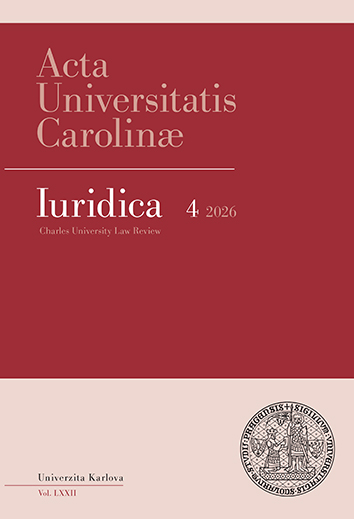
Acta Universitatis Carolinae Iuridica (dále jen AUCI) je hlavním časopisem Právnické fakulty UK. Vychází od roku 1954, patří tak mezi tradiční právnické časopisy teoretického zaměření.
Jako obecný právnický časopis přináší delší studie i kratší články o jakýchkoli relevantních otázkách v právní teorii i mezinárodním, evropském a vnitrostátním právu. AUCI také publikuje materiály vztahující se k aktuálním otázkám legislativy. AUCI je recenzovaný časopis a přijímá příspěvky od českých i zahraničních autorů. Příspěvky zahraničních autorů jsou zveřejňovány v původním jazyku – slovenštině, angličtině, němčině, francouzštině.
AUCI je teoretický časopis pro otázky státu a práva. Jeho vydavatelem je Univerzita Karlova v Praze, Právnická fakulta, prostřednictvím nakladatelství Karolinum. Vychází čtyřikrát ročně, termíny vydání časopisu naleznete zde.
Články uveřejněné v časopise AUCI procházejí nezávislým recenzním řízením (peer review), které je oboustranně anonymní. Posuzovatelé z daného oboru vyjadřují své stanovisko k vědecké kvalitě příspěvku a vhodnosti publikace v časopisu. V případě připomínek je stanovisko zasíláno zpět autorovi s možností přepracování textu (blíže viz Pokyny pro autory – Průběh recenzního řízení).
Časopis AUCI (ISSN 0323-0619) je evidován v České národní bibliografii (vedena Národní knihovnou ČR) a v Index to Foreign Legal Periodicals (veden American Association of Law Libraries). AUCI má přiděleno evidenční číslo periodického tisku e. č. MK E 18585.
V r. 2021 byl jako první časopis Právnické fakulty Univerzity Karlovy zařazen do prestižní mezinárodní databáze Scopus. Tato databáze společnosti Elsevier je největší abstraktovou a citační databází recenzované literatury na světě. Od zařazení do elitní databáze Scopus si redakce časopisu slibuje nejen zvýšení čtenosti časopisu, ale také nárůst zájmu o publikaci příspěvků jak českých, tak zahraničních autorů.
AUCI je tzv. časopisem otevřeným a veškerý jeho obsah je zveřejňován jak na webu fakulty, tak na webových stránkách nakladatelství Karolinum. Přístup k němu je bezplatný. Domovská stránka časopisu AUCI je na webových stránkách Nakladatelství Karolinum.
Časopis AUCI využívá licenci Creative Commons: CC BY 4.0.
Dlouhodobou archivaci digitálního obsahu časopisu zajišťuje Portico.
AUC IURIDICA, Vol 72 No 4 (2026), 43–65
ArticleElectronic Evidence in Criminal Proceedings as a New Challenge for European Judicial Cooperation
Libor Klimek
DOI: https://doi.org/10.14712/23366478.2026.118
zveřejněno: 23. 11. 2026
Abstract
The increasing digitalisation of contemporary society has fundamentally transformed the nature of criminal investigations and the acquisition of evidence. Electronic data has become an essential source of information in criminal proceedings, while its cross-border character has exposed significant limitations of traditional mechanisms of judicial cooperation in criminal matters. In response to these challenges, the European Union adopted a new legal framework, commonly referred to as the e-Evidence package, centred upon Regulation (EU) 2023/1543 and Directive (EU) 2023/1544. This article examines the legal and constitutional implications of the e-Evidence system from the perspective of European Union law. Particular attention is devoted to the impact of the new framework on the principle of member state sovereignty within the Area of Freedom, Security, and Justice. The article seeks to answer the following research question: To what extent does the e-Evidence system affect the principle of member state sovereignty within the framework of judicial cooperation in criminal matters in the European Union? The analysis is based primarily on the doctrinal method, supplemented by analytical and comparative approaches. The article examines the concept and significance of electronic evidence, traditional mechanisms for obtaining electronic evidence in cross-border cases, the legal framework of e-Evidence, the protection of fundamental rights, and the relationship between e-Evidence and existing European structures of judicial cooperation. The article concludes that the e-Evidence system does not eliminate member state sovereignty but contributes to its transformation within an increasingly integrated European legal order.
klíčová slova: electronic evidence; e-Evidence; judicial cooperation in criminal matters; European Union; member state sovereignty; cross-border criminal proceedings
reference (42)
1. ALRAGGAD, M. M. - ALMAHASNEH, A. A. A. A. - BOROVIKOVA, V. - ZHYVKO, Z. - KOMISSARCHUK, Y. The Policy of Rethinking the Criminal Process in the National Security System: The Impact of Digitalisation on Working with Electronic Evidence. Social & Legal Studios [online]. 2024, Vol. 7, No. 2, pp. 162-170 [cit. 2026-05-20]. CrossRef
2. AMBOS, K. (ed.). Europäisches Strafrecht post-Lissabon. Göttingen: Universitätsverlag Göttingen, 2011. CrossRef
3. AMBOS, K. European Criminal Law. Cambridge: Cambridge University Press, 2018. CrossRef
4. ANGEL, O. E. M. et al. Digital Evidence as a Means of Proof in Criminal Proceedings. Russian Law Journal. 2023, Vol. 11, No. 5, pp. 96-105 CrossRef
5. BARNARD, C. - PEERS, S. (eds.). European Union Law. 4th ed. Oxford: Oxford University Press, 2023.
6. BIASIOTTI, M. A. - MIFSUD BONNICI, J. P. - CANNATACI, J. - TURCHI, F. (eds.). Handling and Exchanging Electronic Evidence Across Europe. Cham: Springer, 2018. CrossRef
7. BÖSE, M. (ed.). Europäisches Strafrecht. 2. Aufl. Baden-Baden: Nomos, 2021. CrossRef
8. Consolidated Version of the Treaty on the Functioning of the European Union. Official Journal of the European Union [online]. C 326, 26, 6. 10. 2012 [cit. 2026-05-22]. Available at: https://eur-lex.europa.eu/LexUriServ/LexUriServ.do?uri=CELEX:12012E/TXT:en:PDF.
9. Directive (EU) 2023/1544 of the European Parliament and of the Council of 12 July 2023 Laying Down Harmonised Rules on the Designation of Designated Establishments and the Appointment of Legal Representatives for the Purpose of Gathering Electronic Evidence in Criminal Proceedings. Official Journal of the European Union [online]. L 191, 28. 7. 2023, pp. 181-190 [cit. 2026-05-22]. Available at: https://eur-lex.europa.eu/eli/dir/2023/1544/oj/eng.
10. E-evidence - Cross-Border Access to Electronic Evidence. In: European Commission [online]. [cit. 2026-05-20]. Available at: https://commission.europa.eu/law/cross-border-cases/judicial-cooperation/types-judicial-cooperation/e-evidence-cross-border-access-electronic-evidence_en.
11. Electronic Evidence. In: Eurojust [online]. [cit. 2026-05-22]. Available at: https://www.eurojust.europa.eu/judicial-cooperation/instruments/electronic-evidence.
12. European Commission. Proposal for a Regulation of the European Parliament and of the Council on European Production and Preservation Orders for Electronic Evidence in Criminal Matters, COM(2018) 225 final. In: EUR-Lex: Access to European Union Law [online]. Brussels, 17. 4. 2018 [cit. 2026-05-22]. Available at: https://eur-lex.europa.eu/legal-content/EN/TXT/?uri=celex:52018PC0225.
13. European Commission. Commission Staff Working Document. Impact Assessment Accompanying the Proposal for a Regulation on European Production and Preservation Orders for Electronic Evidence in Criminal Matters and the Proposal for a Directive Laying Down Harmonised Rules on the Appointment of Legal Representatives for the Purpose of Gathering Evidence in Criminal Proceedings. SWD(2018) 118 final. In: EUR-Lex: Access to European Union Law [online]. Brussels, 17. 4. 2018 [cit. 2026-05-22]. Available at: https://eur-lex.europa.eu/legal-content/EN/TXT/?uri=celex:52018SC0118.
14. European Court of Human Rights, Council of Europe. Convention for the Protection of Human Rights and Fundamental Freedoms, as Amended by Protocols Nos. 11, 14 and 15 [online]. Strasbourg [cit. 2026-05-22]. Available at: https://www.echr.coe.int/documents/d/echr/convention_eng.
15. FOMINA, T. H. - RACHYNSKYI, О. О. Електронні докази у кримінальному процесі: проблемні питання теорії та практики [Electronic Evidence in Criminal Proceedings: Problematic Issues of Theory and Practice]. Вісник Харківського національного університету внутрішніх справ [Bulletin of Kharkiv National University of Internal Affairs] [online]. 2023, Vol. 102, No. 3, pp. 207-220 [cit. 2026-05-20]. CrossRef
16. FRANSSEN, V. Cross-Border Gathering of Electronic Evidence in the EU: Toward More Direct Cooperation Under the e-Evidence Regulation. In: MITSILEGAS, V. - BERGSTRÖM, M. - QUINTEL, T. (eds.). Research Handbook on EU Criminal Law. Cheltenham: Edward Elgar Publishing, 2024, pp. 184-185. CrossRef
17. GONZÁLEZ FUSTER, G. - VÁZQUEZ MAYMIR, S. Cross-Border Access to E-Evidence: Framing the Evidence. CEPS Papers in Liberty and Security in Europe, No. 2020-02. Brussels: February 2020.
18. HECKER, B. Europäisches Strafrecht. 7. Aufl. Berlin, Heidelberg: Springer, 2025. CrossRef
19. HECKER, B. Europäisches Strafrecht Post-Lissabon. In: AMBOS, K. (ed.). Europäisches Strafrecht Post-Lissabon. Göttingen: Universitätsverlag Göttingen, 2011, pp. 13-28.
20. Charter of Fundamental Rights of the European Union. Official Journal of the European Union [online]. C 202, 7. 6. 2016, pp. 389-405 [cit. 2026-05-22]. Available at: https://www.europarl.europa.eu/charter/pdf/text_en.pdf.
21. JANSSENS, CH. The Principle of Mutual Recognition in EU Law. Oxford: Oxford University Press, 2013. CrossRef
22. KERR, O. S. Digital Evidence and the New Criminal Procedure. Columbia Law Review [online]. 2005, Vol. 105, No. 1, pp. 279-318.
23. KLIMEK, L. Mutual Recognition of Judicial Decisions in European Criminal Law. Cham: Springer, 2017. CrossRef
24. KLIMEK, L. Základy trestného práva Európskej únie [Fundamentals of European Union Criminal Law]. Bratislava: Wolters Kluwer, 2017.
25. MARSHALL, A. Digital Forensics: Digital Evidence in Criminal Investigations. Chichester: John Wiley & Sons, 2009.
26. MASON, S. - SENG, D. (eds.). Electronic Evidence and Electronic Signatures. 5th ed. London: University of London Press, 2021. CrossRef
27. MITSILEGAS, V. EU Criminal Law After Lisbon: Rights, Trust and the Transformation of Justice in Europe. Oxford, Portland: Hart Publishing, 2018.
28. PAUL, G. L. Foundations of Digital Evidence. Chicago: American Bar Association, 2008.
29. POLYZOIDOU, V. e-Evidence Regulation: A Contemporary Trojan Horse in Criminal Proceedings? In: SYNODINOU, T.-E. et al. (eds.). EU Digital Law in the AI Era. Cham: Springer, 2025, pp. 239-261 [cit. 2026-05-20]. CrossRef
30. Regulation (EU) 2023/1543 of the European Parliament and of the Council of 12 July 2023 on European Production Orders and European Preservation Orders for electronic evidence in criminal proceedings and for the execution of custodial sentences following criminal proceedings. Official Journal of the European Union [online]. 2023, L 191, pp. 118-180 [cit. 2026-05-20]. Available at: https://eur-lex.europa.eu/eli/reg/2023/1543/oj/eng.
31. ROSE, C. - BLOKKER, N. - DAM-DE JONG, D. - VAN DEN DRIEST, S. - HEINSCH, R. - KOPPE, E. - SCHRIJVER, N. An Introduction to Public International Law. Cambridge: Cambridge University Press, 2022. CrossRef
32. SIRIUS: Cross-Border Access to Electronic Evidence. In: Eurojust [online]. [cit. 2026-05-20]. Available at: https://www.eurojust.europa.eu/sirius.
33. SACHOULIDOU, A. Cross-Border Access to Electronic Evidence in Criminal Matters: The New EU Legislation and the Consolidation of a Paradigm Shift in the Area of "Judicial" Cooperation. New Journal of European Criminal Law [online]. 2024, Vol. 15, No. 3, pp. 256-274 [cit. 2026-05-20]. CrossRef
34. SATZGER, H. Internationales und Europäisches Strafrecht. 11. Aufl. Baden-Baden: Nomos, 2025. CrossRef
35. SCANLAN, D. M. Digital Evidence in Criminal Law. Toronto: Canada Law Book, 2011.
36. SHULHA, V. - KALIUZHNA, L. Electronic Evidence in Criminal Procedure: Methods for Its Detection, Investigation and Legal Consolidation. Theory and Practice of Forensic Science and Criminalistics [online]. 2025, Vol. 40, No. 3, pp. 136-152 [cit. 2026-05-20]. CrossRef
37. SHURSON, J. Data Protection and Law Enforcement Access to Digital Evidence: Resolving the Reciprocal Conflicts between EU and US Law. International Journal of Law and Information Technology. 2020, Vol. 28, No. 2, pp. 167-184. CrossRef
38. SIGNORATO, S. Cross-Border Gathering of E-Evidence: Different Legal Frameworks in European Union and Council of Europe. Journal of Eastern European Criminal Law. 2023, Vol. 10, No. 1, pp. 9-18.
39. TOSZA, S. All Evidence Is Equal, But Electronic Evidence Is More Equal Than Any Other. New Journal of European Criminal Law [online]. 2020, Vol. 11, No. 2, pp. 161-183 [cit. 2026-05-20]. CrossRef
40. TURANJANIN, V. EncroChat, Sky ECC and Regulation (EU) 2023/1543: Towards a New Standards of Digital Evidence (I). Journal of Criminology and Criminal Law. 2025, Vol. 63, No. 3, pp. 7-30. CrossRef
41. VOGLER, R. Criminal Evidence and Respect for Fair Trial Guarantees in the Dialogue Between the European Court of Human Rights and National Courts. In: RUGGERI, S. (ed.). Transnational Evidence and Multicultural Inquiries in Europe: Developments in EU Legislation and New Challenges for Human Rights-Oriented Criminal Investigations in Cross-Border Cases. Cham: Springer, 2014, pp. 181-192. CrossRef
42. WARKEN, C. Classification of Electronic Data for Criminal Law Purposes. eucrim [online]. 2018, Vol. 13, No. 4, pp. 226-234 [cit. 2026-05-20]. CrossRef

Electronic Evidence in Criminal Proceedings as a New Challenge for European Judicial Cooperation is licensed under a Creative Commons Attribution 4.0 International License.
157 x 230 mm
vychází: 4 x ročně
cena tištěného čísla: 65 Kč
ISSN: 0323-0619
E-ISSN: 2336-6478
