
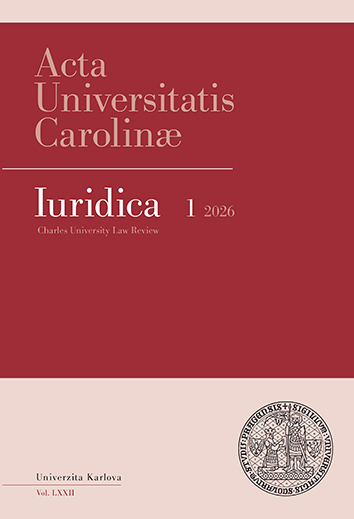
Acta Universitatis Carolinae Iuridica (dále jen AUCI) je hlavním časopisem Právnické fakulty UK. Vychází od roku 1954, patří tak mezi tradiční právnické časopisy teoretického zaměření.
Jako obecný právnický časopis přináší delší studie i kratší články o jakýchkoli relevantních otázkách v právní teorii i mezinárodním, evropském a vnitrostátním právu. AUCI také publikuje materiály vztahující se k aktuálním otázkám legislativy. AUCI je recenzovaný časopis a přijímá příspěvky od českých i zahraničních autorů. Příspěvky zahraničních autorů jsou zveřejňovány v původním jazyku – slovenštině, angličtině, němčině, francouzštině.
AUCI je teoretický časopis pro otázky státu a práva. Jeho vydavatelem je Univerzita Karlova v Praze, Právnická fakulta, prostřednictvím nakladatelství Karolinum. Vychází čtyřikrát ročně, termíny vydání časopisu naleznete zde.
Články uveřejněné v časopise AUCI procházejí nezávislým recenzním řízením (peer review), které je oboustranně anonymní. Posuzovatelé z daného oboru vyjadřují své stanovisko k vědecké kvalitě příspěvku a vhodnosti publikace v časopisu. V případě připomínek je stanovisko zasíláno zpět autorovi s možností přepracování textu (blíže viz Pokyny pro autory – Průběh recenzního řízení).
Časopis AUCI (ISSN 0323-0619) je evidován v České národní bibliografii (vedena Národní knihovnou ČR) a v Index to Foreign Legal Periodicals (veden American Association of Law Libraries). AUCI má přiděleno evidenční číslo periodického tisku e. č. MK E 18585.
V r. 2021 byl jako první časopis Právnické fakulty Univerzity Karlovy zařazen do prestižní mezinárodní databáze Scopus. Tato databáze společnosti Elsevier je největší abstraktovou a citační databází recenzované literatury na světě. Od zařazení do elitní databáze Scopus si redakce časopisu slibuje nejen zvýšení čtenosti časopisu, ale také nárůst zájmu o publikaci příspěvků jak českých, tak zahraničních autorů.
AUCI je tzv. časopisem otevřeným a veškerý jeho obsah je zveřejňován jak na webu fakulty, tak na webových stránkách nakladatelství Karolinum. Přístup k němu je bezplatný. Domovská stránka časopisu AUCI je na webových stránkách Nakladatelství Karolinum.
Časopis AUCI využívá licenci Creative Commons: CC BY 4.0.
Dlouhodobou archivaci digitálního obsahu časopisu zajišťuje Portico.
AUC IURIDICA, Vol 71 No 4 (2025), 145–160
ArticleReforming the EU’s Own Resources and Climate Tax: A Path to Fiscal Stability and Enviromental Responsibility
Ekkehart Reimer , Miroslava Večeř
DOI: https://doi.org/10.14712/23366478.2025.676
zveřejněno: 04. 12. 2025
Abstract
The European Union faces the challenge of ensuring its future budgetary stability, which relates to tendences to find new sources of budgetary revenues. From the perspective of EU objectives in sustainable development, it seems to be necessary to reflect an increasingly significant need to secure support and funding for environmental goals. In this regard, the EU continues to expand its commitments to fiscal and environmental responsibility. It is becoming significantly clearer that existing instruments such as the Emissions Trading Scheme (ETS) and the Carbon Border Adjustment Mechanism (CBAM) are limited and that they cannot contribute to genuine EU Own Resource significantly. This paper examines how the EU might, from the legal perspective, enact new Own Resources to support its efforts in addressing climate change and promoting ecological and fiscal sustainability, and secure new funding of the EU budget and make a pathway to completely new genuine Own Resources. Further, the paper focuses on the question, which new Own Resources are compatible with the EU legal framework, what legal mechanisms under the Treaties, and Own Resources Decision are relevant, or if in this sense the institute of enhanced cooperation can be used. The paper further analyses the several detailed research questions, including the potential scope of the Own Resources Decision in relation to the harmonization of member states’ tax legislation, particularly whether it is bound by the principle of conferral. The project also explores the nature of parliamentary action required across the 27 EU Member States, and whether a climate tax could be introduced based on enhanced cooperation among a group of 9+ like-minded countries. A well-structured climate tax could strengthen the EU budget, ensuring long-term fiscal sustainability while supporting the Union’s environmental objectives. However, successful implementation requires comprehensive coordination between member states.
klíčová slova: own resources; EU budget; fiscal innovation; climate taxation; environmental responsibility
reference (23)
1. BOHÁČ, R. - KERNDLOVÁ, P. Jak ESG pravidla a udržitelnost formují veřejné finance a daně? [How Do ESG Rules and Sustainability Shaped Public Budgets and Taxes?]. Acta Universitatis Carolinae Iuridica. 2025, Vol. LXXI, No. 3, pp. 11-24. CrossRef
2. Bundesministerium der Finanzen. Reform der EU-Finanzierung: Subsidiarität und Transparenz stärken [online]. Berlin: Bundesministerium der Finanzen Referat für Öffentlichkeitsarbeit Wilhelmstr, April 2016, pp. 14-15 [cit. 2025-06-09]. Available at: https://www.bundesfinanzministerium.de/Content/DE/Downloads/Ministerium/Wissenschaftlicher-Beirat/Gutachten/2016-12-02-wissenschaftlicher-beirat-eu-finanzierung.pdf?__blob=publicationFile&v=9.
3. CALLIES, CH. - RUFFERT, M. (eds.). EUV/AEUV Das Verfassungsrecht der Europäischen Union mit Europäischer Grundrechtecharta: Kommentar. 6th Aufl. München: C. H. Beck, 2022.
4. Consolidated text: Commission Delegated Regulation (EU) 2021/2106 of 28 September 2021 on supplementing Regulation (EU) 2021/241 of the European Parliament and of the Council establishing the Recovery and Resilience Facility by setting out the common indicators and the detailed elements of the recovery and resilience scoreboard. In: EUR-Lex: Access to European Union law [online]. 1. 12. 2021 [cit. 2025-06-07]. Available at: https://eur-lex.europa.eu/legal-content/EN/TXT/?uri=CELEX%3A02021R2106-20211201.
5. Consolidated version of the Treaty on the Functioning of the European Union - PROTOCOLS - Protocol (No 2) on the application of the principles of subsidiarity and proportionality. Document 12008E/PRO/02. Official Journal of European Union [online]. 115, 9. 5. 2008, pp. 0206-0209 [cit. 2025-06-07]. Available at: www: https://eur-lex.europa.eu/legal-content/EN/TXT/?uri=celex%3A12008E%2FPRO%2F02&utm.
6. COUNCIL DECISION (EU, Euratom) 2020/2053of 14 December 2020 on the system of own resources of the European Union and repealing Decision 2014/335/EU, Euratom. Official Journal of the European Union [online]. L 424/1, 15. 12. 2020 [cit. 2025-06-07]. Available at: https://eur-lex.europa.eu/eli/dec/2020/2053/oj/eng.
7. Council Directive 2006/112/EC of 28 November 2006 on the common system of value added tax (VAT Systems Directive), OJ 2006 L 347/1.
8. Fit for 55. In: European Council: Council of the European Union [online]. 17. 3. 2025 [cit. 2025-06-07]. Available at: https://www.consilium.europa.eu/en/policies/fit-for-55/.
9. Green Transition. In: European Commission [online]. [cit. 2025-09-07]. Available at: https://ec.europa.eu/economy_finance/recovery-and-resilience-scoreboard/green.html.
10. KENDRICK, M. Next Generation EU: Will the Debt be Repaid by EU Own Resources or Member State Taxpaxers? European Law Review [online]. 2023, Vol. 48, No. 1, pp. 29-61 [cit. 2025-06-11]. Available at: https://openaccess.city.ac.uk/id/eprint/30203.
11. KUBE, H. EU-Steuern - Kompetenzrechtliche Lage und Entwicklungsperspektiven. In: KUBE, H. - REIMER, E. (eds.). Geprägte Freiheit 2021/22: Impulse aus dem Institut für Finanz- und Steuerrecht. Berlin: Lehmanns Media, 2022, pp. 51-58. CrossRef
12. KUBE, H. - REIMER, E. Solid Financing of the EU. Berlin: Lehmanns Media, 2021. CrossRef
13. LE CACHEUX, J. Funding the EU Budget with a Genuine Own Resource: The Case for a European Tax. Notre Europe, Studies & Research, Vol. 57. Paris: Notre Europe, 2007.
14. PEETERS, B. et al. (eds.). The Concept of Tax [online]. EATLP International Tax Series, Vol. 3. Amsterdam: IBFD, 2005 [cit. 2025-06-07]. Available at: https://www.ibfd.org/product/296/download/pdf.
15. REGULATIONS COUNCIL REGULATION (EU) 2020/2094 of 14 December 2020 establishing a European Union Recovery Instrument to support the recovery in the aftermath of the COVID-19 crisis. Official Journal of the European Union [online]. L 433 I/23, 22. 12. 2020 [cit. 2025-06-07]. Available at: https://eur-lex.europa.eu/legal-content/EN/TXT/PDF/?uri=CELEX:32020R2094.
16. REICHERT, G. - SCHWIND, S. - DE PETRIS, A. - JOUSSEAUME, M. The "EU Plastic Tax": Greenwashing New Revenue for the EU Budget. CepInput. 2021, No. 3, pp. 1-12.
17. SCHORKOPF, F. Die Europäische Union auf dem Weg zur Fiskalunion. Neue Juristische Wochenschrift. 2020, Jhrg. 73, Heft 42, pp. 3085-3091.
18. SCHULZE, R. - JANSSEN, A. - KADELBACH, S. (eds.). Europarecht: Handbuch für die deutsche Rechtspraxis. 4th Aufl. Baden-Baden: Nomos, 2020.
19. STREINZ, R. (ed.). EUV/AEUV: Vertrag über die Europäische Union und Vertrag über die Arbeitsweise der Europäischen Union. 3rd Aufl. Beck'sche Kurz-Kommentare. München: C. H. Beck, 2018.
20. VALTA, S. Grundfreiheiten im Kompetenzkonflikt. Berlin: Duncker & Humblot, 2013. CrossRef
21. VYBÍRAL, R. ESG pravidla a jejich role v oblasti udržitelnosti finančních trhů [ESG Rules and Their Role in the Sustainability of Financial Markets]. Acta Universitatis Carolinae Iuridica. 2025, Vol. LXXI, No. 2, pp. 29-46. CrossRef
22. WALDHOFF, CH. Eigene EU-Steuern als Problem des Verfassungs- und Europarechts. In: KONRAD, K. A. - LOHSE, T. (eds.). Einnahmen- und Steuerpolitik in Europa: Herausforderungen und Chancen. Lausanne: Peter Lang, 2009, pp. 47-73.
23. WALDHOFF, CH. Probleme des europäischen Finanzausgleichs im Lichte der Erweiterung der Europäischen Union. Zeitschrift für Europarechtliche Studien. 2000, Nr. 2, pp. 201-242. CrossRef

Reforming the EU’s Own Resources and Climate Tax: A Path to Fiscal Stability and Enviromental Responsibility is licensed under a Creative Commons Attribution 4.0 International License.
230 x 157 mm
vychází: 4 x ročně
cena tištěného čísla: 65 Kč
ISSN: 0323-0619
E-ISSN: 2336-6478