
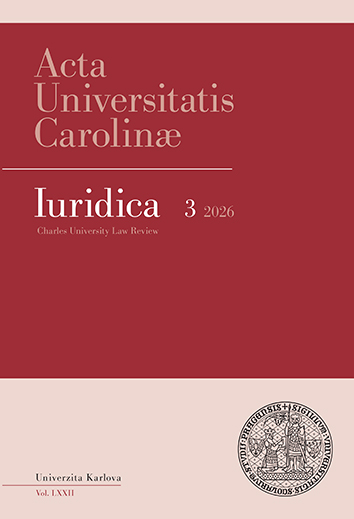
Acta Universitatis Carolinae Iuridica (dále jen AUCI) je hlavním časopisem Právnické fakulty UK. Vychází od roku 1954, patří tak mezi tradiční právnické časopisy teoretického zaměření.
Jako obecný právnický časopis přináší delší studie i kratší články o jakýchkoli relevantních otázkách v právní teorii i mezinárodním, evropském a vnitrostátním právu. AUCI také publikuje materiály vztahující se k aktuálním otázkám legislativy. AUCI je recenzovaný časopis a přijímá příspěvky od českých i zahraničních autorů. Příspěvky zahraničních autorů jsou zveřejňovány v původním jazyku – slovenštině, angličtině, němčině, francouzštině.
AUCI je teoretický časopis pro otázky státu a práva. Jeho vydavatelem je Univerzita Karlova v Praze, Právnická fakulta, prostřednictvím nakladatelství Karolinum. Vychází čtyřikrát ročně, termíny vydání časopisu naleznete zde.
Články uveřejněné v časopise AUCI procházejí nezávislým recenzním řízením (peer review), které je oboustranně anonymní. Posuzovatelé z daného oboru vyjadřují své stanovisko k vědecké kvalitě příspěvku a vhodnosti publikace v časopisu. V případě připomínek je stanovisko zasíláno zpět autorovi s možností přepracování textu (blíže viz Pokyny pro autory – Průběh recenzního řízení).
Časopis AUCI (ISSN 0323-0619) je evidován v České národní bibliografii (vedena Národní knihovnou ČR) a v Index to Foreign Legal Periodicals (veden American Association of Law Libraries). AUCI má přiděleno evidenční číslo periodického tisku e. č. MK E 18585.
V r. 2021 byl jako první časopis Právnické fakulty Univerzity Karlovy zařazen do prestižní mezinárodní databáze Scopus. Tato databáze společnosti Elsevier je největší abstraktovou a citační databází recenzované literatury na světě. Od zařazení do elitní databáze Scopus si redakce časopisu slibuje nejen zvýšení čtenosti časopisu, ale také nárůst zájmu o publikaci příspěvků jak českých, tak zahraničních autorů.
AUCI je tzv. časopisem otevřeným a veškerý jeho obsah je zveřejňován jak na webu fakulty, tak na webových stránkách nakladatelství Karolinum. Přístup k němu je bezplatný. Domovská stránka časopisu AUCI je na webových stránkách Nakladatelství Karolinum.
Časopis AUCI využívá licenci Creative Commons: CC BY 4.0.
Dlouhodobou archivaci digitálního obsahu časopisu zajišťuje Portico.
AUC IURIDICA, Vol 23 No 2 (1978), 129–162
Transmise dědictví
[Inheritance Transmission]
Vojtěch Cepl
DOI: https://doi.org/10.14712/23366478.2025.642
zveřejněno: 25. 09. 2020
Abstract
The study deals with inheritance instances, where the inheritor dies immediately after the deceased, even before be had been able to declare, whether he wished to accept or to reject the inheritance. In such cases (very frequent in modern times, especially in connection with the consequences of road accidents) the point arises, whether the inheritor’s subjective right to accept or to reject he inheritance, that had not been realised, passes onto his next inheritors or not. In the legal systems of various countries and at different historical periods both possible basic types of answer to the question may be found. The Czechoslovak Civil Code of 1964 has no specific provision for inheritance transmission. Contradictory opinions appeared in the legal theory and so the by now classical inheritance transmission controversy, which had started in the last century, was to a certain extent revided. After a brief definition of the problem and terminology in the first and next chapter the development of the inheritance transmission ruling in the territory of the Czechoslovak Socialist Republic is examined. Next, differing opinions on the problem under investigation in the professional literature are classified, followed by a detailed analysis of the main arguments advanced by the advocates and opponents of the transmission (chapter four and five). This is where the author takes up his own position towards the opinion, according to which the institution of inheritance transmission requires a legal inheritance regulation in that the moment of devolution is differentiated from the moment of its acquisition. According to this opinion transmission is inadmissible in Czechoslovak Law, because inheritance is acquired immediately on the deceased’s demise and thus the mentioned requirement is not met. The author argues against this opinion that the contemporary Czechoslovak regulation of immediate inheritance transfer is construed by application of a legal fiction like the legal regulations resting on the manner of mediated inheritance (for inst. hereditas iacens or temporary inheritance administrator) and that it is, therefore, irrelevant in which wider construction the transmission is regulated. His opinion is illustrated with examples from other legal systems and with a systematic survey of the contemporary ruling in the other European socialist countries. Another main argument advanced by the opponents of transmission is the claim that the right to reject inheritance is a personal right and therefore not transferrable. The author classifies subjective rights as personal and property rights and argues that the right of inheritance is a property right. And so he comes to the formulation of his own position to the whole problem under investigation joining ranks with the advocates of transmission. In the remaining part of the study analysed are the incidental consequences of the conclusion that the right of inheritance is a property right, showing in other branches of the law as well. Finally, in conclusion analysed are the consequence of the transmission acceptance in the field of the right of inheritance. Transmission is once more defined and differentiated from similar and connected inheritance law institutions. Further, questions of possible concurrence between transmission and accrestion and vulgar substitution are discussed. The paper leads into a general call for elaboration of the inheritance law theory with the purport of introducing new terms comporting with the changes of the subjective right of inheritance and the elements of the inheritance legal relation at a time level when succession actually takes always place.

Transmise dědictví is licensed under a Creative Commons Attribution 4.0 International License.
157 x 230 mm
vychází: 4 x ročně
cena tištěného čísla: 65 Kč
ISSN: 0323-0619
E-ISSN: 2336-6478