
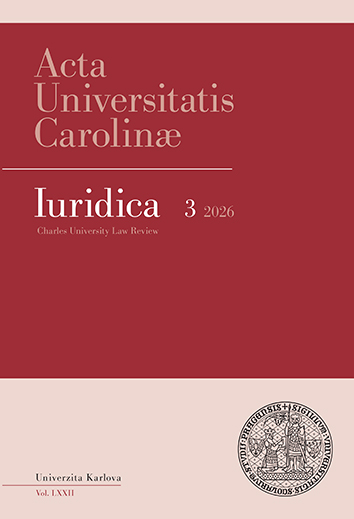
Acta Universitatis Carolinae Iuridica (dále jen AUCI) je hlavním časopisem Právnické fakulty UK. Vychází od roku 1954, patří tak mezi tradiční právnické časopisy teoretického zaměření.
Jako obecný právnický časopis přináší delší studie i kratší články o jakýchkoli relevantních otázkách v právní teorii i mezinárodním, evropském a vnitrostátním právu. AUCI také publikuje materiály vztahující se k aktuálním otázkám legislativy. AUCI je recenzovaný časopis a přijímá příspěvky od českých i zahraničních autorů. Příspěvky zahraničních autorů jsou zveřejňovány v původním jazyku – slovenštině, angličtině, němčině, francouzštině.
AUCI je teoretický časopis pro otázky státu a práva. Jeho vydavatelem je Univerzita Karlova v Praze, Právnická fakulta, prostřednictvím nakladatelství Karolinum. Vychází čtyřikrát ročně, termíny vydání časopisu naleznete zde.
Články uveřejněné v časopise AUCI procházejí nezávislým recenzním řízením (peer review), které je oboustranně anonymní. Posuzovatelé z daného oboru vyjadřují své stanovisko k vědecké kvalitě příspěvku a vhodnosti publikace v časopisu. V případě připomínek je stanovisko zasíláno zpět autorovi s možností přepracování textu (blíže viz Pokyny pro autory – Průběh recenzního řízení).
Časopis AUCI (ISSN 0323-0619) je evidován v České národní bibliografii (vedena Národní knihovnou ČR) a v Index to Foreign Legal Periodicals (veden American Association of Law Libraries). AUCI má přiděleno evidenční číslo periodického tisku e. č. MK E 18585.
V r. 2021 byl jako první časopis Právnické fakulty Univerzity Karlovy zařazen do prestižní mezinárodní databáze Scopus. Tato databáze společnosti Elsevier je největší abstraktovou a citační databází recenzované literatury na světě. Od zařazení do elitní databáze Scopus si redakce časopisu slibuje nejen zvýšení čtenosti časopisu, ale také nárůst zájmu o publikaci příspěvků jak českých, tak zahraničních autorů.
AUCI je tzv. časopisem otevřeným a veškerý jeho obsah je zveřejňován jak na webu fakulty, tak na webových stránkách nakladatelství Karolinum. Přístup k němu je bezplatný. Domovská stránka časopisu AUCI je na webových stránkách Nakladatelství Karolinum.
Časopis AUCI využívá licenci Creative Commons: CC BY 4.0.
Dlouhodobou archivaci digitálního obsahu časopisu zajišťuje Portico.
AUC IURIDICA, Vol 12 No 2 (1965), 163–176
ArticleNěkolik poznámek o předmětu a systému československého hospodářského práva
[Several Remarks Concerning the Object and the System of the Czechoslovak Economic Law]
Jaroslav Oehm
DOI: https://doi.org/10.14712/23366478.2025.798
zveřejněno: 10. 02. 2021
Abstract
The development and the utilization of the productive forces in the Czechoslovak national economy resulted in dissensions concerning their juridical organization and regulation. The dissensions in question led to the adoption of new legal norms, of which the most important is the Economical Code. The new juridical branch of economic law is studied by the author as far as its system and its relation to other juridical disciplines are concerned. When determining its system, the author bases himself on the object of economic law defined so that it concerns relations which are created in the course of the management of socialist economy, with the inclusion of the planified division of labour between socialist organizations. Actually, the task is to maintain a central system of planification of high quality and to utilize at the same time to the out most the categories of value; therefore becomes the most important the problem concerning the unity of direct and indirect management and the unity of economic management and economic activities. The author divides economic law into three fundamental parts: 1. the general part, 2. the special part, 3. the deciding of economic law suits. The author divides the general part into three sections. The first one comprises first of all the relations resulting from the socialist social property, the object, the principles and the sources of economic law. The planified direction of the economic activities by the organs of economic management, with the inclusion of the organs, the instruments and the acts of economic management, constitutes the second section. The third section, dealing with economic activities of the socialist organizations, is divided by the author into a part, where the general notions are defined, as the subjects of economic activities and the juridical facts, and a part dealing with the forms of cooperation, such as economic obligations, relations of payment, the economy of the socialist organizations and the rights of industrial property. The special part of economic law studies the specific aspects of the management and of the economic activities, principally in the industry, in agriculture, in the building industry, in transports and communications, in commerce and in the local economy. The basis of the third part is constituted by the arbitration procedure. The conclusions, which the author draws from his considerations on the object of economic law and from his proposal of a system of that law, are the following ones: 1. The main idea of economic law is to seize and express the unity between economic management and the proper economic activity. 2. The object of economic law is constituted by relations which are created during the economic activities of the State, that means relations of economic management, with a proper system of organs and proper methods, different from the methods of management of the society as far as the non productive sphere is concerned, this later being the object of administrative law. 3. The relations originated in the course of economic activities of socialist organizations are only relations where we find on both sides socialist organizations. This is the feature by which they differ from relations of civil law and of relations of labour law. 4. As soon as the law of agricultural cooperatives, which evolves toward a complex conception of the whole agriculture, will become agricultural law, it will loose its specific character, which makes it actually different from the economic law and will become a section of the special part of economic law. 5. The object of economic law is constituted also by financial activities which appear in the course of the realization of the relations of payment and credit. 6. The economic law has its proper formal law – the arbitration procedure, which differs from the civil procedure as well as from the administrative one.

Několik poznámek o předmětu a systému československého hospodářského práva is licensed under a Creative Commons Attribution 4.0 International License.
157 x 230 mm
vychází: 4 x ročně
cena tištěného čísla: 65 Kč
ISSN: 0323-0619
E-ISSN: 2336-6478