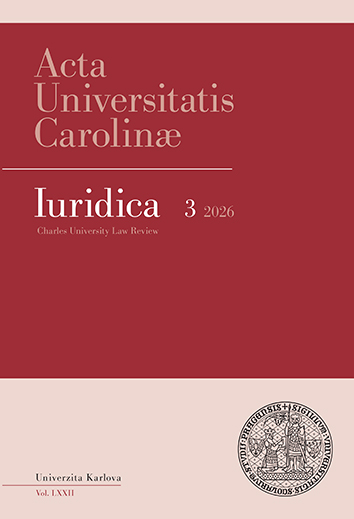
Acta Universitatis Carolinae Iuridica (dále jen AUCI) je hlavním časopisem Právnické fakulty UK. Vychází od roku 1954, patří tak mezi tradiční právnické časopisy teoretického zaměření.
Jako obecný právnický časopis přináší delší studie i kratší články o jakýchkoli relevantních otázkách v právní teorii i mezinárodním, evropském a vnitrostátním právu. AUCI také publikuje materiály vztahující se k aktuálním otázkám legislativy. AUCI je recenzovaný časopis a přijímá příspěvky od českých i zahraničních autorů. Příspěvky zahraničních autorů jsou zveřejňovány v původním jazyku – slovenštině, angličtině, němčině, francouzštině.
AUCI je teoretický časopis pro otázky státu a práva. Jeho vydavatelem je Univerzita Karlova v Praze, Právnická fakulta, prostřednictvím nakladatelství Karolinum. Vychází čtyřikrát ročně, termíny vydání časopisu naleznete zde.
Články uveřejněné v časopise AUCI procházejí nezávislým recenzním řízením (peer review), které je oboustranně anonymní. Posuzovatelé z daného oboru vyjadřují své stanovisko k vědecké kvalitě příspěvku a vhodnosti publikace v časopisu. V případě připomínek je stanovisko zasíláno zpět autorovi s možností přepracování textu (blíže viz Pokyny pro autory – Průběh recenzního řízení).
Časopis AUCI (ISSN 0323-0619) je evidován v České národní bibliografii (vedena Národní knihovnou ČR) a v Index to Foreign Legal Periodicals (veden American Association of Law Libraries). AUCI má přiděleno evidenční číslo periodického tisku e. č. MK E 18585.
V r. 2021 byl jako první časopis Právnické fakulty Univerzity Karlovy zařazen do prestižní mezinárodní databáze Scopus. Tato databáze společnosti Elsevier je největší abstraktovou a citační databází recenzované literatury na světě. Od zařazení do elitní databáze Scopus si redakce časopisu slibuje nejen zvýšení čtenosti časopisu, ale také nárůst zájmu o publikaci příspěvků jak českých, tak zahraničních autorů.
AUCI je tzv. časopisem otevřeným a veškerý jeho obsah je zveřejňován jak na webu fakulty, tak na webových stránkách nakladatelství Karolinum. Přístup k němu je bezplatný. Domovská stránka časopisu AUCI je na webových stránkách Nakladatelství Karolinum.
Časopis AUCI využívá licenci Creative Commons: CC BY 4.0.
Dlouhodobou archivaci digitálního obsahu časopisu zajišťuje Portico.
AUC IURIDICA, Vol 12 No 2 (1965), 125–142
ArticleNěkolik poznámek k otázkám vývoje právního postavení státních hospodářských organizací v ČSSR
[Several Remarks on Questions Concerning the Evolution of the Juridical Position of the State Economical Organizations in Czechoslovak Socialist Republic]
Zdeněk Přibyl
DOI: https://doi.org/10.14712/23366478.2025.764
zveřejněno: 10. 02. 2021
Abstract
The article deals with some of the problems which it will be necessary to elaborate in details in connection with the realization of the principles of the improvement- of the planified management of national economy, principles which have been approved by the presidency of the Central Committee of the Communist Party of Czechoslovakia and have been published in the journal “Rudé právo” on October 17, 1964. The considerations contained in the present article are founded on the examination of the evolution of the juridical regulation concerning the position of the State economical organizations (principally in the industry and in the construction industry), event, of some of the aspects of this regulation. So, first of all, is examined (from the point of view of the concrete evolution which has taken place in Czechoslovakia) the problem of the juridical subjectivity of the State economical organizations, in connection with the subordination of these organizations to the society-wide management. Follows a comparison of the characteristic features of the juridical position of the State economical organizations in the course of two very characteristic periods of evolution of the Czechoslovak national economy, that means on one hand in the course of the initial period (approximatively during the years 1945–1950), when the mercantile and pecuniary relations were used in national economy as instruments of management, and on the other hand during the period starting from the beginning of the years fifty and lasting up to the year 1958, during which have been introduced in the Czechoslovak national economy principles of an administrative and authoritative management. The examination in question results in the following conclusions: The fundamental principles of the juridical regulation of the position of the State economical organizations are predeterminated by the character of the socialist national economy on the actual level of evolution, as constituting a dialectical unity of a society-wide managemen tand the mode of mercantile production. This results logically also in a complicated character of the juridical problems connected with the regulation of national economy. Instead of the traditional juridical forms, appears the necessity to utilize in the juridical regulation of the problems of national economy simultaneously and within a logically harmonized structure different methods, so, in the first place, simultaneously methods considered formerly as being proper to civil law and methods, considered up to now as being typical for administrative law. In this respect the article mentions also the recent discussion on economic law. As the most positive achievement of this discussion is considered the fact, that the demand was clearly stated for a complex theoretic examination of juridical problems concerning national economy and for the creation of a specific branch of economic legislation. As a great pace in advance is also considered the system of management of national economy, which will be based on an as great as possible operative economic independence of the State economical organizations, within which the harmony between the interests of these single organizations and those of the society considered as a whole will not be secured by administrative orders, but by a system of economic incentives. Is considered as constituting a necessary condition of such a regulation the attribution of juridical subjectivity to the State economical organizations. At the same time is also emphasized the fact that such a system does not suppose, and in socialism even cannot suppose, the elimination of the possibility of direct interventions into the activities of the different organizations, even if the principle is stressed according to which such interventions (as expressing subjectivism in management) must be limited to the smallest possible extension. It is hinted further to the fact that the transfer of the operative management of the single organizations from State organs to the sphere of the “khozrazchot” will make possible the improvement of the quality of central management and, at the same time, will create better conditions for a more effective struggle against bureaucracy and for the renewal of an enterprising spirit in the sphere of socialist enterprises. The article stresses also the fact that a greater application of the mercantile and pecuniary relations and a new conception of the planification will result in a greater importance of the obligations, principally of the long term obligations. That is the reason why the article devotes its attention to the examination of questions of the juridical regulation of the economical obligations, principally as far as the provisions in execution of the law are concerned (the basic conditions of delivery), to the examination of the juridical regulation of the planification and in this connection also to the juridical character of some other acts of economic management. Finally, the article reacts against certain isolated opinions which impute to the existence of the State socialist property an unfavourable influence on the mentality of the working people in the sense that the consciousness of this property weakens the interest in the protection of it. According to the article, the cause of the unsatisfactory situation in the protection of national property is to be looked after principally in the sphere of material conditions. When we shall succeed in finding a mode of interestedness of all the working people of the organization in the results of the activities of the organization, comprising also the results of the protection of national property, at that moment only conditions will be created for an improvement of the actual situation.

Několik poznámek k otázkám vývoje právního postavení státních hospodářských organizací v ČSSR is licensed under a Creative Commons Attribution 4.0 International License.
157 x 230 mm
vychází: 4 x ročně
cena tištěného čísla: 65 Kč
ISSN: 0323-0619
E-ISSN: 2336-6478