
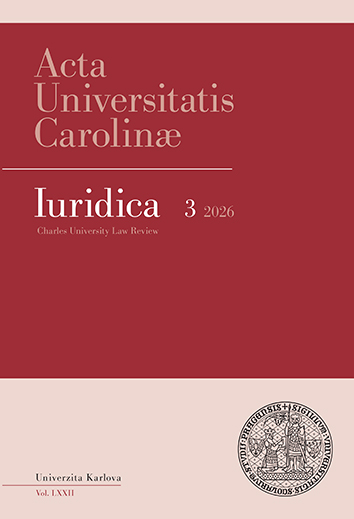
Acta Universitatis Carolinae Iuridica (dále jen AUCI) je hlavním časopisem Právnické fakulty UK. Vychází od roku 1954, patří tak mezi tradiční právnické časopisy teoretického zaměření.
Jako obecný právnický časopis přináší delší studie i kratší články o jakýchkoli relevantních otázkách v právní teorii i mezinárodním, evropském a vnitrostátním právu. AUCI také publikuje materiály vztahující se k aktuálním otázkám legislativy. AUCI je recenzovaný časopis a přijímá příspěvky od českých i zahraničních autorů. Příspěvky zahraničních autorů jsou zveřejňovány v původním jazyku – slovenštině, angličtině, němčině, francouzštině.
AUCI je teoretický časopis pro otázky státu a práva. Jeho vydavatelem je Univerzita Karlova v Praze, Právnická fakulta, prostřednictvím nakladatelství Karolinum. Vychází čtyřikrát ročně, termíny vydání časopisu naleznete zde.
Články uveřejněné v časopise AUCI procházejí nezávislým recenzním řízením (peer review), které je oboustranně anonymní. Posuzovatelé z daného oboru vyjadřují své stanovisko k vědecké kvalitě příspěvku a vhodnosti publikace v časopisu. V případě připomínek je stanovisko zasíláno zpět autorovi s možností přepracování textu (blíže viz Pokyny pro autory – Průběh recenzního řízení).
Časopis AUCI (ISSN 0323-0619) je evidován v České národní bibliografii (vedena Národní knihovnou ČR) a v Index to Foreign Legal Periodicals (veden American Association of Law Libraries). AUCI má přiděleno evidenční číslo periodického tisku e. č. MK E 18585.
V r. 2021 byl jako první časopis Právnické fakulty Univerzity Karlovy zařazen do prestižní mezinárodní databáze Scopus. Tato databáze společnosti Elsevier je největší abstraktovou a citační databází recenzované literatury na světě. Od zařazení do elitní databáze Scopus si redakce časopisu slibuje nejen zvýšení čtenosti časopisu, ale také nárůst zájmu o publikaci příspěvků jak českých, tak zahraničních autorů.
AUCI je tzv. časopisem otevřeným a veškerý jeho obsah je zveřejňován jak na webu fakulty, tak na webových stránkách nakladatelství Karolinum. Přístup k němu je bezplatný. Domovská stránka časopisu AUCI je na webových stránkách Nakladatelství Karolinum.
Časopis AUCI využívá licenci Creative Commons: CC BY 4.0.
Dlouhodobou archivaci digitálního obsahu časopisu zajišťuje Portico.
AUC IURIDICA, Vol 11 No 4 (1964), 31–50
ArticleVztah druha a družky
[The Relation Between the Unmarried Man and the Unmarried Wife]
Senta Radvanová
DOI: https://doi.org/10.14712/23366478.2025.753
zveřejněno: 11. 02. 2021
Abstract
The article deals in the first place with some general questions concerning the bearing of the society on matrimony and on the life together of the unmarried man and the unmarried wife. The phenomenon of an unmarried man and an unmarried wife, living together in a union, which presents features of family life (concubinage), occurs in all class societies. The legal order prefers always matrimony to any other mode of family life between a man and a woman. From the social and the legal viewpoint it is matrimony which is considered in the first place as being the basis of family life. Matrimony and family are accomplishing important social functions. It can be stated that even the actual life together of a man and a woman complies with these functions. This fact implicates for anybody who lives in such a union of two unmarried persons of different sex a lot of personal consequences. This personal position is however connected also with a certain social position and the consequences of this social position of the unmarried man and the unmarried wife are taken into account by the legal order. The relation of the unmarried man and the unmarried wife differs from matrimony, as far as the Czechoslovak legislation is concerned, first of all by the intensity of protection of the relations in question. Matrimony has a preferential position. This principle results first of all from the provisions of the family law. Only spouses can be subject of rights and duties (personal and property ones] based on matrimony. Matrimony ensues from and becomes extinct by legal formalities, the relation between the unmarried man and the unmarried wife constitutes both as far as its origin and its extinction are concerned, only a factual relation. Certain norms of our legislation take however into account certain consequences of such an actual state of things; they grant certain rights to the subjects of such a relation, provided the life together of the man and wife in question has the character of family life and lasts a fixed length of time. The conditions under which the different rights based upon the life together of the unmarried man and the unmarried wife are acquired, are not uniform as far as the single legal norms are concerned (principally the length of time during which the life together of the partners has to last is fixed differently). Some provisions do not mention by express words the unmarried man and wife, but are formulated in such a way that the provision in question can be applied also to such a relation (for instance the provisions of the article 528 of the Civil Code, of the article 393 of the Code of Civil Procedure). In other cases the legal norms employ the term in question by express words (Act. No. 54/56 of the Law Gazette on the health insurance of employees, Act. No. 55/56 of the Law Gazette on Social Security, Act. No. 67/56 of the Law Gazette on the housing economy, Act. No. 76/52 of the Law Gazette on the wages tax a. s. o.). The article deals then with the analysis of some provisions of these legal norms and tries to give a comment on the aim of the regulation of the legal consequences of the relation between an unmarried man and an unmarried wife. The article compares in this connection the formulations employed by the legislator in order to express the relation in question. Our legislation doesn’t put the relation between the unmarried man and the unmarried wife on the same level with matrimony. When some legal rights are to be founded, the legal norms have to qualify the actual relation between the unmarried partners in order to differentiate it from other social relations between a man and a woman which have no legal relevance at all. The article mentions hereafter the way in which a certain formulation of the provision on the divorce of matrimony, or eventually even the divorce practice of the courts, may influence the origin, event, the existence of factual relations between unmarried men and unmarried wifes. This was the case of the situation existing during the years 1950–1955, caused by the original formulation of the provision of the article 30 of the Family Law Act. In view of the fact that the socialist society gives preference to matrimony, the legislation and the practice of the courts had to proceed in such a way as to make it possible for persons living, because of the impossibility to obtain the divorce, in a factual union, to settle their situation on the legal basis of matrimony. The problem to be solved consisted in rendering possible the divorce of the so called dead marriages; the reform of the law brought about this possibility. The tendency to give priority to matrimony before the factual relation between partners living together becomes manifest in the bill of the new Family Law Act. Even in the future one must however reckon with the occurrence of factual relations between unmarried partners. In order to make the legal regulation of the consequences of such relations meet its social function, it would be necessary to study in a more profound way the objective social causes determining the occurrence of such relations in our society.

Vztah druha a družky is licensed under a Creative Commons Attribution 4.0 International License.
157 x 230 mm
vychází: 4 x ročně
cena tištěného čísla: 65 Kč
ISSN: 0323-0619
E-ISSN: 2336-6478