
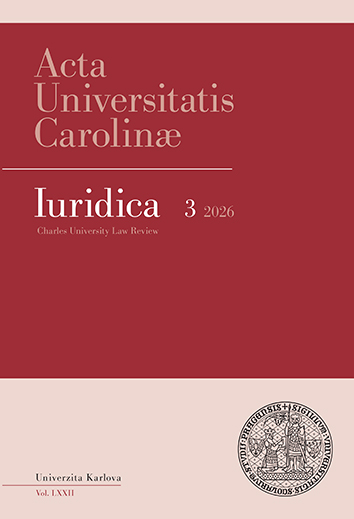
Acta Universitatis Carolinae Iuridica (dále jen AUCI) je hlavním časopisem Právnické fakulty UK. Vychází od roku 1954, patří tak mezi tradiční právnické časopisy teoretického zaměření.
Jako obecný právnický časopis přináší delší studie i kratší články o jakýchkoli relevantních otázkách v právní teorii i mezinárodním, evropském a vnitrostátním právu. AUCI také publikuje materiály vztahující se k aktuálním otázkám legislativy. AUCI je recenzovaný časopis a přijímá příspěvky od českých i zahraničních autorů. Příspěvky zahraničních autorů jsou zveřejňovány v původním jazyku – slovenštině, angličtině, němčině, francouzštině.
AUCI je teoretický časopis pro otázky státu a práva. Jeho vydavatelem je Univerzita Karlova v Praze, Právnická fakulta, prostřednictvím nakladatelství Karolinum. Vychází čtyřikrát ročně, termíny vydání časopisu naleznete zde.
Články uveřejněné v časopise AUCI procházejí nezávislým recenzním řízením (peer review), které je oboustranně anonymní. Posuzovatelé z daného oboru vyjadřují své stanovisko k vědecké kvalitě příspěvku a vhodnosti publikace v časopisu. V případě připomínek je stanovisko zasíláno zpět autorovi s možností přepracování textu (blíže viz Pokyny pro autory – Průběh recenzního řízení).
Časopis AUCI (ISSN 0323-0619) je evidován v České národní bibliografii (vedena Národní knihovnou ČR) a v Index to Foreign Legal Periodicals (veden American Association of Law Libraries). AUCI má přiděleno evidenční číslo periodického tisku e. č. MK E 18585.
V r. 2021 byl jako první časopis Právnické fakulty Univerzity Karlovy zařazen do prestižní mezinárodní databáze Scopus. Tato databáze společnosti Elsevier je největší abstraktovou a citační databází recenzované literatury na světě. Od zařazení do elitní databáze Scopus si redakce časopisu slibuje nejen zvýšení čtenosti časopisu, ale také nárůst zájmu o publikaci příspěvků jak českých, tak zahraničních autorů.
AUCI je tzv. časopisem otevřeným a veškerý jeho obsah je zveřejňován jak na webu fakulty, tak na webových stránkách nakladatelství Karolinum. Přístup k němu je bezplatný. Domovská stránka časopisu AUCI je na webových stránkách Nakladatelství Karolinum.
Časopis AUCI využívá licenci Creative Commons: CC BY 4.0.
Dlouhodobou archivaci digitálního obsahu časopisu zajišťuje Portico.
AUC IURIDICA, Vol 11 No 1 (1964), 49–72
ArticleK pojmu, systému a kritériím účelové kategorizace půdy
[On the Significance, the System and the Criteria of the Classification of Land According to Its Designation]
Valer Fábry
DOI: https://doi.org/10.14712/23366478.2025.746
zveřejněno: 11. 02. 2021
Abstract
It is a consequence of the economic and political importance of land, that it represents also the object of investigation of social sciences and in the first place of the science of State and of Law in general and especially of the science of land law. These sciences however do not examine land from the point of view of its substance and its qualities, but the object of their investigation are social relations connected with it. The social relations in question are determined by the given social and economic formation, but also by certain characteristic qualities of the land; in agriculture and in forestry the land constitutes a means of production and a force of production, in mining industry it represents the labour object and a permanent stock of raw-materials and as far as the whole social activity is concerned, land constitutes its base and condition. Because of the special importance of land for the development of the entire society, land being the basis of all our natural resources, it is necessary that the whole land fund should be utilized in a planned way and in the interest of a proportional development of our entire society and of all its economical branches, under the condition of respecting fully the unity existing between the interests of the society and the particular interests; land can be therefore classified as object of the right of ownership or as object of institutes of use, but principally according to the specific appointment of its individual parts. One of the decisive criteria for the classification of land is the designation of the individual parts of the territory (land), that means the economic or some other social purpose of their exploitation, which determines different land law relations connected with the different categories of land. The purpose in question, that is a certain mode of the exploitation of the land, is determined in a socialist society by State organs which protect the interest of the whole society in its unity with group and individual interests. The necessity of the regulation of this question by the whole society, results from the extraordinary importance of land for the development of society, from the possibility of utilizing the same land for different purposes and from the necessity to find a harmonious solution to the problem of the utilization of a given space. In that sense the territory is composed of different categories of land having the same specific designation, which is different from the designation of lands of all the other categories, that means of lands united not in space (even if such a unification is not excluded, this however being not the decisive point) but by their designation which is the same and determines the same system of legal relations securing the completion of a certain economic purpose. The right and the duty of the State to determine the economic appointment of individual parts of the territory does not result in this country from the right of ownership of the State, but from its economical and organizational function, from the socially determined objective necessity to secure the most effective exploitation of all the land and of all natural resources, in complete harmony of the heterogenous social, group and personal interests and of all elements which constitute the harmonious unity of the territory. The designation of the land determines thus the rights and the duties: 1. of its users (proprietors) to utilize the given territory for a certain purpose, or to sustain the utilization of it also by other users; 2. of State organs and organizations (f.i. to expropriate lands for certain purposes, to effect agrochemical tests of the land, to secure the cultivation of farm land, to effect geological researches etc.); 3. of socialist organizations and individuals as users, and also as owners of adjoining or other near lands (f.i. the duty to prevent exhalations); 4. organizations and persons nearer not specified (f.i. of subjects authorized to make use of the right of gamekeeping, or authorized to intrude etc.). The system of the classification of the designation of land according to the specific appointment of its parts differs at the different stages of development of the society and depends on what is regarded as being the decisive economic aim. According to the actual legal situation, the most important complex classification is implemented by the Act. No. 22/1964 and the Decree No. 23/1964 concerning the Evidence of Immovables which substituted from the 1st of April 1964, without having changed them in any substantial way, the Instructions of the Central Administration of Geodesy and Carthography No. 154/1957 Official Gazette, concerning the designation of categories of land for the purposes of a unified evidence and for the purposes of the delivery obligations and the purchase of agricultural products. This does not imply that the system of evidence in question would give a true picture of all the categories of land to which are connected special legal institutions of use. To the date of the 31st of December 1963 the territory of the State was divided into farm land (56,6%) and non farm land (43,4%). Farm land is further divided into arable land (40 per cent of the whole territory), hopfields (0,1%), vineyards (0,2%), gardens (1,7%), intensively cultivated orchards (0,4%), meadows (8,1%), pastures (6,1%). Non farm land is divided into forest land (34,6% of the whole territory), water surfaces (1,5%), built-up areas (1,5%), sterile areas (1%), the so called „other land“ which include storage and workshop areas, land assigned to open-cast extraction of minerals, to the stockage of residual products of mineral mining, to purposes of national defence, of the health service, of gymnastics and recreation, further protected areas, state natural reservations and cultural values, parks and embellishing gardens e.t.c. (4,8%). The classification of territory based on the distinction between farm and non farm land and the internal classification within these two categories of land, are immediately related to the question what characteristic features determine that a given land is classified as belonging to a certain category. Undoubtedly, at the one hand the natural conditions will be decisive, at the other hand the social and the economical ones. More and more, as far as the designation of land is concerned, the voluntary element, is asserted that means the society recognizes the laws of social development and creates out of the territory where it lives a harmonious entity which would satisfy all its needs. The utilization of the territory for all the needs of the society necessitates that the designation of land according to one or the other category should not have a static character of a phenomenon given once and forever by nature or by the standing development and only registered by men. The interest of the whole society requires that necessary changes should be effected. In this connection it is necessary to mention the act No. 48/1959 of the Collection of Laws concerning the protection of agricultural land fund. Within the global category of “non farm land” an extraordinary importance is attached to forest land and water surfaces. Agricultural, forest and water economy represents a certain unity and a harmonious entity with mutual interacting influences. To the social importance of the mentioned two categories of land correspond also legal rules among them the Act No. 166/1960 C. of L. and the Notice No. 17/1961 C. of L. concerning forests and forest economy, as well the Act No. 11/1955 C. of L. (in the wording of the Act. No. 12/1959 C. of L.) and the Notice No. 13/1959 C. of L.) concerning water economy and the Decree No. 14/1959 C. of L. which implements the act in question. The classification of non farm lands and surfaces is not sufficient. We lack for instance an exact evidence of building sites. For the development of our national economy and the exploitation of our raw material basis, the disclosure, the extraction and the exploitation of mineral resources is of extraordinary importance. The most important regulations in this respect are the Act. No. 41/1957 C. of L. concerning the exploitation of mineral resources (Mining Act) and the Notice No. 260/1957 Official Gazette. The mining territories, registered in the so called Register of mining territories, administered by the State Board of Mines, should also be recorded in a unified evidence of the land. What has been said about minerals, is adequately true also for turf, which is however not a mineral; the social relations in question are regulated by the Legal Measure No. 61/1956 C. of L. and by the Notice No 151/1957 Official Gazette, concerning the extraction of turf. A special specific category of land constitutes by land serving for purposes of transportation. Every kind of transportation has its peculirities which must be taken into account; I have principally in mind land, appointed for railway, road and air transportation, as well as for the municipal transport network. There exists however also land, the designation of which is other than exploitation for economic purposes. I have here in mind principally land which is used for purposes of national, defence, which secure certain sanitary demands, or which are used for gymnas, tics, recreation or other cultural purposes. This category may include f.i. also land the purpose of which is the protection and exploitation of natural mineral springs as well as the protection of nature and of important cultural values.

K pojmu, systému a kritériím účelové kategorizace půdy is licensed under a Creative Commons Attribution 4.0 International License.
157 x 230 mm
vychází: 4 x ročně
cena tištěného čísla: 65 Kč
ISSN: 0323-0619
E-ISSN: 2336-6478