
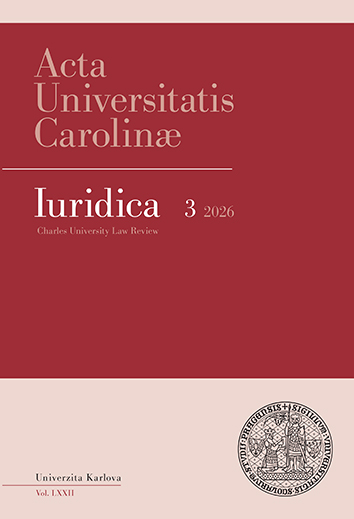
Acta Universitatis Carolinae Iuridica (dále jen AUCI) je hlavním časopisem Právnické fakulty UK. Vychází od roku 1954, patří tak mezi tradiční právnické časopisy teoretického zaměření.
Jako obecný právnický časopis přináší delší studie i kratší články o jakýchkoli relevantních otázkách v právní teorii i mezinárodním, evropském a vnitrostátním právu. AUCI také publikuje materiály vztahující se k aktuálním otázkám legislativy. AUCI je recenzovaný časopis a přijímá příspěvky od českých i zahraničních autorů. Příspěvky zahraničních autorů jsou zveřejňovány v původním jazyku – slovenštině, angličtině, němčině, francouzštině.
AUCI je teoretický časopis pro otázky státu a práva. Jeho vydavatelem je Univerzita Karlova v Praze, Právnická fakulta, prostřednictvím nakladatelství Karolinum. Vychází čtyřikrát ročně, termíny vydání časopisu naleznete zde.
Články uveřejněné v časopise AUCI procházejí nezávislým recenzním řízením (peer review), které je oboustranně anonymní. Posuzovatelé z daného oboru vyjadřují své stanovisko k vědecké kvalitě příspěvku a vhodnosti publikace v časopisu. V případě připomínek je stanovisko zasíláno zpět autorovi s možností přepracování textu (blíže viz Pokyny pro autory – Průběh recenzního řízení).
Časopis AUCI (ISSN 0323-0619) je evidován v České národní bibliografii (vedena Národní knihovnou ČR) a v Index to Foreign Legal Periodicals (veden American Association of Law Libraries). AUCI má přiděleno evidenční číslo periodického tisku e. č. MK E 18585.
V r. 2021 byl jako první časopis Právnické fakulty Univerzity Karlovy zařazen do prestižní mezinárodní databáze Scopus. Tato databáze společnosti Elsevier je největší abstraktovou a citační databází recenzované literatury na světě. Od zařazení do elitní databáze Scopus si redakce časopisu slibuje nejen zvýšení čtenosti časopisu, ale také nárůst zájmu o publikaci příspěvků jak českých, tak zahraničních autorů.
AUCI je tzv. časopisem otevřeným a veškerý jeho obsah je zveřejňován jak na webu fakulty, tak na webových stránkách nakladatelství Karolinum. Přístup k němu je bezplatný. Domovská stránka časopisu AUCI je na webových stránkách Nakladatelství Karolinum.
Časopis AUCI využívá licenci Creative Commons: CC BY 4.0.
Dlouhodobou archivaci digitálního obsahu časopisu zajišťuje Portico.
AUC IURIDICA, Vol 11 No 1 (1964), 3–24
ArticleK otázce jednotné úpravy pracovněprávních vztahů v ČSSR
[On the Question of a Unified Regulation of Labour Law Relations in the Czechoslovak Socialist Republic]
Jan Kovářík
DOI: https://doi.org/10.14712/23366478.2025.743
zveřejněno: 11. 02. 2021
Abstract
The objective of the present article is to indicate certain theoretical problems related to questions concerning a unified regulation of labour relations (relations between employer and employee) which would extend to all workers of our society. In the course of the construction of socialism in this country a socialist economic system has been built up, founded on the socialization of the means of production and on a planified direction of the entire national economy. On that base and simultaneously with the development and intensification of the socialist relations of production the exploitation of man by man was abolished and the liberated human labour became the fundamental factor in our whole society. These facts lead to the creation of a unified and compact system of social labour relations within the socialist system. The unity of these relations and the interest of the whole working people, headed by the working class, require that the conduct of men in social labour relations should be regulated on the basis of unified principles, determined finally by the knowledge and the utilization of economic laws, which govern the socialist society. This way a base was brought into existence making possible the creation of a unified system of socialist labour legislation, which becomes an independent branch of the legal system. The unified regulation of human conduct in socialist labour relations is a part of the unified system of labour legislation. On the basis of the above mentioned facts we come in the present article to the following principal conclusions: Primo, the principle of a unified legal regulation of human conduct in social labour relations existing in our society has an objective character, as it results from the economical and political facts which determine the essence of those relations in a socialist society. When speaking about a unified regulation of labour relations extending to all workers in our society, we have in view the regulation of basic questions referring to: a) the determination of the participants in labour relations (that means of the subjects of labour legislation); b) the regulation of human conduct in social labour relations, within the norms of the socialist labour legislation, that means the regulation of the content of labour relations; c) the definition of legal data determining the origin, the change and the extinction of concrete labour relations, as well as the definition of conditions which have to be fulfilled in order that the legal data (principally acts in the law) should become perfect. The principle of a unified regulation of labour relations in the exposed sense was put into practice gradually in our society, simultaneously with the creation of the necessary economic and political conditions. Secundo, the principle of a unified regulation of labour relations does not exclude the existence of certain indispensable departures from the rule, concerning the regulation of labour relations; this becomes manifest when the mentioned unified principles have to be applied to the individual branches of national economy, or even within those branches. These indispensable departures from the rule result from the complex character of human relations in the course of the organization of social labour on the given stage of development of our society. They are determined also by the fact that labour conditions are different in the individual branches of national economy, by the different character of the performed work a. s. o. The existence of these indispensable departures from the rule is, according to our opinion, as objectively determined as the principle of the unified regulation of basic questions referring to the labour relations of all the workers. The problems resulting from the necessity of departures from the rule as far as the regulation of labour relations in our society is concerned, have been in a certain degree neglected on behalf of the examination of problems resulting from the unified regulation. Tertio: according to our opinion it results from the mentioned facts that the legal regulation of human conduct in social labour relations of a socialist society cannot be effected by a unique act (f. i. by a Labour Code). The direction of the organization of social labour and consequently also the regulation of human conduct in social labour relations of a socialist society necessitate a certain “hierarchy” of organizational forms, headed by the State (on the society wide scale), passing througle the different ministries and other central administrations, and finishing by the individual socialist organizations and their internal organizational formations. This implies a process which begins by the determination of the most general unified principles valid on the society wide scale and ends by the setting up of very concrete dispositions, concerning individual socialist organizations and within their frame even individual workshops a.s.o. To this must correspond also a certain „hierarchy“ of legal regulations, event, of their forms (on the one hand of economic, on the other hand of labour regulations), which stretches from dispositions containing general and unified principles (Acts, event, the Labour Code) to continually concreter dispositions, comprising also the mentioned necessary departures from the rule (governmental decrees, edicts, ministerial ordinances a.s.o.), and finishes by labour regulations, bonus regulations a.s.o. which are in force in the individual socialist organizations.

K otázce jednotné úpravy pracovněprávních vztahů v ČSSR is licensed under a Creative Commons Attribution 4.0 International License.
157 x 230 mm
vychází: 4 x ročně
cena tištěného čísla: 65 Kč
ISSN: 0323-0619
E-ISSN: 2336-6478