
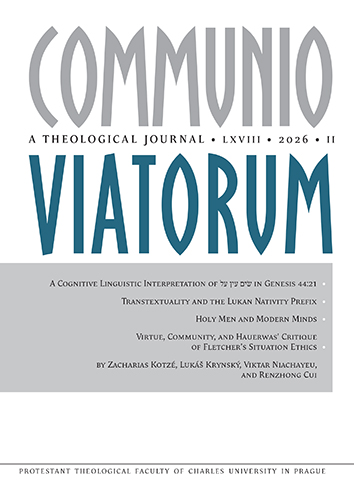
Communio viatorum is a theological journal from Central European perspectives founded in 1958 by J. L. Hromádka and J. B. Souček, published by the Protestant Theological Faculty of Charles University in Prague three times a year.
Communio Viatorum seeks to promote research and scholarly debate in all theological disciplines. Since its foundation special attention has been paid to both biblical studies and Czech Protestant history. The journal is also interested in articles that reflect new accents within the field of theology as well as relevant challenges from neighbouring disciplines, developments in the Church worldwide as well as new moves within society. It seeks to promote an ongoing process of theological debate from a specific Central European Protestant background, but open to authors from all around the world and all denominations who wish to engage in such a conversation.
As of 2024, the journal Communio Viatorum has transitioned to an open-access publication, issued by Charles University Karolinum Press.
Articles published here are indexed in the ATLA Religion Database® and are included in the full-text ATLASerials® (ATLAS®) collection. They are also indexed and abstracted in the Web of Science – Arts and Humanities Citation Index® of Clarivate Analytics, in Scopus, in CEEOL, and in ERIH PLUS.
The previous journal homapage with an archive of published issues
COMMUNIO VIATORUM, Vol 68 No 2 (2026), 222–244
ArticleHoly Men and Modern Minds: How Hesychast Spirituality Transforms During the Monastic Transition
Viktar Niachayeu
DOI: https://doi.org/10.14712/30296374.2026.17
zveřejněno: 23. 10. 2026
Abstract
Viktor Frankl views self-transcendence as a key objective in developing into a fully realised human being. Hesychastic spirituality in Orthodox monasticism has a similar aim. During the transition from the secular to monastic life, monks go through radical self-transformation from the egoic to Edenic state. In that setting, self-transcendence becomes the ultimate aim of deification and a coping mechanism to deal with the suffering experiences often accompanying monastic spiritual development. I consider four elements of Hesychast spirituality: nostalgia, metanoia, Jesus Prayer, and spiritual fatherhood, to be forming elements of spiritual transformation based on the real-life experiences of Athonite hermits. Through qualitative interviews with four participants and thematic phenomenological analysis, I focus on psychological transformation processes that have been only partially addressed in previous research.
klíčová slova: Hesychast spirituality; self-transcendence; spiritual transformation; the transition phase

Holy Men and Modern Minds: How Hesychast Spirituality Transforms During the Monastic Transition is licensed under a Creative Commons Attribution 4.0 International License.
148 x 210 mm
vychází: 3 x ročně
cena tištěného čísla: 500 Kč
ISSN: 0010-3713
E-ISSN: 3029-6374
