
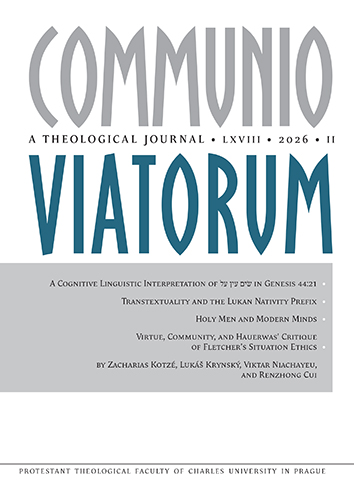
Communio viatorum is a theological journal from Central European perspectives founded in 1958 by J. L. Hromádka and J. B. Souček, published by the Protestant Theological Faculty of Charles University in Prague three times a year.
Communio Viatorum seeks to promote research and scholarly debate in all theological disciplines. Since its foundation special attention has been paid to both biblical studies and Czech Protestant history. The journal is also interested in articles that reflect new accents within the field of theology as well as relevant challenges from neighbouring disciplines, developments in the Church worldwide as well as new moves within society. It seeks to promote an ongoing process of theological debate from a specific Central European Protestant background, but open to authors from all around the world and all denominations who wish to engage in such a conversation.
As of 2024, the journal Communio Viatorum has transitioned to an open-access publication, issued by Charles University Karolinum Press.
Articles published here are indexed in the ATLA Religion Database® and are included in the full-text ATLASerials® (ATLAS®) collection. They are also indexed and abstracted in the Web of Science – Arts and Humanities Citation Index® of Clarivate Analytics, in Scopus, in CEEOL, and in ERIH PLUS.
The previous journal homapage with an archive of published issues
COMMUNIO VIATORUM, Vol 68 No 2 (2026), 194–204
ArticleA Cognitive Linguistic Interpretation of שׂים עין על in Genesis 44:21
Zacharias Kotzé
DOI: https://doi.org/10.14712/30296374.2026.15
zveřejněno: 23. 10. 2026
Abstract
The Hebrew idiom שׂים עין על (“to set/put the eye on”) appears in Genesis 44:21 within Judah’s speech, where he quotes Joseph’s command concerning Benjamin. Traditional interpretations have generally understood the phrase as a neutral or benevolent expression of attention or authority. This article proposes that, from Judah’s fearful perspective, the idiom evokes the image of a powerful and potentially dangerous gaze. Employing a cognitive linguistic approach, the study analyses the expression as a metaphorical-metonymic construction in which the eye functions as an instrument of influence and authority. Attention is given to the idiom’s dual valence – capable of conveying both benevolent oversight (cf. Jer 24:6) and potential threat – and to its relationship with the more frequent prophetic idiom שׂים פנים על (“set the face on”). Ancient Near Eastern parallels, particularly from Mesopotamia and Egypt, illuminate the cultural background of the active, projective eye and help clarify Judah’s anxiety in the context of the silver cup crisis (Gen 44:2–17). By focusing on Judah’s perspective, this study offers new insight into the emotional depth and cultural resonance of Genesis 44–45, contributing to a broader understanding of how biblical authors engaged with shared regional concepts of vision, power, and authority.
klíčová slova: cognitive linguistics; powerful gaze; שׂים עין על; Genesis 44:21; Judah’s speech; ancient Near East; metaphor

A Cognitive Linguistic Interpretation of שׂים עין על in Genesis 44:21 is licensed under a Creative Commons Attribution 4.0 International License.
148 x 210 mm
vychází: 3 x ročně
cena tištěného čísla: 500 Kč
ISSN: 0010-3713
E-ISSN: 3029-6374
