
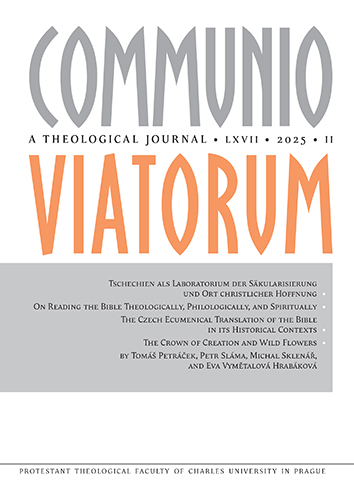
Communio viatorum is a theological journal from Central European perspectives founded in 1958 by J. L. Hromádka and J. B. Souček, published by the Protestant Theological Faculty of Charles University in Prague three times a year.
Communio Viatorum seeks to promote research and scholarly debate in all theological disciplines. Since its foundation special attention has been paid to both biblical studies and Czech Protestant history. The journal is also interested in articles that reflect new accents within the field of theology as well as relevant challenges from neighbouring disciplines, developments in the Church worldwide as well as new moves within society. It seeks to promote an ongoing process of theological debate from a specific Central European Protestant background, but open to authors from all around the world and all denominations who wish to engage in such a conversation.
As of 2024, the journal Communio Viatorum has transitioned to an open-access publication, issued by Charles University Karolinum Press.
Articles published here are indexed in the ATLA Religion Database® and are included in the full-text ATLASerials® (ATLAS®) collection. They are also indexed and abstracted in the Web of Science – Arts and Humanities Citation Index® of Clarivate Analytics, in Scopus, in CEEOL, and in ERIH PLUS.
The previous journal homapage with an archive of published issues
COMMUNIO VIATORUM, Vol 67 No 2 (2025), 160–183
ArticleThe Czech Ecumenical Translation of the Bible in its Historical Contexts
Michal Sklenář
DOI: https://doi.org/10.14712/30296374.2025.18
zveřejněno: 15. 01. 2026
Abstract
The paper concentrates on the circumstances of the genesis of the Czech Ecumenical Translation of the Bible (1961–1979). It presents the preparation and finalization of the project which can be labelled as unique in relation to the former Eastern Bloc countries and remarkable with respect to the church and religious history of the Czech Lands. The text consists of six contexts – the first one concerns global church history, whereas the remaining five contexts concern various aspects of Czech church history. 1) Global church history offers an insight into the paradigmatic shift of the Second Vatican Council in relation to Bible studies and ecumenism. 2) The second context describes the readiness of the non-Catholic and Catholic milieu for a new translation into the national language. 3) Subsequently, the process of the translation is briefly introduced as well as the non-implementation of this translation in the Roman Catholic Church with respect to liturgy. 4) The paper then shows contemporary pillars (i.e. at the time) of the communist church policy and the matter of the ecumenical relations between the Czech Christians. 5) Within an analysis, a paradoxical situation is shown when ecumenical activity was not systematically suppressed by the state; reasons for such an approach are considered. 6) The paper addresses a positive perception of the translation in the contemporary and later reception and in the church collective memory.
klíčová slova: 20th Century; Czechoslovakia; Communism; Church History; Ecumenism; Czech Ecumenical Translation of the Bible

The Czech Ecumenical Translation of the Bible in its Historical Contexts is licensed under a Creative Commons Attribution 4.0 International License.
210 x 148 mm
vychází: 3 x ročně
cena tištěného čísla: 500 Kč
ISSN: 0010-3713
E-ISSN: 3029-6374