
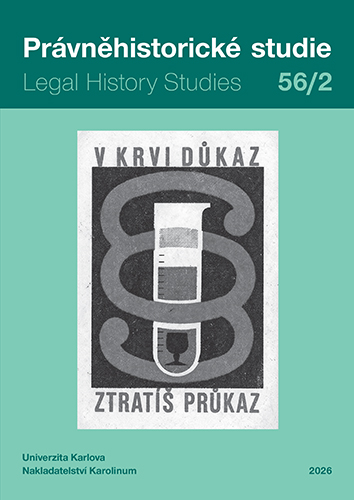
Právněhistorické studie / Legal History Studies (Charles University journal; below referred to as PHS or Journal) is a scientific journal listed in the international prestigious database SCOPUS. The journal is published by Charles University in Prague under the guarantee of the Department of Legal History of the Faculty of Law of Charles University. It is published by the Karolinum Press. The journal focuses on the field of legal history and related topics.
Issue 1 of the Journal was published by the Czechoslovak Academy of Sciences Publishing in June 1955. The Journal was initially published by the Cabinet of Legal History of the Czechoslovak Academy of Science (CSAV), later by the Institute of State and Law (CSAV) and then by the Institute of Legal History of the Faculty of Law of Charles University.
PHS is issued three times a year in April, August, and December and it presents original scientific works/papers as well as reviews, annotations and news from the scientific field of legal history. It also introduces annotated texts of a legal history nature. PHS accepts manuscripts from domestic as well as foreign authors. Manuscripts submitted by foreign authors are published in original language, namely in English, Slovak, German, French, Italian or Polish.
PHS (ISSN 0079-4929) is registered in the Czech national ISSN centre (supervised by the State Technical Library). The Journal is registered by the Ministry of Culture of the Czech Republic according to Act No. 46/2000 Sb., on Rights and Liabilities for the Publishing of Periodicals and Change of Some Acts (Press Act), and it is allocated with registration number of periodical press MK E 18813.
PHS is an open journal and ensures open access to scientific data (Open Access). The entire content is released as open to the public on the web pages of the journal.
The journal is archived in Portico.
PRÁVNĚHISTORICKÉ STUDIE, Vol 56 No 2 (2026), 13–31
ArticleOd rituálov k alimentácii: Náčrt raného vývoja fideikomisov v prospech familia libertorum
[From Rituals to Alimentation: An Outline of the Early Development of Fideicommissa in Favor of the Familia Libertorum]
Timotej Práznovský
DOI: https://doi.org/10.14712/2464689X.2026.550
published online: 06. 10. 2026
abstract
The paper explores the early development of the Roman legal institution known as the fideicommissum familiae relictum, with a particular focus on its application in favour of groups of freedmen (familia libertorum). It argues that the phrase ne de nomine suo exiret – commonly found in testamentary dispositions and funerary inscriptions – reflects a concern with ensuring the continuity of burial rites and private cults (sacra privata). Drawing on epigraphic evidence and legal sources, particularly the Digest of Justinian and fragments from jurists such as Aburnius Valens and Scaevola, the paper examines how land bequests to freedmen were structured to guarantee the upkeep of tombs and the perpetuation of ancestral worship. The analysis reveals that over time, particularly from the mid-2nd century CE onward, the institution appears to have shifted towards a more alimentary function, providing support for freedmen in the absence of biological heirs. Legislative developments, such as Hadrian’s ban on dispositions to uncertain persons (personae incertae), curtailed the long-term application of such fideicommissa, leading to alternative legal mechanisms, including transfers to municipalities. The development of fideicommissa in favour of freedmen thus illustrates broader transformations in Roman private law and social practice, including the decline of traditional religion and the rise of new forms of property management and welfare provision in the Roman world.
keywords: fideicommissum; familiae relictum; sacra privata; law of tombs; trust; Aburnius Valens; familia libertorum; familia nominis
references (47)
1. AUDIN, A. Le droit des tombeaux romains. Revue belge de philologie et d'histoire, 1965, Tome 43, fasc. 1, s. 79-87. CrossRef
2. AVENARIUS, M. Gentilnamen, Grundstücke und Gedächtnis: Die Förderung der memoria als Zweck römischer Familienfideikommisse an Immobiliarvermögen. In: D'ANGELO, G. - DE SIMONE, M. - VARVARO, M. (eds.). Scritti per il novantesimo compleanno di Mateo Marrone. Torino: Giappichelli, 2020, s. 1-26.
3. AVENARIUS, M. Ordo testamenti. Tübingen: Mohr Siebeck, 2024. CrossRef
4. AVENARIUS, M. The Pre-Classical fidei committere and the Order to be Established Upon Death: Emotion as the Basis of the Legal Bindingness of the Decedent's Last Wishes. In: BETTENWORTH, A. - HAMMERSTAEDT, J. (eds.). Writing Order and Emotions: Affect and the Structures of Power in Greek and Latin Authors. Hildesheim: Georg Olms Verlag, 2020, s. 65-91.
5. BABUSIAUX, U. Dis Manibus. Zum römischen Grabrecht. Zeitschrift der Savigny-Stiftung für Rechtsgeschichte: Romanistische Abteilung, 2024, Bd. 141, s. 61-133. CrossRef
6. BABUSIAUX, U. Il valore della terra e il "fideicommissum familiae relictum". Una configurazione giuridica motivata da fattori economici? In: Atti dell'Accademia Romanistica Costantiniana. Vol. 22. Napoli: Edizioni Scientifiche Italiane, 2017, s. 405-435.
7. BABUSIAUX, U. Papinians Quaestiones: Zur rhetorischen Methode eines spätklassischen Juristen. München: C. H. Beck, 2011. CrossRef
8. BABUSIAUX, U. Zum Testament der Iunia Libertas aus Ostia (AE 1940,94). In: ISOLA, L. (Hrsg.) Klauselgestaltungen in Römischen Testamenten. Berlin: Peter Lang, 2022, s. 45-77.
9. BOYER, L. La Fonction sociale des legs d'après la jurisprudence classique. Revue historique de droit français et étranger, Quatrième série, 1965, Vol. 43, s. 333-408.
10. BRUCK, E. F. Über römisches Recht im Rahmen der Kulturgeschichte. Berlin - Göttingen - Heidelberg: Springer-Verlag, 1954. CrossRef
11. DE VISSCHER, F. Le droit des tombeaux romains. Milano: Giuffrè, 1963.
12. DECLAREUIL, J. Quelques notes sur certains types de fidéicommis. In: Mélanges Gérardin. Paris: Libraire de la societe du recueil J.-B. Sirey, 1907, s. 135-155.
13. DESANTI, L. Restitutionis post mortem onus: I fedecommessi da restituirsi dopo la morte dell'onerato. Milano: Giuffrè, 2003.
14. GIODICE-SABBATELLI, V. La tutela giuridica dei fedecommessi fra Augusto e Vespasiano. Bari: Cacucci editore, 1993.
15. GREGORI, G. L. Definizione e misurazione dello spazio funerario nell'epigrafia repubblicana e protoimperiale di Roma. Un'indagine campione. In: CRESCI MARRONE, G. - TIRELLI, M. (cura). Terminavit sepulcrum: I recinti funerari nelle necropoli di Altino: Atti del Convegno, Venezia, 3-4 dicembre 2003. Roma: Quasar, 2005, s. 77-126.
16. HILLNER, J. Domus, Family, and Inheritance: The Senatorial Family House in Late Antiquity Rome. The Journal of Roman Studies, 2003, Vol. 93, s. 129-145. CrossRef
17. HONORÉ, A. M. Iulian's circle. Tijdschrift voor Rechtsgeschiedenis, 1964, Vol. 32, Nr. 1, s. 1-44. CrossRef
18. HUSCHKE, P. E. T. Flavii Synantrophi Instrumentum Donationis Ineditum. Vratislavia: F. Hirt, 1838.
19. JOHNSTON, D. E. L. Trusts and Tombs. Zeitschrift für Papyrologie und Epigraphik, 1988, Bd. 72, s. 81-87.
20. JOHNSTON, D. Prohibitions and perpetuities: family settlements in Roman law. Zeitschrift der Savigny-Stiftung für Rechtsgeschichte: Romanistische Abteilung, 1985, Bd. 102, s. 220-290. CrossRef
21. JOHNSTON, D. The Roman Law of Trusts. Oxford: Clarendon Press, 1988. CrossRef
22. KASER, M. Zum römischen Grabrecht. Zeitschrift der Savigny-Stiftung für Rechtsgeschichte: Romanistische Abteilung, 1978, Bd. 95, s. 15-92. CrossRef
23. KLOKNER, T. Korene modernej alimentácie: Alimentačný program v rímskom svete (1. až 3. storočie n. l.). Pezinok: Malokarpatské múzeum v Pezinku, 2017.
24. KURYŁOWICZ, M. Publius Pactumeius Clemens i publiczna działalność jurystów rzymskich. Zeszyty Prawnicze, 2023, Tom. 23, Nr. 3, s. 5-25. CrossRef
25. LAUBRY, N. Romanus mos ? La culture funéraire romaine et ses transformations (IIe siècle av. J.-C. - IIe siècle apr. J.-C.). In: CUCHET, G. et al. (eds.) Transitions funéraires en Occident. Rome: Publications de l'École française de Rome, 2023, s. 125-160. CrossRef
26. LE BRAS, G. Les fondations privées du Haut Empire. In: Studi in onore di Salvatore Riccobono nel XL anno del suo insegnamento. Vol. 3. Palermo: Arti grafiche G. Castiglia, 1936, s. 23-67.
27. LENEL, O. Palingenesia iuris civilis. 2. vols. Graz: Akademische Druck- u. Verlagsanstalt, 1960.
28. LIEBS, D. § 414. L. Octavius Cornelius P. Salvius Iulianus Aemilianus. In: SALLMAN, K. (Hrsg.). Handbuch der lateinischen Literatur der Antike. Bd. 4. Die Literatur des Umbruchs Von der römischen zur christlichen Literatur 117-284 n. Chr. München: C. H. Beck, 1997, s. 101-105.
29. LIEBS, D. § 415.6. Q. Cervidius Scaevola (Scaevola II). In: SALLMAN, Klaus (Hrsg.). Handbuch der lateinischen Literatur der Antike. Bd. 4. Die Literatur des Umbruchs Von der römischen zur christlichen Literatur 117-284 n. Chr. München: C. H. Beck, 1997, s. 113-116.
30. LIEBS, D. § 419.1. Aburnius Valens, Fideicommissorum libri VII. In: SALLMAN, K. (Hrsg.). Handbuch der lateinischen Literatur der Antike. Bd. 4. Die Literatur des Umbruchs Von der römischen zur christlichen Literatur 117-284 n. Chr. München: C. H. Beck, 1997, s. 128-130.
31. LIEBS, D. Ewiges Gedenken durch freigelassene Sklaven. Römisches Recht und römische Sitten. In: GULCZYNSKI, A. (Hrsg.). Leben nach dem Tod: Rechtliche Probleme im Dualismus: Mensch - Rechtssubjekt. Graz: Leykam, 2010, s. 49-65.
32. LONGCHAMPS DE BÉRIER, F. O elastyczność prawa. Wyd. II, pierwsze polskie. Warszawa: Liber, 2006.
33. MAGIONCALDA, A. Donazioni private a fini perpetui destinate alle città. Esempi dalla documentazione latina in età imperiale. In: Il capitolo delle entrate nelle finanze municipali in Occidente ed in Oriente: Actes de la Xe Rencontre franco-italienne sur l'épigraphie du monde romain (Rome, 27-29 mai 1996). Rome: École Française de Rome, 199, s. 175-216.
34. MAIURI, A. Sacra privata: Rituali domestici e istituti giuridici in Roma antica. Milano: L'Erma di Bretschneider, 2013.
35. MIEROW, Ch. Ch. Hoc Monumentum Heredem Non Sequitur - An Interpretation. Transactions and Proceedings of the American Philological Association, 1934, Vol. 65, s. 163-177. CrossRef
36. NASTI, F. Papyrus Hauniensis de legatis et fideicommissis: Pars altera II. 1 (PHaun. III 45 verso + CPL 73 A e B verso). Napoli: Satura Editrice, 2013.
37. PATURET, A. Le mécanisme de l'actio sepulchri violati en droit romain. In: Il diritto alla sepoltura nel Mediterraneo antico, édité par Reine-Marie Bérard. Roma: Publications de l'École française de Rome, 2021, s. 191-221. CrossRef
38. PAULUS, Ch. G. Auf der Suche nach Unsterblichkeit. Berlin: Franz Steiner Verlag, 2018. CrossRef
39. PLATSCHEK, J. Das vermachte Wohnrecht in Scaevola D. 33,2,34pr. (18 dig.). In: FINKENAUER, T. - SIRKS, A. J. B. (Hrsg.). Interpretationes iuris antiqui: Dankesgabe für Shigeo Nishimura. Wiesbaden: Harrassowitz Verlag, 2018, s. 241-255
40. RADULOVA, L. Iura sepulchrorum nella Moesia Inferior: la realizzazione di un fenomeno romano in un ambito greco-trace. Revue Internationale des Droits de l'Antiquité, 2016, Tom. 63, s. 197-212.
41. RICCOBONO, S. Il gnomon dell'idios logos. [Palermo]: Palumbo, [1950].
42. RÜFNER, T. Das römische Familienfideikomiss. In: ISOLA, L. (Hrsg.). Klauselgestaltungen in Römischen Testamenten. Berlin: Peter Lang, 2022, s. 177-188.
43. SARRIS, P. Merchants, Trade and Commerce in Byzantine Law From Justinian I to Basil II. In MAGDALINO, P. - NECIPOGLU, N. (Eds.). Trade in Byzantium: Papers from the Third International Sevgi Gönül Byzantine Studies Symposium. Istanbul: Koç University Research Center for Anatolian Civilizations, 2016, s. 11-23.
44. SORKA, K. Usucapio pro herede in The Institutes of Gaius. Krakowskie Studia z Historii Państwa i Prawa, 2018, Zeszyt specjalny, wersja anglojęzyczna, s. 1-28. CrossRef
45. STLOUKALOVÁ, K. Interpretace pojmu familia v římském právu se zaměřením na Justiniánská Digesta. In: Interpretační úskalí justiniánskych Digest. Praha: Auditorium, 2020, s. 15-40.
46. TORRENT, A. Fideicommissum familiae relictum. Oviedo: Universidad de Oviedo, 1975.
47. ZANCAN, L. Il diritto di sepolcro nel Gnomon. Aegyptus. 1936, Anno 16, No. 1/2, s. 148-165.

Od rituálov k alimentácii: Náčrt raného vývoja fideikomisov v prospech familia libertorum is licensed under a Creative Commons Attribution 4.0 International License.
170 x 240 mm
periodicity: 3 x per year
print price: 250 czk
ISSN: 0079-4929
E-ISSN: 2464-689X
