
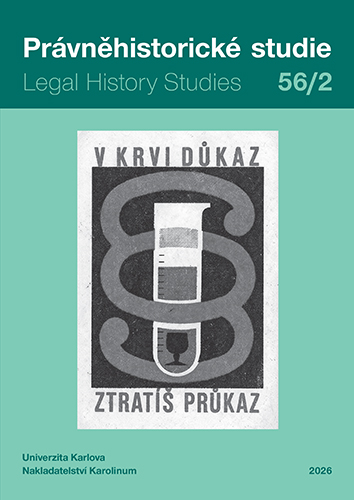
Právněhistorické studie / Legal History Studies (Charles University journal; below referred to as PHS or Journal) is a scientific journal listed in the international prestigious database SCOPUS. The journal is published by Charles University in Prague under the guarantee of the Department of Legal History of the Faculty of Law of Charles University. It is published by the Karolinum Press. The journal focuses on the field of legal history and related topics.
Issue 1 of the Journal was published by the Czechoslovak Academy of Sciences Publishing in June 1955. The Journal was initially published by the Cabinet of Legal History of the Czechoslovak Academy of Science (CSAV), later by the Institute of State and Law (CSAV) and then by the Institute of Legal History of the Faculty of Law of Charles University.
PHS is issued three times a year in April, August, and December and it presents original scientific works/papers as well as reviews, annotations and news from the scientific field of legal history. It also introduces annotated texts of a legal history nature. PHS accepts manuscripts from domestic as well as foreign authors. Manuscripts submitted by foreign authors are published in original language, namely in English, Slovak, German, French, Italian or Polish.
PHS (ISSN 0079-4929) is registered in the Czech national ISSN centre (supervised by the State Technical Library). The Journal is registered by the Ministry of Culture of the Czech Republic according to Act No. 46/2000 Sb., on Rights and Liabilities for the Publishing of Periodicals and Change of Some Acts (Press Act), and it is allocated with registration number of periodical press MK E 18813.
PHS is an open journal and ensures open access to scientific data (Open Access). The entire content is released as open to the public on the web pages of the journal.
The journal is archived in Portico.
PRÁVNĚHISTORICKÉ STUDIE, Vol 32 No 1 (1992), 37–51
ArticlePostavení a činnost sacra scrinia za dominátu
[The Position and Activities of sacra scrinia during the Dominate]
Michal Skřejpek
DOI: https://doi.org/10.14712/2464689X.2026.767
published online: 19. 08. 2020
abstract
The imperial administrative underwent far-reaching changes during the Dominate. Only a limited number of administrative departments may be recognised as the continuation of the former departments of the Principate. They are mostly the imperial departments – the auxiliary administrative bodies of the emperor that are called sacra scrinia. However their position in the imperial administrative changed considerably. Originally they helped the emperor directly, but later they were only one of many palatine offices, albeit with a specific position. Officers working in the scrinia were under judicial and organizational supervision of the magister officiorum but they were almost exclusively responsible for tasks set by the quaestor sacri palatii. As scriniarii closely cooperated with the quaestor and performed specific duties they became one of the pillars of the system of law of the late Roman Empire. Magistri scriniorum formally at the head of the scrinia were not their real chiefs. The chiefs of the personnel were proximi, magistri only chose assistants from among them. It even seems probable that the magistri scriniorum were directly under the emperor’s supervision. In attempting to specify the contents of duties of individual scrinia during the Dominate it is important to differentiate whether their officers were engaged in the services of the quaestor or in the services of the relevant magister scriniorum. The personnel of the scrinia in the services of the quaestor sacri palatii all engaged in attending to private requests called processes. One task was however common for all the scrinia as information from all parts of the Roman State in the field of administration flowed into the hands of the personnel of these departments, they in fact, together with the body agentes in rebus, inspected the whole administration of the Empire. In this paper when I speak about the contents of the tasks of each scrinia, it is not fully justified as scrinia as a body never functioned, the specific duties were fulfilled only by its individual members. scrinium epistolarum – The personnel of this scrinium who worked for the quaestor, were charged with the making out of the consultationes, leges dictandae, and finally they also made out letters of appointment for senior officers called probatoria. Epistolares working for the magister officiorum attended to the agenda connected with diplomatic activities. Magister epistolarum most probably engaged in the traditional sphere of duties, he took care of the emperor’s correspondence. In the eastern part of the Empire there existed the magister Graecarum, who was concerned with the Greek correspondence. scrinium libellorum – Quaestor sacri palatii made use of “his” libellenses for the making out of the probatoria for junior officers. Under the magister’s supervision they prepared cases held before the emperor and therefore engaged mostly in attending to appeals – supplicationes. scrinium memoriae – This scrinium retained its former exceptional position among other departments as it was the case during the Principate. Four members of the personnel called antiquarii carried out the duties of the central archives under supervision of the magister. Other members of the personnel performed other smaller tasks as e.g. they reported on students in Rome. The personnel in the services of the quaestor issued probatoria and made out adnotationes – replies to requests that required only a short answer from the emperor. scrinium dispositionum – The character of this office was very close to that of the departments functioning during the Principáte. However, there is not available any direct analogy from that period. The organizational structure of this scrinium also differed from other scrinia as it was supervised by magister officiorum. Moreover, at the beginning it was directed only by the primicerius. This scrinium formed the emperor’s mobile secretariat that performed regular office duties and took care of his official programme.
Published by the Karolinum Press. For permission to use please write to journals@karolinum.cz.
170 x 240 mm
periodicity: 3 x per year
print price: 250 czk
ISSN: 0079-4929
E-ISSN: 2464-689X