
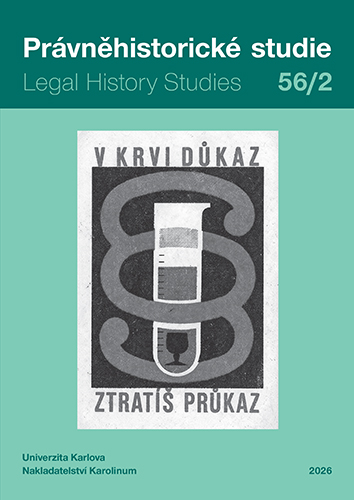
Právněhistorické studie / Legal History Studies (Charles University journal; below referred to as PHS or Journal) is a scientific journal listed in the international prestigious database SCOPUS. The journal is published by Charles University in Prague under the guarantee of the Department of Legal History of the Faculty of Law of Charles University. It is published by the Karolinum Press. The journal focuses on the field of legal history and related topics.
Issue 1 of the Journal was published by the Czechoslovak Academy of Sciences Publishing in June 1955. The Journal was initially published by the Cabinet of Legal History of the Czechoslovak Academy of Science (CSAV), later by the Institute of State and Law (CSAV) and then by the Institute of Legal History of the Faculty of Law of Charles University.
PHS is issued three times a year in April, August, and December and it presents original scientific works/papers as well as reviews, annotations and news from the scientific field of legal history. It also introduces annotated texts of a legal history nature. PHS accepts manuscripts from domestic as well as foreign authors. Manuscripts submitted by foreign authors are published in original language, namely in English, Slovak, German, French, Italian or Polish.
PHS (ISSN 0079-4929) is registered in the Czech national ISSN centre (supervised by the State Technical Library). The Journal is registered by the Ministry of Culture of the Czech Republic according to Act No. 46/2000 Sb., on Rights and Liabilities for the Publishing of Periodicals and Change of Some Acts (Press Act), and it is allocated with registration number of periodical press MK E 18813.
PHS is an open journal and ensures open access to scientific data (Open Access). The entire content is released as open to the public on the web pages of the journal.
The journal is archived in Portico.
PRÁVNĚHISTORICKÉ STUDIE, Vol 14 No 1 (1969), 85–116
ArticleBoj o reformu Nejvyššího soudu USA a jeho význam pro stát a právo Spojených států
[The Fight for the Reform of the U. S. Supreme Court and its Importance for the Constitutional Law of the United States]
Josef Blahož
DOI: https://doi.org/10.14712/2464689X.2026.275
published online: 21. 04. 2020
abstract
The era of the Thirties was most crucial for the modern constitutional history of the United States. During the Roosevelt’s New Deal – there came the most vigorous constitutional conflict between the President and the U. S. Supreme Court. The forces of progressivism and reformism rallied behind Franklin Delano Roosevelt attempted to the utmost to assert the J. M. Keynes’s principles of controlled economy and clashed with the extreme conservative and reactionary group at that time represented in the governing bodies by a majority of the Justices and many senators and congressmen. These were only concerned with preserving in the U.S.A. the economical, political and legal order as it developed in the years before the turn of the century and in the first twenty years of the present century. In the years 1934–1936 the Supreme Court began to scrutinize some of the Roosevelt’s New Deal enactments and decided that these were unconstitutional and void. Roosevelt was re-elected in 1936 and the following year he proposed a bill which would have the effect of increasing the Court’s membership sufficiently to provide a majority of liberal minded Justices (under the pretext that the average age of Justices was high) and thus would practically invalidate the Supreme Court as one of the counterbalancing agents of the federal government. But his project found a vigorous criticism not only among the diehards but it was disliked even by liberal and leftist groups, by progressive scientists and journalists who had endorsed the President and his policies up till now. They feared – not without reason – that the executive power of the President would no more be subject to the restraints imposed by the Supreme Court and might well turn towards dictatorship. After a bitter struggle in Congress, the bill never went through, however this great Court battle left a permanent mark upon the American constitutional life. The Court’s rulings began to show an important more liberal trend in favor of the President and partly Congress too. Thus the decisions on some most important constitutional questions in fact, got out of the hands of the Supreme Court. The power of the President and that of the Congress to control national economy, the relations between the national and state governments (especially the safeguards of the rights of states) and in general questions as to the limits of constitutional powers held by the executive and the legislature were the principal questions. The outcome of the battle which the President waged for the reform of the Supreme Court and the work of the Supreme Court itself during the last thirty years seem to confirm the following hypothesis: this was by far not a battle between progressive and conservative forces wherein afterwards the matter were restored to status quo ante, but that this conflict also had a prominent institutional character. Roosevelt s “constitutional revolution” made possible an unusual aggrandizement of the power of the federal government (in the first place of the executive power) in all fields of the politic and public life. On the other hand, it exerted a beneficial influence on the work of the U. S. Supreme Court in the sphere of civil rights and liberties and brought about the formulation of many progressive constitutional doctrines.
Published by the Karolinum Press. For permission to use please write to journals@karolinum.cz.
170 x 240 mm
periodicity: 3 x per year
print price: 250 czk
ISSN: 0079-4929
E-ISSN: 2464-689X