
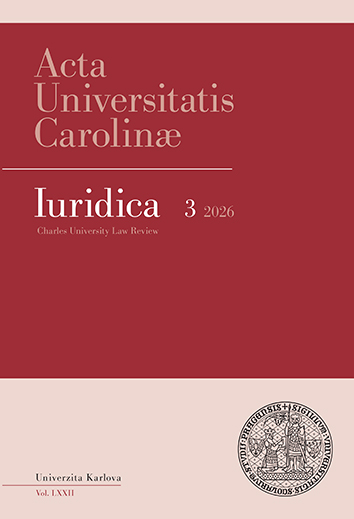
Acta Universitatis Carolinae Iuridica (AUCI) is the main journal of the Faculty of Law of Charles University. It has been published since 1954 and is one of the traditional law journals with a theoretical focus.
As a general law journal, it publishes longer studies and shorter articles on any relevant issues in legal theory and international, European and national law. AUCI also publishes material relating to current legislative issues. AUCI is a peer-reviewed journal and accepts submissions from both Czech and international authors. Contributions by foreign authors are published in their original language – Slovak, English, German, French.
AUCI is a theoretical journal for questions of state and law. It is published by Charles University in Prague, Faculty of Law, through Karolinum Press. It is published four times a year, the dates of publication can be found here.
Articles published in AUCI undergo an independent peer review process, which is anonymous on both sides. Reviewers from the field give their opinion on the scientific quality of the paper and the suitability of publication in the journal. In the case of comments, the opinion is sent back to the author with the possibility of revising the text (see Guidelines for Authors – Per Review Process for more details).
The AUCI journal (ISSN 0323-0619) is registered in the Czech National Bibliography (kept by the National Library of the Czech Republic) and in the Index to Foreign Legal Periodicals (kept by the American Association of Law Libraries). AUCI has been assigned a periodical registration number MK E 18585.
In 2021 the journal AUCI was the first journal of the Faculty of Law of Charles University to be included in the prestigious international database Scopus. This Elsevier database is the largest abstract and citation database of peer-reviewed literature in the world. The editors of the journal expect from the inclusion in the elite Scopus database not only an increase in the readership of the journal, but also an increase in interest in the publication of papers by both Czech and foreign authors.
AUCI is an open journal and all its content is published both on the faculty website and on the Karolinum Press website. Access to it is free of charge. The homepage of AUCI is on the Karolinum Press website.
The AUCI journal uses the Creative Commons license: CC BY 4.0.
Long-term archiving of the digital content of the journal is provided by Portico.
AUC IURIDICA, Vol 72 No 1 (2026), 133–145
ArticleUmělá inteligence a soudní přezkum
[Artificial Intelligence and Judicial Review]
Richard Pomahač
DOI: https://doi.org/10.14712/23366478.2026.9
published online: 23. 02. 2026
abstract
The legal sector is being affected by artificial intelligence around the world. Should we be more concerned about further developments, or can we look forward to a better functioning of the judiciary? This article seeks to find an answer, with a particular focus on administrative justice. Courts and administrative tribunals in Europe are not yet fully using automated decision-making applications. However, they are increasingly experimenting with supporting and collaborative applications of artificial intelligence. The effectiveness of artificial intelligence in judicial review is not in the hands of computer experts, but of judges. Automated predictive analytics tools can be used to express an administrative authority’s chance of a predictable judicial review. This is only relevant if there is no inherent tension between administrative authorities and courts regarding the use of artificial intelligence.
keywords: artificial intelligence; algorithmic processing; large language models; administrative justice; judicial review
references (40)
1. 2023 Year-End Report on the Federal Judiciary [online]. [cit. 2025-06-16]. Dostupné na: https://www.supremecourt.gov/publicinfo/year-end/2023year-endreport.pdf.
2. ADLER, S. Would ChatGPT risk your life to avoid getting shut down? In: Steven Adler's Substack [online]. 11. 6. 2025 [cit. 2025-06-16]. Dostupné na: https://stevenadler.substack.com/p/chatgpt-would-risk-your-life-to-avoid.
3. BOEHME-NESSLER, V. Unscharfes Recht Überlegungen zur Relativierung des Rechts in der digitalisierten Welt. Berlin: Duncker & Humblot, 2008. CrossRef
4. CVRČEK, F. V. Knapp a 50 let právní informatiky v ČR. Právník. 2013, roč. 152, č. 12, s. 1220.
5. DALY, P. Artificial Intelligence and Administrative Tribunals. In: YEE-FUI N. G. - GROVES, M. (eds.). Automation in Governance [online]. London: Bloomsbury Publishing, 2025 [online] [v tisku]. [cit. 2025-06-16]. Dostupné na: https://ssrn.com/abstract=5041097. CrossRef
6. European Commission for the Efficiency of Justice. 1st AIAB Report on the Use of Artificial Intelligence (AI) in the Judiciary Based on the Information Contained in the Resource Centre on Cyberjustice and AI [online]. CEPEJ-AIAB(2024)4Rev5, Strasbourg, 28. 2. 2025 [cit. 2025-06-16]. Dostupné na: https://rm.coe.int/cepej-aiab-2024-4rev5-en-first-aiab-report-2788-0938-9324-v-1/1680b49def.
7. FABRI, M. From Court Automation to e-Justice and Beyond in Europe. International Journal for Court Administration. 2024, Vol. 15, No. 3. CrossRef
8. FANCHER, P. The Love Letter Generator That Foretold ChatGPT. In: JSTOR Daily [online]. 26. 6. 2024 [cit. 2025-06-16]. Dostupné na: https://daily.jstor.org/the-love-letter-generator-that-foretold-chatgpt.
9. GROOTELAAR, H. A. M. - VAN DEN BOS, K. Conducting experiments and surveys in the field of administrative justice: on the importance of fair procedures in governance. In: VAN BOOM, W. H. - DESMET, P. - MASCINI, P. (eds.). Empirical Legal Research in Action. Cheltenham: Edward Elgar, 2018, s. 23-56. CrossRef
10. CHESTERMAN, S. The Tragedy of AI Governance. In: KASIRZADEH, A. - NYHOLM, S. - ZERILLI, J. (eds.). Contemporary Debates in the Ethics of Artificial Intelligence [online]. Hoboken: Wiley-Blackwell, 2025 [online] [v tisku] [cit. 2025-06-16]. Dostupné na: https://ssrn.com/abstract=4600065.
11. KATZ, D. M. The MIT School of Law? A Perspective on Legal Education in the 21st Century. University of Illinois Law Review. 2014, No. 5, s. 1431-1472.
12. KNAPP, V. O možnosti použití kybernetických metod v právu. Praha: Nakladatelství Československé akademie věd, 1963.
13. KNAPP, V. Teorie práva. Praha: C. H. Beck, 1995.
14. KORT, F. Predicting Supreme Court Decisions Mathematically: A Quantitative Analysis of the "Right to Counsel" Cases. The American Political Science Review. 1957, Vol. 51, No. 1, s. 1-12. CrossRef
15. KOVÁŘ, D. - NEČAS, J. Jak si poradí jazykové modely AI s českým právem? Složí advokátní zkoušky? In: Havel & Partners [online]. 28. 3. 2024 [cit. 2025-06-16]. Dostupné na: https://www.havelpartners.blog/jak-si-poradi-jazykove-modely-ai-s-ceskym-pravem-slozi-advokatni-zkousky?utm_source=chatgpt.com.
16. LEDERER, F. I. Technology Comes to the Courtroom, and… Emory Law Journal. 1994, Vol. 43, s. 1095-1122.
17. LIU, J. Z. - LI, X. How do judges use large language models? Evidence from Shenzhen. Journal of Legal Analysis. 2024, Vol. 16, No. 1, s. 235-262. CrossRef
18. LUHMANN, N. Recht und Automation in der öffentlichen Verwaltung: Eine verwaltungswissenschaftliche Untersuchung. 2. Aufl. Berlin: Duncker & Humblot, 1997. CrossRef
19. Nejvyšší soud uspořádal kulatý stůl na téma umělé inteligence. Aequitas [online]. 2024, roč. 8, č. 4, s. 6. [cit. 2025-06-16]. Dostupné na: https://www.nsoud.cz/fileadmin/user_upload/AEQUITAS/2024/04-aequitas.pdf.
20. PÍTROVÁ, L. - POMAHAČ, R. Evropské správní soudnictví. Praha: C. H. Beck, 1998.
21. POMAHAČ, R. Nezávislost správního soudnictví v kontextu politizace a judicializace veřejného práva. In: GERLOCH, A. - ŽÁK KRZYŽANKOVÁ, K. (eds.). Právo v měnícím se světě. Plzeň: Vydavatelství a nakladatelství Aleš Čeněk, 2020, s. 265-266.
22. POSNER, E. A. - SARAN, S. Judge AI: Assessing Large Language Models in Judicial Decision-Making [online]. University of Chicago Coase-Sandor Institute for Law & Economics Research Paper No. 25-03, s. 26-29 [cit. 2025-06-16]. Dostupné na: https://ssrn.com/abstract=5098708.
23. Rozhovor: Karel Šimka - Právo ve světě "unaveného Západu" a další postřehy předsedy NSS. In: Právní prostor [online]. 4. 4. 2024 [cit. 2025-06-16]. Dostupné na: https://www.pravniprostor.cz/clanky/ostatni-pravo/rozhovor-karel-simka-pravo-unaveny-zapad-predseda-NSS.
24. Rozhovor: Vladimír Jirousek a Karel Šimka ke Sjezdu českých právníků. In: Právní prostor [online]. 9. 5. 2025 [cit. 2025-06-16]. Dostupné na: https://www.pravniprostor.cz/clanky/ostatni-pravo/rozhovor-vladimir-jirousek-karel-simka-ke-sjezdu-ceskych-pravniku.
25. Rozsudek Městského soudu v Praze ze dne 9. 11. 2023, č. j. 10 A 99/2023-73.
26. SALES, P. J. Judicial Review Methodology in the Automated State: Presentation for the Conference on Automation in Public Governance - Theory, Practice and Problems [online]. Prato, Italy, September 2024 [cit. 2025-06-16]. Dostupné na: https://supremecourt.uk/uploads/speech_lord_sales_2409_157955367d.pdf.
27. Sdělení Evropské komise Evropskému parlamentu, Radě, Evropskému hospodářskému a sociálnímu výboru a Výboru regionů Digitalizace soudnictví v Evropské unii Soubor příležitostí, COM(2020) 710 final [online]. 2. 12. 2020, s. 11 [cit. 2025-06-16]. Dostupné na: https://eur-lex.europa.eu/legal-content/CS/TXT/PDF/?uri=CELEX:52020DC0710.
28. SCHLEGEL, S. A Call for Education Over Regulation: An Open Letter. In: Scott Schlegel blog [online]. 28. 11. 2023 [cit. 2025-06-16]. Dostupné na: https://judgeschlegel.com/blog/-a-call-for-education-over-regulation-an-open-letter.
29. SCHLEGEL, S. Mind Over Machine: Preserving Human Judgment in Legal Writing. In: Scott Schlegel blog [online]. 13. 1. 2025 [cit. 2025-06-16]. Dostupné na: https://judgeschlegel.com/blog/mind-over-machine-preserving-human-judgment-in-legal-writing.
30. SIMON, H. A. The Sciences of the Artificial. 3rd ed. Cambridge (MA): MIT Press, 1996.
31. SIMON, H. A. - NEWELL, A. Heuristic Problem Solving: The Next Advance in Operations Research. Operations Research. 1958, Vol. 6, No. 1, s. 8-10. CrossRef
32. SOURDIN, T. Judges, Technology and Artificial Intelligence: The Artificial Judge. Cheltenham: Edward Elgar, 2021. CrossRef
33. SPAMANN, H. - KLÖHN, L. Can Law Students Replace Judges in Experiments of Judicial Decision-Making? Journal of Law and Empirical Analysis. 2024, Vol. 1, No. 1, s. 149-161. CrossRef
34. STONE. J. Man and Machine in the Search for Justice. Stanford Law Review. 1964, Vol. 16, No. 3, s. 559-560. CrossRef
35. STRACHEY, D. The "Thinking" Machine. In: Encounter [online]. October 1954, s. 25-31 [cit. 2025-06-16]. Dostupné na: https://www.unz.com/print/Encounter-1954oct-00025.
36. Studujete práva? Za 10 let nebudete právníci, ale konzultanti, říká zakladatel startupu. In: FocusOn.cz [online]. 20. 5. 2025 [cit. 2025-06-16]. Dostupné na: https://www.focuson.cz/studujete-prava-za-10-let-nebudete-pravnici-ale-konzultanti-rika-zakladatel-startupu/?utm_source=chatgpt.com.
37. SUSSKIND, R. Online Courts and the Future of Justice. Oxford: Oxford University Press, 2019. CrossRef
38. SUSSKIND, R. How to Think About AI: A Guide for the Perplexed. Oxford: Oxford University Press, 2025. CrossRef
39. WOLF, M. J. Collaborative Technology Improves Access to Justice. Journal of Legislation and Public Policy. 2012, Vol. 15, No. 3, s. 759-789.
40. YEE-FUI N. G. - GROVES, M. (eds.). Automation in Governance [online]. London: Bloomsbury Publishing, 2025 [online] [v tisku]. [cit. 2025-06-16]. Dostupné na: https://ssrn.com/abstract=5041097.

Umělá inteligence a soudní přezkum is licensed under a Creative Commons Attribution 4.0 International License.
157 x 230 mm
periodicity: 4 x per year
print price: 65 czk
ISSN: 0323-0619
E-ISSN: 2336-6478