
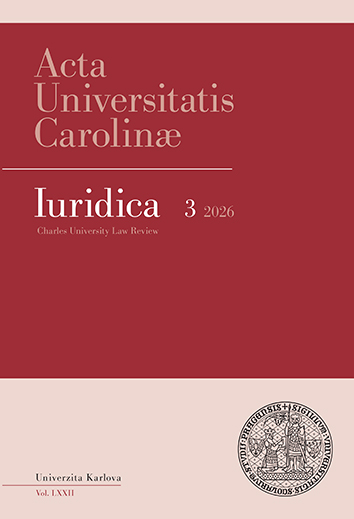
Acta Universitatis Carolinae Iuridica (AUCI) is the main journal of the Faculty of Law of Charles University. It has been published since 1954 and is one of the traditional law journals with a theoretical focus.
As a general law journal, it publishes longer studies and shorter articles on any relevant issues in legal theory and international, European and national law. AUCI also publishes material relating to current legislative issues. AUCI is a peer-reviewed journal and accepts submissions from both Czech and international authors. Contributions by foreign authors are published in their original language – Slovak, English, German, French.
AUCI is a theoretical journal for questions of state and law. It is published by Charles University in Prague, Faculty of Law, through Karolinum Press. It is published four times a year, the dates of publication can be found here.
Articles published in AUCI undergo an independent peer review process, which is anonymous on both sides. Reviewers from the field give their opinion on the scientific quality of the paper and the suitability of publication in the journal. In the case of comments, the opinion is sent back to the author with the possibility of revising the text (see Guidelines for Authors – Per Review Process for more details).
The AUCI journal (ISSN 0323-0619) is registered in the Czech National Bibliography (kept by the National Library of the Czech Republic) and in the Index to Foreign Legal Periodicals (kept by the American Association of Law Libraries). AUCI has been assigned a periodical registration number MK E 18585.
In 2021 the journal AUCI was the first journal of the Faculty of Law of Charles University to be included in the prestigious international database Scopus. This Elsevier database is the largest abstract and citation database of peer-reviewed literature in the world. The editors of the journal expect from the inclusion in the elite Scopus database not only an increase in the readership of the journal, but also an increase in interest in the publication of papers by both Czech and foreign authors.
AUCI is an open journal and all its content is published both on the faculty website and on the Karolinum Press website. Access to it is free of charge. The homepage of AUCI is on the Karolinum Press website.
The AUCI journal uses the Creative Commons license: CC BY 4.0.
Long-term archiving of the digital content of the journal is provided by Portico.
AUC IURIDICA, Vol 72 No 1 (2026), 45–63
ArticleUmělá inteligence a koncept dobré správy
[Artificial Intelligence and Good Governance Concept]
Josef Staša
DOI: https://doi.org/10.14712/23366478.2026.4
published online: 23. 02. 2026
abstract
The issue of using artificial intelligence tools in public administration is a hot topic in administrative science and administrative law theory. The boom of artificial intelligence affects ideas about the proper functioning of public administration, which have been formulated into good governance principles. Specialized literature devotes considerable attention to the relationship between the automation of public administration, including the use of artificial intelligence, and the good governance concept, pointing out both the potential benefits and risks. It can be assumed that the use of artificial intelligence in public administration is currently still compatible with the traditional general good governance concept. Looking ahead, it seems promising to consider new approaches that may lead to the formulation of new rights and principles related to the use of artificial intelligence. It can be concluded that the good artificial intelligence governance principles may include, among others, the principle of synchronization, the principle of fructification, and the principle of vigilance. The European Artificial Intelligence Act has contributed to the fulfillment of the ideas of good governance. However, this new legislation also requires critical evaluation.
keywords: public administration; artificial intelligence; good administration principles; Artificial Intelligence Act
references (32)
1. BARTH, T. J. - ARNOLD, E. Artificial Intelligence and Administrative Discretion: Implications for Public Administration. American Review of Public Administration. 1999, Vol. 29, No. 4, s. 332-351. CrossRef
2. Council of Europe (ed.). Administration and You: A Handbook: Principles of administrative law concerning the relations between individuals and public authorities. 3rd ed. Strasbourg: Council of Europe, 2024.
3. Coursera staff. What Is Machine Learning? Definition, Types, and Examples. In: coursea [online]. 15. 10. 2025 [cit. 2025-09-15]. Dostupné na: na https://www.coursera.org/articles/what-is-machine-learning.
4. COVILLA, J. C. Artificial Intelligence and Administrative Discretion: Exploring Adaptations and Boundaries. European Journal of Risk Regulation. 2025, Vol. 16, No. 1, s. 36-50. CrossRef
5. DUNLEAVY, P. - MARGETTS, H. - BASTOW, S. - TINKLER, J. New Public Management Is Dead - Long Live Digital-Era Governance. Journal of Public Administration Research and Theory. 2006, Vol. 16, No. 3, s. 467-494. CrossRef
6. EU AI ACT: General Purpose AI: Code of Practice [online]. 10. 7. 2025 [cit. 2025-09-15]. Dostupné na: https://code-of-practice.ai/?section=summary.
7. First Draft of the General-Purpose AI Code of Practice published, written by independent experts. In: European Commission: Shaping Europe's digital future [online]. 14. 11. 2024 [cit. 2025-09-15]. Dostupné na: https://digital-strategy.ec.europa.eu/en/library/first-draft-general-purpose-ai-code-practice-published-written-independent-experts.
8. GALETTA, D. - HOFMANN, H. C. H. Evolving AI-based Automation - Continuing Relevance of Good Administration. European Law Review. 2023, Vol. 48, No. 6, s. 617-635.
9. HOOD, C. A. Public Management for All Seasons? Public Administration. 1991, Vol. 69, No. 1, s. 3-19. CrossRef
10. HRABCOVÁ, D. (ed.). Principy dobré správy: sborník příspěvků přednesených na pracovní konferenci. Brno: Masarykova univerzita, 2006.
11. HUQ, A. Z. A Right to a Human Decision. Virginia Law Review. 2020, Vol. 106, No. 3, s. 611-688.
12. LAUKYTE, M. Averting enfeeblement and fostering empowerment: Algorithmic rights and the right to good administration. Computer Law & Security Review. 2022, Vol. 46. CrossRef
13. Listina základních práv Evropské unie (2016/C 202/02). Úřední věstník Evropské unie. C 202/389, 7. 6. 2016.
14. MCCANN, S. Discretion in the Automated Administrative State. Canadian Journal of Law & Jurisprudence. 2023, Vol. XXXVI, No. 1, s. 171-194. CrossRef
15. Nařízení (EU) 2024/1689, kterým se stanoví harmonizovaná pravidla pro umělou inteligenci a mění nařízení (ES) č. 300/2008, (EU) č. 167/2013, (EU) č. 168/2013, (EU) 2018/858, (EU) 2018/1139 a (EU) 2019/2144 a směrnice 2014/90/EU, (EU) 2016/797 a (EU) 2020/1828 (Akt o umělé inteligenci); dále jen "nařízení" nebo "Akt o umělé inteligenci".
16. NEUDERT, L.-M. - HOWARD, P. N. Four Principles for Integrating AI & Good Governance: Working Paper [online]. Oxford Commission on AI & Good Governance, Oxford Internet Institute, University of Oxford, 2020 [cit. 2025-09-15]. Dostupné na: https://www.oii.ox.ac.uk/news-events/reports/four-principles-for-integrating-ai-good-governance/.
17. PANAGOPOULOU, F. Algorithmic Decision-Making in Public Administration. Journal of Public Administration. 2024, Vol. 6, No. 1, s. 34-38. CrossRef
18. Parlament České republiky, Poslanecká sněmovna. Návrh poslanců Tomáše Dubského, Milady Voborské, Martiny Ochodnické, Jiřího Havránka a Jiřího Carbola na vydání zákona, kterým se mění zákon č. 128/2000 Sb., o obcích (obecní zřízení), ve znění pozdějších předpisů, a další zákony v souvislosti s podporou spolupráce obcí, sněmovní tisk č. 845/0. 2024, 9. volební období.
19. PERY, CH. Jaký je nejčastější typ umělé inteligence? Rozdělení 7 typů. In: undetectable [online]. 30. 11. 2024 [cit. 2025-09-15]. Dostupné na: https://undetectable.ai/blog/cs/nejcasteji-pouzivany-typ-ai/. CrossRef
20. President Begaj decrees the appointment of the Prime Minister of the Republic of Albania. In: President.al [online]. 12. 9. 2025 [cit. 2025-09-15]. Dostupné na: https://president.al/114933/?lang=en.
21. RAFALSKI, K. 8 Types of AI You Should Know About in 2025. In: netguru [online]. 5. 12. 2025 [cit. 2025-09-15]. Dostupné na: https://www.netguru.com/blog/ai-types#comparison-table.
22. ROEHL, U. B. U. Automated decision-making and good administration: Views from inside the government machinery. Government Information Quarterly. 2023, Vol. 40, No. 4. CrossRef
23. SANCHEZ-GRAELLS, A. Resh(AI)ping Good Administration: Addressing the Mass Effects of Public Sector Digitalisation. MDPI, Laws. 2024, Vol. 13, No. 1. CrossRef
24. SHEEHY, B. - NG, Y.-F. The Challenges of AI Decision-making in Government and Administrative Law: A Proposal for Regulatory Design. Indiana Law Review. 2024, Vol. 57, No. 3, s. 665-699. CrossRef
25. Statement on Inclusive and Sustainable Artificial Intelligence for People and the Planet. In: Permanent mission of France [online]. 2025 [cit. 2025-09-15]. Dostupné na: https://onu.delegfrance.org/statement-on-inclusive-and-sustainable-artificial-intelligence-for-people-and.
26. Third Draft of the General-Purpose AI Code of Practice published, written by independent experts. In: European Commission: Shaping Europe's digital future [online]. 11. 3. 2025 [cit. 2025-09-15] Dostupné na: https://digital-strategy.ec.europa.eu/en/library/third-draft-general-purpose-ai-code-practice-published-written-independent-experts.
27. US State AI Governance Legislation Tracker. In: iapp [online]. 23. 5. 2024 [cit. 2025-09-15]. Dostupné na: https://iapp.org/resources/article/us-state-ai-governance-legislation-tracker/#enacted-laws.
28. WalkMeTeam. 10 types of AI and how to use them. In: walkme Blog [online]. 20. 6. 2025 [cit. 2025-09-15]. Dostupné na: https://www.walkme.com/blog/types-of-ai/.
29. WANG, P. On Defining Artificial Intelligence. Journal of Artificial General Intelligence. 2019, Vol. 10, No. 2, s. 1-37. CrossRef
30. WIDLAK, A. - VAN ECK, M. - PEETERS, R. Towards principles of good digital administration: Fairness, accountability and proportionality in automated decision-making. In: SCHUILENBURG, M. - PEETERS, R. (eds.). The Algorithmic Society: Technology, Power, and Knowledge. London, New York: Routledge, 2021, s. 67-84. CrossRef
31. WRÓBEL, I. Artificial intelligence systems and the right to good administration. Review of European and Comparative Law. 2022, Vol. 49, No. 2, s. 203-223. CrossRef
32. YOUNG, M. M. - BULLOCK, J. B. - LECY, J. D. Artificial Discretion as a Tool of Governance: A Framework for Understanding the Impact of Artificial Intelligence on Public Administration. Perspectives on Public Management and Governance. 2019, Vol. 2, No. 4, s. 301-313. CrossRef

Umělá inteligence a koncept dobré správy is licensed under a Creative Commons Attribution 4.0 International License.
157 x 230 mm
periodicity: 4 x per year
print price: 65 czk
ISSN: 0323-0619
E-ISSN: 2336-6478