
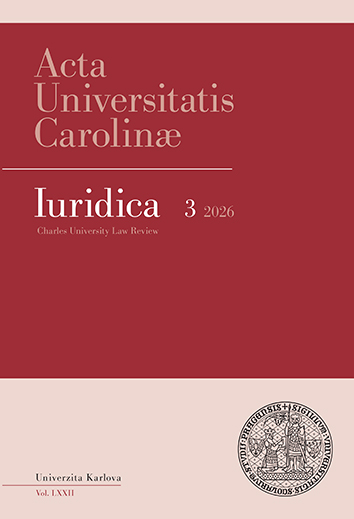
Acta Universitatis Carolinae Iuridica (AUCI) is the main journal of the Faculty of Law of Charles University. It has been published since 1954 and is one of the traditional law journals with a theoretical focus.
As a general law journal, it publishes longer studies and shorter articles on any relevant issues in legal theory and international, European and national law. AUCI also publishes material relating to current legislative issues. AUCI is a peer-reviewed journal and accepts submissions from both Czech and international authors. Contributions by foreign authors are published in their original language – Slovak, English, German, French.
AUCI is a theoretical journal for questions of state and law. It is published by Charles University in Prague, Faculty of Law, through Karolinum Press. It is published four times a year, the dates of publication can be found here.
Articles published in AUCI undergo an independent peer review process, which is anonymous on both sides. Reviewers from the field give their opinion on the scientific quality of the paper and the suitability of publication in the journal. In the case of comments, the opinion is sent back to the author with the possibility of revising the text (see Guidelines for Authors – Per Review Process for more details).
The AUCI journal (ISSN 0323-0619) is registered in the Czech National Bibliography (kept by the National Library of the Czech Republic) and in the Index to Foreign Legal Periodicals (kept by the American Association of Law Libraries). AUCI has been assigned a periodical registration number MK E 18585.
In 2021 the journal AUCI was the first journal of the Faculty of Law of Charles University to be included in the prestigious international database Scopus. This Elsevier database is the largest abstract and citation database of peer-reviewed literature in the world. The editors of the journal expect from the inclusion in the elite Scopus database not only an increase in the readership of the journal, but also an increase in interest in the publication of papers by both Czech and foreign authors.
AUCI is an open journal and all its content is published both on the faculty website and on the Karolinum Press website. Access to it is free of charge. The homepage of AUCI is on the Karolinum Press website.
The AUCI journal uses the Creative Commons license: CC BY 4.0.
Long-term archiving of the digital content of the journal is provided by Portico.
AUC IURIDICA, Vol 12 No 3 (1965), 215–235
ArticleGrafické znázornění v právu
[Graphical Demonstration in Law]
Adolf Dolenský
DOI: https://doi.org/10.14712/23366478.2026.27
published online: 10. 02. 2021
abstract
I. The first part deals in a general way with the means of graphical demonstration. The sphere of investigation is limited to graphs based on (enumeration according to the graphical means employed): 1. the oriented straight line pict. 1, 2 2: the abscissa – pict. 3, 4, 5 – 3. square formations – pict. 6, 7, 8, 9 – 4. connections between a number of elements – pict. 12, 13, 14 5. tabular graphs – pict. 15, 16 – 6. cartograms. These graphs can be used in legal science for the purpose of demonstrating (enumeration according to the demonstrated objects): 1. the division of a total into its parts, 2. the mutual comparison of certain totals with regard to their parts, 3. other mutual relations between juridical notions, 4. the demonstration of' a sequence in time, 5. the territorial dispersion. The purpose, which these graphical means can serve, can be: 1. a communicative one, 2. a pedagogical one, 3. that of modelling juridical considerations, 4. a cognitive one (in a double sense: exceptionally these means can directly help to find out new connections, normally they help indirectly to facilitate the orientation in the matter). Among these purposes the most important is the pedagogical one, which is treated in part II. The graphical demonstration has the character of a special language in the sense logic gives to this word. Its precision is based upon the convention concerning the coordination between the set of juridical notions and the set of graphical elements. The graphical demonstration simplifies its model; this can be interpreted as: a) a lack of completion, b) as a distortion caused by the technics of drawing, c) as the isolation of certain features, d) as the stressing of what is essential. The cases c) and d) cannot be regarded as deficiencies of graphical methods; the contrary is true in this case. If the graphical demonstration has to be applied within the mentioned limits, certain conditions have however to be respected. II. The intuitive character of graphs will find a good application in the instruction. The graphical demonstration belongs to the so called indirect intuitiveness. The author argues then against some objections against the extension of intuitive methods to the instruction of legal science in the universities; he quotes examples of cases when intuitive methods have given good results and he draws the attention to the fact that a certain simplification is necessary in the instruction and is proper to every didactical means. He disagrees with the objection that the graphical demonstration would draw the attention away from essential problems to secondary ones. He agrees however with the objection that the means in question have an unilateral character and he rejects intuitive methods in their more primitive forms. The sphere within which graphs can be used in law is naturally a smaller one than it is in technical-sciences. The author has prepared simultaneously a manual of penal law and of penal procedure and he intends to prove practically in his manual that the possibilities of these methods are much wider than their actual utilization. As far as more complicated graphical means are concerned, one cannot suppose that the student would make them out successfully by himself. The author remarks in his conclusion that the neglecting of graphical demonstration in law is caused by a long tradition and by the way in which lawyers acquire their instruction. Even if graphical demonstration has but limited possibilities in law, it is necessary to utilize those possibilities as much as possible.

Grafické znázornění v právu is licensed under a Creative Commons Attribution 4.0 International License.
157 x 230 mm
periodicity: 4 x per year
print price: 65 czk
ISSN: 0323-0619
E-ISSN: 2336-6478