
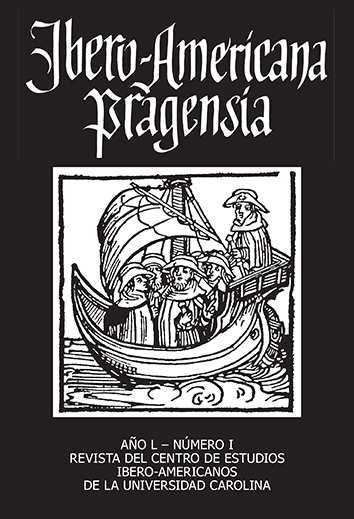
Ibero-Americana Pragensia is a professional peer-reviewed journal, originally a yearbook, which has been published twice a year since 2017. The magazine focuses on the history and culture of Latin America, as well as on relations between the Western world and Latin America. It publishes scholarly studies, short articles, essays, annotated archival materials and reports on conferences as well as reviews of specialized literature and cultural events. All the published texts are authorial. Scholarly studies and essays are subject to review. The journal publishes texts of various methodological and thematic focus (e.g., history, literary science, linguistics, ethnology, political science, art history, translation studies, etc.), as well as annotated archival materials related to Latin American studies. It puts emphasis on primary research and is intended primarily for the professional public. The texts are published in Spanish, Portuguese and English. The objective of the journal is to raise public awareness of Latin American studies as a field, to profile it and to serve as a professional communication platform for controversies and discussions and, at the same time, what is happening in Latin America and its international relations and, hence, to contribute to a more detailed understanding of this region, its history and its culture.
The yearbook Ibero-Americana Pragensia was founded in 1967 as the first periodical published in the Spanish language in Central and Eastern Europe. The yearbook has gradually gained considerable prestige and since the early 1990s has been regularly mentioned in one of the most respected bibliographic journals, the Revista Interamericana de Bibliografía, published by the Organization of American States. The yearbook has been registered by the Ministry of Culture of the Czech Republic as a reviewed title since 2008, and since 2017 has been peer-reviewed and published twice a year. The director of the magazine is Prof. PhDr. Josef Opatrný, CSc., the editor-in-chief PhDr. Simona Binková, CSc., and the executive editor Mgr. Monika Brenišínová, Ph.D. The magazine is led by the executive editor together with an editorial collective composed of scholars from Czech universities. The scholarly and professional level of the journal is further supervised by an international advisory board, which consists of academics from leading foreign universities.
Scholarly studies, short articles and essays are published after the double-blind peer review procedure and acceptance by the editorial board. Professional reviewers are scholars from domestic and foreign universities. The journal is open to cooperation and welcomes scholarly studies, short articles and essays, as well as reports from conferences and projects and reviews. Please send texts to email: monika.brenisinova@ff.cuni.cz.
Ibero-Americana Pragensia es una revista profesional bajo el sistema de revisión por pares, originalmente un anuario, que se publica dos veces al año desde 2017. La revista se centra en la historia y la cultura de América Latina, así como en las relaciones entre el mundo occidental y América Latina. Publica artículos y estudios breves especializados, fuentes y referencias, así como informes de conferencias o reseñas tanto de libros como de eventos culturales. Todos los textos publicados pertenecen a sus autores. Los artículos de expertos y los estudios breves están sujetos a revisión. Se pone énfasis en investigaciones primarias. La revista publica textos de diversos enfoques metodológicos y temáticos (historia, ciencia literaria, lingüística, etnología, ciencias políticas, historia del arte, estudios de traducción, etc.), así como fuentes relacionadas con la temática iberoamericana. Está destinada principalmente al público profesional. Los textos se publican en español, inglés y portugués. El objetivo de la revista es dar a conocer la Iberoamericanística como disciplina científica, perfilarla y servir como plataforma de comunicación y discusión, dar a conocer lo que está sucediendo en América Latina y las relaciones internacionales con la región para contribuir así a un conocimiento más profundo de esta región, su historia y cultura.
El anuario Ibero-Americana Pragensia fue fundado en 1967 como la primera publicación periódica en español en Europa Central y Oriental. El anuario, publicado como un título revisado por pares académicos, ganó gradualmente un prestigio considerable y desde principios de la década de los noventa del siglo XX ha sido mencionado regularmente en una de las revistas bibliográficas más respetadas, Revista Interamericana de Bibliografía, publicada por la Organización de los Estados Americanos. Desde 2008, el anuario ha sido registrado por el Ministerio de Cultura de la República Checa como revista científica. En 2017, la revista comenzó a publicarse dos veces al año y los estudios profesionales se someten a la revisión anónima bajo la metodología de doble ciego. El director de la revista es el prof. PhDr. Josef Opatrný, CSc., la jefa de la redacción es PhDr. Simona Binková, CSc., y la redactora ejecutiva es Mgr. Monika Brenišínová, Ph.D. La revista está dirigida por la editora ejecutiva junto con el consejo de redacción, que actúa como un órgano asesor más amplio y está compuesto por expertos nacionales de las principales universidades checas. El nivel profesional de la revista es supervisado, además, por un consejo asesor, que está formado por expertos de prestigiosas universidades extranjeras.
Los artículos especializados se publican después de la revisión anónima por parte de dos evaluadores con la aceptación por parte del consejo de redacción. Los evaluadores son expertos de universidades nacionales y extranjeras. La revista está abierta a la cooperación y acepta tanto artículos profesionales como estudios breves, así como informes de congresos, proyectos y reseñas. Los textos deben enviarse al correo electrónico: monika.brenisinova@ff.cuni.cz.
IBERO-AMERICANA PRAGENSIA, Vol 50 No 1 (2022), 115–132
ArticleMaking Mayan Myths: Fragments of New World Civilizations and the Epistemological Turn by José Luis Escalona Victoria, Ciudad de México
José Luis Escalona Victoria
DOI: https://doi.org/10.14712/24647063.2025.15
published online: 13. 04. 2026
abstract
The nineteenth century interest in the exotic spread along new scientific fields, as an epistemological turn, a radical change in people’s interpretation of the spatiotemporal order of things. This article outlines some changes in perceptions of ancient writings preserved in archives in Europe and America, the spoken languages and the ruined monuments buried under the jungle in Mexico and Central America, under the early interpretations focused on mythology.
keywords: anthropology; epistemological turn; mythology; the Maya; Mexico; Guatemala
references (41)
1. ACHIM, Miruna, From Idols to Antiquity. Forging the National Museum of Mexico, Lincoln: University of Nebraska Press, 2017. CrossRef
2. BEAUDRY-CORBETT, Marilyn - HARDY, Hellen T. (editors), Early Scholars Visits' to Central America, Reports by Karl Sapper, Walter Lehmann and Franz Termer, Los Angeles: Cotsen Institute of Archaeology & University of California, 2000. CrossRef
3. BRINTON, Daniel G., "Memoir of Dr. C. H. Berendt", Proceedings of the American Antiquarian Society, 3, 1884, pp. 205-210.
4. CALDERÓN, Joseph Antonio, "Informe (1784)", in: Ricardo Castañeda Paganini (ed.), Las Ruinas de Palenque, Guatemala: Tipografía Nacional, 1946, pp. 22-29.
5. CASTAÑEDA PAGANINI, Ricardo (ed.), Las Ruinas de Palenque, Guatemala: Tipografía Nacional, 1946.
6. COE, Michael D., Breaking the Maya Code, NY: Thames & Hudson, Third Edition, 2012 [First Edition, 1992]. CrossRef
7. CHINCHILLA, Rosa Helena, "Introducción", in: Francisco Ximénez, Arte de las tres lenguas kaqchiquel, k'iche' y tz'utujil, sf. Mcs, Chicago: The Newberry Library, & Academia de Geografía e Historia de Guatemala (Biblioteca Goathemala, volumen XXXI), 1993, pp. IX-XXXII.
8. DUPAIX, Guillaume - CASTANEDA, José Luciano (illustr.), Antiquités mexicaines. Relation des trois Expéditions du Capitaine Dupaix, ordonnées en 1805, 1806, et 1807, pour la Recherche des Antiquités du Pays, notamment celles de Mitla et de Palenque…, Paris: Jules Didot, Printed for the Bureau des Antiquités Mexicaines, 1834.
9. DURKHEIM, Émile, Les formes élémentaires de la vie religieuse. Le système totémique en Australie, Paris: Les Presses universitaires de France, 1968 [1912].
10. FRAZER, James George, The Golden Bough: A Study in Comparative Religion, Cambridge: Cambridge University Press, 2012 [1890]. CrossRef
11. LÓPEZ, Omar, Nociones sobre los primeros pobladores del sureste: la representación del "indio" en el pensamiento de exploradores, eruditos y viajeros en la provincia de Chiapa, (1784-1840), [Unpublished Ph.D. Dissertation], Ciudad de México: Universidad Nacional Autónoma de México, 2021.
12. OROZCO Y BERRA, Manuel, Geografía de las lenguas y carta etnográfica de México: precedidas de un ensayo de clasificación de las mismas lenguas y de apuntes para las inmigraciones de las tribus, Ciudad de México: J. M. Andrade y F. Escalante, 1864.
13. PIMENTEL, Francisco, Cuadro descriptivo y comparativo de las lenguas indígenas de México o tratado de filología mexicana, Ciudad de México: Sociedad Mexicana de Geografía y Estadística, 1874.
14. PHILLIPS, Philip, "Alfred Marsten Tozzer, 1877-1954", American Antiquity 21/1, 1955, pp. 72-80. CrossRef
15. RACKNITZ, Joseph Friedrich zu, A Rare Treatise on Interior Decoration and Architecture: Joseph Friedrich zu Racknitz's Presentation and History of the Taste of the Leading Nations by Joseph Friedrich zu Racknitz, (Simon Swynfen Jervis translation and edition), Los Angeles: Getty Research Institute.
16. SCHELLHAS, Paul, "Representation of Deities of the Maya Manuscripts", Papers of the Peabody Museum of American Archaeology and Ethnology IV/1, Cambridge: Harvard University, 1904 [1897, first edition].
17. SCHERZER, Karl von, Las Historias del origen de los Indios de Guatemala, Traducida de las lengua Quiché al castellano para más comodidad de los ministros del S. Evangelio. Por el R. P. F. Francisco Ximenes, Vienna: Casa de Carlos Gerold é Hijo, 1857.
18. STUART, George E., "The Beginning of the Maya Hieroglyphic Study: Contributions of Constantine S. Rafinesque and James H McCulloch, Jr.", Washington: Research Reports on Ancient Maya Writing 29, 1989.
19. SUKIKARA, Fumiko, Formación y transformación en la narrativa del Popol Vuh: las publicaciones y las prácticas de traducción al japonés, 1928-1971 [Unpublished Master Thesis], Ciudad de México: Universidad Autónoma de Chiapas, 2019.
20. TOZZER, Alfred, Landa's Relacion de las Cosas de Yucatan, a Translation (with 1154 Notes and Syllabus), Cambridge: Peabody Museum Papers, 1941.
21. TOZZER, Alfred, A comparative Study of the Mayas and the Lacandones, Report of the Fellow of American Archaeology, 1902-1905, New York: Archaeological Institute of America, 1907.
22. TYLOR, Edward Burnett, Primitive Culture: Researches into the Development of Mythology, Philosophy, Religion, Art, and Custom, Cambridge: Cambridge University Press, 2010 [1871]. CrossRef
23. WEEKS, John M., "The Daniel Garrison Brinton Collection", in: The Penn Library Collections at 250: From Franklin to the Web, Philadelphia: University of Pennsylvania Library, 2000, pp. 165-181.
24. WOLFE, Elizabeth F., "Contributions of Karl Hermann Berendt to Central American Anthropology", Kroeber Anthropological Society Papers 61-62, 1982, pp. 1-19.
25. ALMENDARIZ, Ricardo, Colección de Estampas Copiadas de las Figuras … de Chiapas, una de las del Reyno de Guatemala en la América Septentrional, Palenque, in The Jay I. Kislak Collection, The Rare Book and Special Collections Division, The Library of Congress, [on-line], Ciudad de México: 1787. Internet Archive, [Consulted 31 March, 2021]. Accessible from: http://lcweb2.loc.gov/cgi-bin/ampage?collId=rbc3&fileName=rbc0001_2005kislak1page.db&recNum=0.
26. BERENDT, Karl H., Report of Explorations in Central America (= Annual Report of the Smithsonian Institution for 1867, pp. 420-426). [on-line], Washington: 1867. Internet Archive, [Consulted 31 March 2021]. Accessible from: https://babel.hathitrust.org/cgi/pt?id=uc1.a0005998810&view=image&seq=1&q1=Berendt.
27. BRASSEUR DE BOURBOURG, Charles Etienne, Popol Vuh. Le Livre Sacré et les Mythes de I'Antiquité Américaine, [on-line], Paris: Arthus Bertrand, 1861. Internet Archive, [Consulted 31 March 2021]. Accessible from: https://archive.org/details/CollectionDeDocumentsDansLesLangues/page/n13/mode/2up.
28. BRINTON, Daniel G., The Myths of The New World: A Treatise on the Symbolism and Mythology of the Red Race of America, [on-line], New York & London: Leypoldt & Holt & Trubner & Co., 1868. Internet Archive, [Consulted 31 March 2021]. Accessible from: http://www.gutenberg.org/files/19347/19347-0.txt.
29. BRINTON, Daniel G., The Names of the Gods in the Kiche Myths, Central America, Proceedings of the American Philosophical Society, Vol. 19, pp. 613-647, [on-line], Philadelphia, 1881. Internet Archive, [Consulted 31 March 2021]. Accessible from: https://archive.org/details/jstor-982803.
30. COTO, Thomas, Vocabulario de la lengua Cakchiquel, v, Guatimalteca / nuevamente hecho y recopilado con fummo estudio, traujo y erudicio por el Pe. F. Thomas Coto, predicador y padre de esta Prouja. de el S.Smo. Nombre de Jesus de Guatimala / en que se contienen todos los modos y frases elegantes con que los naturalas la hablan y dq. fe pueden valer los ministros estudiossos para su mejor educacion y enseñanza, / Tomás Coto, 1651, [on-line], MSS 279 Series 8 Sub-Series 2 Sub-Series 1, Box: 36, Folder: 1. William Gates papers, MSS 279. L. Tom Perry Special Collections. Internet Archive, [Consulted 31 March 2021]. Accessible from: http://archives.lib.byu.edu/repositories/14/archival_objects/53726.
31. CHARENCEY, Hyacinthe de [Charles-Félix-Hyacinthe Gouhier], "Recherches sur le Lois phonétiques dans les idiomes de la famille Mame-Huastèque", [on-line], Revue de linguistique et de philologie comparée, tome 5, 1872, pp. 129-167. Internet Archive, [Consulted 31 March 2021]. Accessible from: https://fr.wikisource.org/wiki/Livre:Revue_de_linguistique_et_de_philologie_compar%C3%A9e,_tome_5.djvu.
32. GANN, Thomas W. F., The Maya Indians of southern Yucatan and northern British Honduras, [on-line], Washington: Smithsonian Institution, Bureau of American Ethnology, BULLETIN 64, 1918. Internet Archive, [Consulted 31 March 2021]. Accessible from: http://www.gutenberg.org/ebooks/46973.
33. HERVÁS Y PANDURO, Lorenzo, Catalogo delle lingue conosciute e notizia della loro affinita e diversita. Opera del signor abbate Don Lorenzo Hervas, [on-line], Italia: Cesena, Gregorio Biasini, 1784. Internet Archive, [Consulted 31 March 2021]. Accessible from: http://bdh-rd.bne.es/viewer.vm?id=0000046751&page=1.
34. HERVÁS Y PANDURO, Lorenzo, Catálogo de las lenguas de las naciones conocidas, y numeración, división, y clases de éstas según la diversidad de sus idiomas y dialectos, [on-line], Madrid: Imprenta de la Administración del Real Arbitrio de Beneficencia, 1800. Internet Archive, [Consulted 31 March 2021]. Accessible from: http://www.cervantesvirtual.com/obra-visor/catalogo-de-las-lenguas-de-las-naciones-conocidas-y-numeracion-division-y-clases-de-estas-segun-la-diversidad-de-sus-idiomas-y-dialectos-volumen-1-lengua-y-naciones-americanas--0/html/01d25bf6-82b2-11df-acc7-002185ce6064_9.htm.
35. HUMBOLDT, Alexander von, Vues des cordillères, et monumens des peuples indigènes de l'Amérique, [on-line], Paris: F. Schoell, 1810. Internet Archive, [Consulted 31 March 2021]. Accessible from: https://gallica.bnf.fr/ark:/12148/bpt6k61301m/f1.item.texteImage.
36. RÍO, Antonio del, Description of the Ruins of an Ancient City, Discovered near Palenque, in the Kingdom of Guatemala in Spanish America, [on-line], London: Henry Bertoud, 1922. Internet Archive, [Consulted 31 March 2021]. Accessible from: https://babel.hathitrust.org/cgi/pt?id=hvd.32044095049060&view=image&seq=1.
37. SELER, Eduard, et al., Mexican and Central American Antiquities, Calendar Systems, and History, [on-line], Washington: Smithsonian Institution, Bureau of American Ethnology, 1904. Internet Archive, [Consulted 31 March 2021]. Accessible from: https://antropowiki.alterum.info/index.php/Eduard_Seler.
38. SELER, Eduard, On the present state of our knowledge of the Mexican and Central American hieroglyphic writing, [on-line], Transactions of the International Congress of Americanists, Austin: University of Texas, 1902. Internet Archive, [Consulted 31 March 2021]. Accessible from: https://antropowiki.alterum.info/index.php/Eduard_Seler.
39. STEPHENS, John L. - CATHERWOOD, Fredrich, Incidents of Travel in Central America, Chiapas and Yucatan, [on-line], London: Arthur Hall, Virtue & Co., 1854 [1841]. Internet Archive, [Consulted 31 March 2021]. Accessible from: https://commons.wikimedia.org/wiki/File:Incidents_of_travel_in_Central_America,_Chiapas_and_Yucatan.pdf. CrossRef
40. TURNER, Olivia Horsfall, "World views - revisiting an 18th-century survey of global style, Review of A Rare Treatise on Interior Decoration and Architecture: Joseph Friedrich zu Racknitz's Presentation and History of the Taste of the Leading Nations by Joseph Friedrich zu Racknitz (edited and translated by Simon Swynfen Jervis)", [on-line], Apollo, the 9th of July 2020. Internet Archive, [Consulted 31 March 2021]. Accessible from: https://www.apollo-magazine.com/joseph-friedrich-zu-racknitz-book-review.
41. WALDECK, Fréderic, Voyage pittoresque et archeologique dans la province d' Yucatan (Amérique centrale), pendant les anneés 1834 et 1836, [on-line], Paris: Bellizard Dufour Et Co., Éditeurs, 1838. Internet Archive, [Consulted 31 March 2021]. Accessible from: ttp://www.cervantesvirtual.com/obra/voyage-pittoresque-et-archeologique-dans-la-province-dyucatan-amerique-centrale-pendant-les-annees-1834-et-1836-986066.

Making Mayan Myths: Fragments of New World Civilizations and the Epistemological Turn by José Luis Escalona Victoria, Ciudad de México is licensed under a Creative Commons Attribution 4.0 International License.
157 x 230 mm
periodicity: 2 x per year
print price: 160 czk
ISSN: 0536-2520
E-ISSN: 2464-7063