
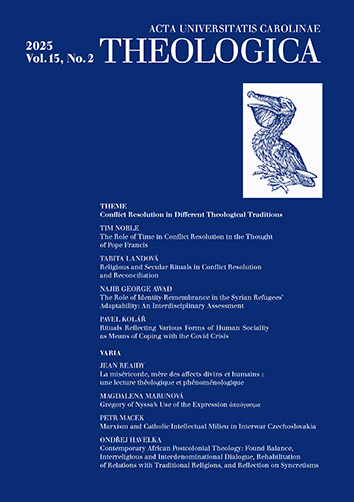
AUC Theologica is a peer-reviewed journal for theology published twice a year. As we publish original papers in English, German, French, and Italian, our mission is to serve as a platform both for Czech researchers, who can present their research results in these languages, and for international contributors, who are invited to enter the academic theological discussion in the heart of Europe.
The journal focuses on a wide range of theological disciplines, such as systematic theology, biblical studies, patristic studies, pastoral and spiritual theology, religious education, church history, etc. Within these fields, the journal seeks to reflect the current theological questions and problems, which often requires interdisciplinary approaches. Supporting the intersection of various theological disciplines, we thus also welcome theological papers touching other academic fields including philosophy, sociology, literary studies, and science.
Each issue consists of two sections. The thematic section presents papers of the same focus. The section called ‘Varia’ invites papers dealing with various theological themes from the perspective of all Christian traditions. Our current and past issues are approachable for free on this website in the form of Open Access.
AUC THEOLOGICA, Vol 15 No 2 (2025), 113–132
ArticleGregory of Nyssa’s Use of the Expression ἀπαύγασμα
Magdalena Marunová
DOI: https://doi.org/10.14712/23363398.2026.18
published online: 19. 05. 2026
abstract
This study examines the use of the term ἀπαύγασμα in the writings of Gregory of Nyssa, with particular attention to its semantic flexibility and theological function across different doctrinal contexts. Focusing on Gregory’s exegetical, ascetical, Trinitarian, and Christological texts, the article aims to show how the imagery of radiance and reflection serves to articulate the relation between divine transcendence and manifestation while safeguarding the incomprehensibility of the divine essence. Special emphasis is placed on Gregory’s polemical use of ἀπαύγασμα in his anti-Eunomian and anti-Apollinarian writings, where the term becomes a precise conceptual tool for defending the co-eternity and consubstantiality of the Son with the Father, as well as the integrity of Christ’s two natures. The study argues that Gregory’s disciplined interpretation of this biblical metaphor exemplifies the pro-Nicene integration of scriptural exegesis and systematic theological reasoning.
keywords: Gregory of Nyssa; ἀπαύγασμα; radiance and reflection; Trinitarian theology; pro-Nicene theology; divine causality; incomprehensibility of God; Christologyood; Filiation; Compassion; Suffering community; Intersubjectivity

Gregory of Nyssa’s Use of the Expression ἀπαύγασμα is licensed under a Creative Commons Attribution 4.0 International License.
148 x 210 mm
periodicity: 2 x per year
print price: 100 czk
ISSN: 1804-5588
E-ISSN: 2336-3398