
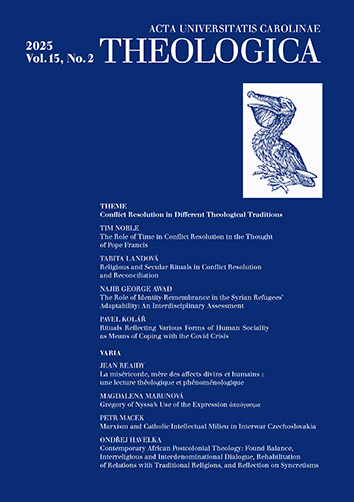
AUC Theologica is a peer-reviewed journal for theology published twice a year. As we publish original papers in English, German, French, and Italian, our mission is to serve as a platform both for Czech researchers, who can present their research results in these languages, and for international contributors, who are invited to enter the academic theological discussion in the heart of Europe.
The journal focuses on a wide range of theological disciplines, such as systematic theology, biblical studies, patristic studies, pastoral and spiritual theology, religious education, church history, etc. Within these fields, the journal seeks to reflect the current theological questions and problems, which often requires interdisciplinary approaches. Supporting the intersection of various theological disciplines, we thus also welcome theological papers touching other academic fields including philosophy, sociology, literary studies, and science.
Each issue consists of two sections. The thematic section presents papers of the same focus. The section called ‘Varia’ invites papers dealing with various theological themes from the perspective of all Christian traditions. Our current and past issues are approachable for free on this website in the form of Open Access.
AUC THEOLOGICA, Vol 15 No 1 (2025), 35–56
ArticleOrthodox Spiritual Resistance Through the Eucharist in Romanian Communist Prisons
Mihail Khalid Qaramah
DOI: https://doi.org/10.14712/23363398.2026.3
published online: 16. 03. 2026
abstract
The paper explores how Holy Communion was administered and the Eucharist was celebrated among political prisoners of the Orthodox faith in Romanian communist prisons. The main information is taken from memoirs of those who survived the Romanian gulag, but some informative notes found in the funds of the National Council for the Study of the Securitate Archive also contain interesting details that complete the picture of the liturgical act in detention. Priests had to face several practical and liturgical constraints, such as the lack of Eucharistic elements in accordance with Orthodox practice, the absence of liturgical vestments and objects that had to be improvised, and the difficulty of preserving and distributing the Holy Gifts, which had to be protected from profanation. The harsh conditions also led some ministers to step back from certain liturgical rigors that are usually obligatory. Moreover, given the state of shared suffering, on a few occasions confessional barriers were ignored and inter-communion celebrations took place.
keywords: Romanian gulag; Divine liturgy; Communion; Ecumenism; Political detainees

Orthodox Spiritual Resistance Through the Eucharist in Romanian Communist Prisons is licensed under a Creative Commons Attribution 4.0 International License.
148 x 210 mm
periodicity: 2 x per year
print price: 100 czk
ISSN: 1804-5588
E-ISSN: 2336-3398