
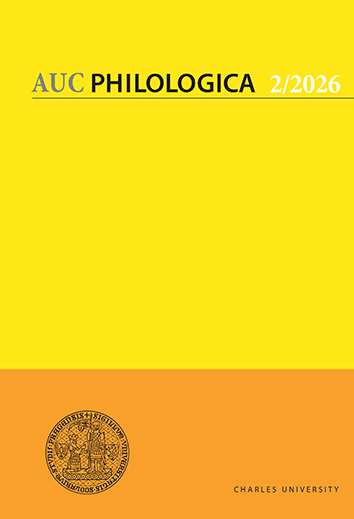
AUC Philologica (Acta Universitatis Carolinae Philologica) is an academic journal published by Charles University. It publishes scholarly articles in a large number of disciplines (English, German, Greek and Latin, Oriental, Romance and Slavonic studies, as well as in phonetics and translation studies), both on linguistic and on literary and cultural topics. Apart from articles it publishes reviews of new academic books or special issues of academic journals.
The journal is indexed in CEEOL, DOAJ, EBSCO, ERIH PLUS, and Scopus.
AUC PHILOLOGICA, Vol 2026 No 2 (2026), 13–27
ArticleVers une pédagogie critique du roman noir : polyphonie, subversion et enjeux didactiques en français langue étrangère
[Towards a critical pedagogy of the noir novel: exploring polyphony, stylistic subversion, and didactic insights in French as a foreign language]
Niv N. Schvartz
DOI: https://doi.org/10.14712/24646830.2026.10
published online: 16. 10. 2026
abstract
This article explores noir fiction as a critical and pedagogical framework for the teaching of French as a foreign language, proposing that this genre transcends its conventional association with crime and marginality to serve as a dynamic discursive laboratory. Within this space, linguistic, aesthetic, and ideological norms are incessantly contested, subverted, and reimagined. Situated at the nexus of literary studies, sociolinguistics, and critical pedagogy, we contend that noir functions as a heteroglossic arena where language ceases to be a transparent conduit of communication and instead emerges as a contested terrain shaped by multiple voices and shifting registers. Drawing upon the theoretical insights of Barthes, Bakhtin, Bourdieu, and post-structuralist discourse, this study elucidates how noir literature foregrounds linguistic hybridity and polyphony as strategies to destabilize dominant discourses. By interweaving sociolects, argot, bureaucratic registers, and poetic distortions, the noir narrative disrupts hierarchies of linguistic legitimacy, thereby creating a critical space for engaging language as a locus of power, identity, and symbolic transformation. From a pedagogical standpoint, we advocate for a “pedagogy of uncertainty” – an approach that valorizes ambiguity, contestation, and interpretive openness. This is operationalized through diverse classroom methodologies including reverse analysis workshops, rewriting exercises in marginalized vernaculars, performative debates, and reflective writing on linguistic exclusion. Ultimately, noir fiction invites educators and learners alike to reconceptualize language education as a space of epistemic dissonance and semiotic emancipation – a horizon where meaning is co-constructed rather than imposed, and where learning becomes an aesthetic and critical encounter with alterity.
keywords: Linguistic Subversion; Pedagogy of Uncertainty; Heteroglossia; Discursive Destabilization; Language awareness; Narrative Polyphony; Sociolinguistic Hybridity; Performativity of Language
references (27)
1. Abdallah-Pretceille, Martine (1986). Vers une pédagogie interculturelle. Paris : Publications de la Sorbonne et de l'Institut national de recherche pédagogique.
2. Albert, Marie-Claude - Souchon, Marc (2000). Les textes littéraires en classe de langue. Paris : Hachette.
3. Bakhtine, Mikhaïl (1978). Esthétique et théorie du roman. Paris : Seuil.
4. Barthes, Roland (1953). Le Degré zéro de l'écriture. Paris : Seuil.
5. Bemporard, Chiara - Jeanneret, Thérèse (éd., 2007). Études de Lettres, n° 4, Lectures littéraires et appropriation des langues étrangères. Lausanne : Faculté des Lettres de l'Université de Lausanne. CrossRef
6. Benveniste, Émile (1966). Problèmes de linguistique générale. Paris : Gallimard.
7. Berthelier, Vincent (2024). « Du titi au truand : argot et effet d'argot dans le roman noir français d'après la Libération », dans Andreas Dufter - Susanne Zepp-Zwirner (éd.), La Langue du peuple dans la littérature : Le français populaire mis en texte, de l'âge classique à nos jours. Berlin : De Gruyter, p. 131-143. CrossRef
8. Bourdieu, Pierre (1979). La Distinction. Paris : Les Éditions de Minuit.
9. Bourdieu, Pierre (1982). Ce que parler veut dire. L'économie des échanges linguistiques. Paris : Fayard.
10. Dard, Frédéric (1980). À prendre ou à lécher. Paris : Fleuve Noir.
11. Genette, Gérard (1972). Figures III. Paris : Seuil.
12. Glissant, Édouard (2009). Philosophie de la Relation. Poésie en étendue. Paris : Gallimard.
13. Gorrara, Claire (2003). The Roman Noir in Post-war French Culture: Dark Fiction. New York : Oxford University Press. CrossRef
14. Izzo, Jean-Claude (1995). Total Khéops. Paris : Gallimard.
15. Maingueneau, Dominique (2004). Le Discours littéraire : Paratopie et scène d'énonciation. Paris : Armand Colin.
16. Maingueneau, Dominique (2016). Trouver sa place dans le champ littéraire : Paratopie et création. Louvain-la-Neuve : Academia.
17. Manchette, Jean-Patrick (1972). Nada. Paris : Gallimard.
18. Manchette, Jean-Patrick (1981). La Position du tireur couché. Paris : Gallimard.
19. Manotti, Dominique (2007). « Roman noir ». Le Mouvement social, no 219-220, p. 107-109. CrossRef
20. Meschonnic, Henri (1991). Des mots et des mondes. Paris : Hatier.
21. Mouralis, Bernard (1975). Les contre-littératures. Paris : Presses Universitaires de France.
22. Naudillon, Françoise (2011). « Polar africain et subversion langagière », dans Musanji Ngalasso-Mwatha (dir.), L'Imaginaire linguistique dans les discours littéraires, politiques et médiatiques en Afrique. Pessac : Presses Universitaires de Bordeaux, p. 349-365. CrossRef
23. Poslaniec, Christian - Houyel, Christine (2001). Activités de lecture à partir de la littérature policière. Paris : Hachette Éducation.
24. Pouy, Jean-Bernard - Delestré, Stéfanie (2009). Une brève histoire du roman noir. Paris : L'Oeil neuf éditions, coll. « Brève histoire ».
25. Rastier, François (1987). Sémantique interprétative. Paris : Presses Universitaires de France, coll. « Formes sémiotiques ».
26. Reuter, Yves (1986). « Les paralittératures : problèmes théoriques et pédagogiques ». Pratiques : linguistique, littérature, didactique, n° 50, p. 3-21. CrossRef
27. Riquois, Estelle (2008). « La littérature policière en classe de français langue étrangère, un support original et motivant ». Le Langage et l'Homme, vol. XXXXIII, no 1, p. 5-14.

Vers une pédagogie critique du roman noir : polyphonie, subversion et enjeux didactiques en français langue étrangère is licensed under a Creative Commons Attribution 4.0 International License.
157 x 230 mm
periodicity: 3 x per year
print price: 150 czk
ISSN: 0567-8269
E-ISSN: 2464-6830