
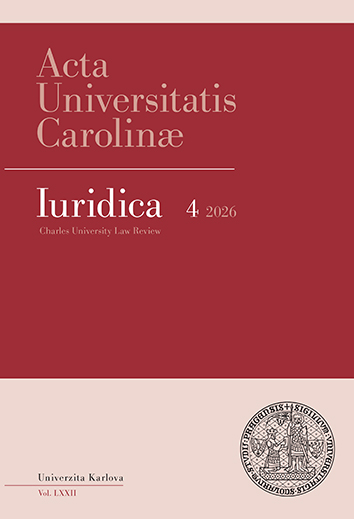
Acta Universitatis Carolinae Iuridica (AUCI) is the main journal of the Faculty of Law of Charles University. It has been published since 1954 and is one of the traditional law journals with a theoretical focus.
As a general law journal, it publishes longer studies and shorter articles on any relevant issues in legal theory and international, European and national law. AUCI also publishes material relating to current legislative issues. AUCI is a peer-reviewed journal and accepts submissions from both Czech and international authors. Contributions by foreign authors are published in their original language – Slovak, English, German, French.
AUCI is a theoretical journal for questions of state and law. It is published by Charles University in Prague, Faculty of Law, through Karolinum Press. It is published four times a year, the dates of publication can be found here.
Articles published in AUCI undergo an independent peer review process, which is anonymous on both sides. Reviewers from the field give their opinion on the scientific quality of the paper and the suitability of publication in the journal. In the case of comments, the opinion is sent back to the author with the possibility of revising the text (see Guidelines for Authors – Per Review Process for more details).
The AUCI journal (ISSN 0323-0619) is registered in the Czech National Bibliography (kept by the National Library of the Czech Republic) and in the Index to Foreign Legal Periodicals (kept by the American Association of Law Libraries). AUCI has been assigned a periodical registration number MK E 18585.
In 2021 the journal AUCI was the first journal of the Faculty of Law of Charles University to be included in the prestigious international database Scopus. This Elsevier database is the largest abstract and citation database of peer-reviewed literature in the world. The editors of the journal expect from the inclusion in the elite Scopus database not only an increase in the readership of the journal, but also an increase in interest in the publication of papers by both Czech and foreign authors.
AUCI is an open journal and all its content is published both on the faculty website and on the Karolinum Press website. Access to it is free of charge. The homepage of AUCI is on the Karolinum Press website.
The AUCI journal uses the Creative Commons license: CC BY 4.0.
Long-term archiving of the digital content of the journal is provided by Portico.
AUC IURIDICA, Vol 72 No 4 (2026), 43–65
ArticleElectronic Evidence in Criminal Proceedings as a New Challenge for European Judicial Cooperation
Libor Klimek
DOI: https://doi.org/10.14712/23366478.2026.118
published online: 23. 11. 2026
abstract
The increasing digitalisation of contemporary society has fundamentally transformed the nature of criminal investigations and the acquisition of evidence. Electronic data has become an essential source of information in criminal proceedings, while its cross-border character has exposed significant limitations of traditional mechanisms of judicial cooperation in criminal matters. In response to these challenges, the European Union adopted a new legal framework, commonly referred to as the e-Evidence package, centred upon Regulation (EU) 2023/1543 and Directive (EU) 2023/1544. This article examines the legal and constitutional implications of the e-Evidence system from the perspective of European Union law. Particular attention is devoted to the impact of the new framework on the principle of member state sovereignty within the Area of Freedom, Security, and Justice. The article seeks to answer the following research question: To what extent does the e-Evidence system affect the principle of member state sovereignty within the framework of judicial cooperation in criminal matters in the European Union? The analysis is based primarily on the doctrinal method, supplemented by analytical and comparative approaches. The article examines the concept and significance of electronic evidence, traditional mechanisms for obtaining electronic evidence in cross-border cases, the legal framework of e-Evidence, the protection of fundamental rights, and the relationship between e-Evidence and existing European structures of judicial cooperation. The article concludes that the e-Evidence system does not eliminate member state sovereignty but contributes to its transformation within an increasingly integrated European legal order.
keywords: electronic evidence; e-Evidence; judicial cooperation in criminal matters; European Union; member state sovereignty; cross-border criminal proceedings
references (42)
1. ALRAGGAD, M. M. - ALMAHASNEH, A. A. A. A. - BOROVIKOVA, V. - ZHYVKO, Z. - KOMISSARCHUK, Y. The Policy of Rethinking the Criminal Process in the National Security System: The Impact of Digitalisation on Working with Electronic Evidence. Social & Legal Studios [online]. 2024, Vol. 7, No. 2, pp. 162-170 [cit. 2026-05-20]. CrossRef
2. AMBOS, K. (ed.). Europäisches Strafrecht post-Lissabon. Göttingen: Universitätsverlag Göttingen, 2011. CrossRef
3. AMBOS, K. European Criminal Law. Cambridge: Cambridge University Press, 2018. CrossRef
4. ANGEL, O. E. M. et al. Digital Evidence as a Means of Proof in Criminal Proceedings. Russian Law Journal. 2023, Vol. 11, No. 5, pp. 96-105 CrossRef
5. BARNARD, C. - PEERS, S. (eds.). European Union Law. 4th ed. Oxford: Oxford University Press, 2023.
6. BIASIOTTI, M. A. - MIFSUD BONNICI, J. P. - CANNATACI, J. - TURCHI, F. (eds.). Handling and Exchanging Electronic Evidence Across Europe. Cham: Springer, 2018. CrossRef
7. BÖSE, M. (ed.). Europäisches Strafrecht. 2. Aufl. Baden-Baden: Nomos, 2021. CrossRef
8. Consolidated Version of the Treaty on the Functioning of the European Union. Official Journal of the European Union [online]. C 326, 26, 6. 10. 2012 [cit. 2026-05-22]. Available at: https://eur-lex.europa.eu/LexUriServ/LexUriServ.do?uri=CELEX:12012E/TXT:en:PDF.
9. Directive (EU) 2023/1544 of the European Parliament and of the Council of 12 July 2023 Laying Down Harmonised Rules on the Designation of Designated Establishments and the Appointment of Legal Representatives for the Purpose of Gathering Electronic Evidence in Criminal Proceedings. Official Journal of the European Union [online]. L 191, 28. 7. 2023, pp. 181-190 [cit. 2026-05-22]. Available at: https://eur-lex.europa.eu/eli/dir/2023/1544/oj/eng.
10. E-evidence - Cross-Border Access to Electronic Evidence. In: European Commission [online]. [cit. 2026-05-20]. Available at: https://commission.europa.eu/law/cross-border-cases/judicial-cooperation/types-judicial-cooperation/e-evidence-cross-border-access-electronic-evidence_en.
11. Electronic Evidence. In: Eurojust [online]. [cit. 2026-05-22]. Available at: https://www.eurojust.europa.eu/judicial-cooperation/instruments/electronic-evidence.
12. European Commission. Proposal for a Regulation of the European Parliament and of the Council on European Production and Preservation Orders for Electronic Evidence in Criminal Matters, COM(2018) 225 final. In: EUR-Lex: Access to European Union Law [online]. Brussels, 17. 4. 2018 [cit. 2026-05-22]. Available at: https://eur-lex.europa.eu/legal-content/EN/TXT/?uri=celex:52018PC0225.
13. European Commission. Commission Staff Working Document. Impact Assessment Accompanying the Proposal for a Regulation on European Production and Preservation Orders for Electronic Evidence in Criminal Matters and the Proposal for a Directive Laying Down Harmonised Rules on the Appointment of Legal Representatives for the Purpose of Gathering Evidence in Criminal Proceedings. SWD(2018) 118 final. In: EUR-Lex: Access to European Union Law [online]. Brussels, 17. 4. 2018 [cit. 2026-05-22]. Available at: https://eur-lex.europa.eu/legal-content/EN/TXT/?uri=celex:52018SC0118.
14. European Court of Human Rights, Council of Europe. Convention for the Protection of Human Rights and Fundamental Freedoms, as Amended by Protocols Nos. 11, 14 and 15 [online]. Strasbourg [cit. 2026-05-22]. Available at: https://www.echr.coe.int/documents/d/echr/convention_eng.
15. FOMINA, T. H. - RACHYNSKYI, О. О. Електронні докази у кримінальному процесі: проблемні питання теорії та практики [Electronic Evidence in Criminal Proceedings: Problematic Issues of Theory and Practice]. Вісник Харківського національного університету внутрішніх справ [Bulletin of Kharkiv National University of Internal Affairs] [online]. 2023, Vol. 102, No. 3, pp. 207-220 [cit. 2026-05-20]. CrossRef
16. FRANSSEN, V. Cross-Border Gathering of Electronic Evidence in the EU: Toward More Direct Cooperation Under the e-Evidence Regulation. In: MITSILEGAS, V. - BERGSTRÖM, M. - QUINTEL, T. (eds.). Research Handbook on EU Criminal Law. Cheltenham: Edward Elgar Publishing, 2024, pp. 184-185. CrossRef
17. GONZÁLEZ FUSTER, G. - VÁZQUEZ MAYMIR, S. Cross-Border Access to E-Evidence: Framing the Evidence. CEPS Papers in Liberty and Security in Europe, No. 2020-02. Brussels: February 2020.
18. HECKER, B. Europäisches Strafrecht. 7. Aufl. Berlin, Heidelberg: Springer, 2025. CrossRef
19. HECKER, B. Europäisches Strafrecht Post-Lissabon. In: AMBOS, K. (ed.). Europäisches Strafrecht Post-Lissabon. Göttingen: Universitätsverlag Göttingen, 2011, pp. 13-28.
20. Charter of Fundamental Rights of the European Union. Official Journal of the European Union [online]. C 202, 7. 6. 2016, pp. 389-405 [cit. 2026-05-22]. Available at: https://www.europarl.europa.eu/charter/pdf/text_en.pdf.
21. JANSSENS, CH. The Principle of Mutual Recognition in EU Law. Oxford: Oxford University Press, 2013. CrossRef
22. KERR, O. S. Digital Evidence and the New Criminal Procedure. Columbia Law Review [online]. 2005, Vol. 105, No. 1, pp. 279-318.
23. KLIMEK, L. Mutual Recognition of Judicial Decisions in European Criminal Law. Cham: Springer, 2017. CrossRef
24. KLIMEK, L. Základy trestného práva Európskej únie [Fundamentals of European Union Criminal Law]. Bratislava: Wolters Kluwer, 2017.
25. MARSHALL, A. Digital Forensics: Digital Evidence in Criminal Investigations. Chichester: John Wiley & Sons, 2009.
26. MASON, S. - SENG, D. (eds.). Electronic Evidence and Electronic Signatures. 5th ed. London: University of London Press, 2021. CrossRef
27. MITSILEGAS, V. EU Criminal Law After Lisbon: Rights, Trust and the Transformation of Justice in Europe. Oxford, Portland: Hart Publishing, 2018.
28. PAUL, G. L. Foundations of Digital Evidence. Chicago: American Bar Association, 2008.
29. POLYZOIDOU, V. e-Evidence Regulation: A Contemporary Trojan Horse in Criminal Proceedings? In: SYNODINOU, T.-E. et al. (eds.). EU Digital Law in the AI Era. Cham: Springer, 2025, pp. 239-261 [cit. 2026-05-20]. CrossRef
30. Regulation (EU) 2023/1543 of the European Parliament and of the Council of 12 July 2023 on European Production Orders and European Preservation Orders for electronic evidence in criminal proceedings and for the execution of custodial sentences following criminal proceedings. Official Journal of the European Union [online]. 2023, L 191, pp. 118-180 [cit. 2026-05-20]. Available at: https://eur-lex.europa.eu/eli/reg/2023/1543/oj/eng.
31. ROSE, C. - BLOKKER, N. - DAM-DE JONG, D. - VAN DEN DRIEST, S. - HEINSCH, R. - KOPPE, E. - SCHRIJVER, N. An Introduction to Public International Law. Cambridge: Cambridge University Press, 2022. CrossRef
32. SIRIUS: Cross-Border Access to Electronic Evidence. In: Eurojust [online]. [cit. 2026-05-20]. Available at: https://www.eurojust.europa.eu/sirius.
33. SACHOULIDOU, A. Cross-Border Access to Electronic Evidence in Criminal Matters: The New EU Legislation and the Consolidation of a Paradigm Shift in the Area of "Judicial" Cooperation. New Journal of European Criminal Law [online]. 2024, Vol. 15, No. 3, pp. 256-274 [cit. 2026-05-20]. CrossRef
34. SATZGER, H. Internationales und Europäisches Strafrecht. 11. Aufl. Baden-Baden: Nomos, 2025. CrossRef
35. SCANLAN, D. M. Digital Evidence in Criminal Law. Toronto: Canada Law Book, 2011.
36. SHULHA, V. - KALIUZHNA, L. Electronic Evidence in Criminal Procedure: Methods for Its Detection, Investigation and Legal Consolidation. Theory and Practice of Forensic Science and Criminalistics [online]. 2025, Vol. 40, No. 3, pp. 136-152 [cit. 2026-05-20]. CrossRef
37. SHURSON, J. Data Protection and Law Enforcement Access to Digital Evidence: Resolving the Reciprocal Conflicts between EU and US Law. International Journal of Law and Information Technology. 2020, Vol. 28, No. 2, pp. 167-184. CrossRef
38. SIGNORATO, S. Cross-Border Gathering of E-Evidence: Different Legal Frameworks in European Union and Council of Europe. Journal of Eastern European Criminal Law. 2023, Vol. 10, No. 1, pp. 9-18.
39. TOSZA, S. All Evidence Is Equal, But Electronic Evidence Is More Equal Than Any Other. New Journal of European Criminal Law [online]. 2020, Vol. 11, No. 2, pp. 161-183 [cit. 2026-05-20]. CrossRef
40. TURANJANIN, V. EncroChat, Sky ECC and Regulation (EU) 2023/1543: Towards a New Standards of Digital Evidence (I). Journal of Criminology and Criminal Law. 2025, Vol. 63, No. 3, pp. 7-30. CrossRef
41. VOGLER, R. Criminal Evidence and Respect for Fair Trial Guarantees in the Dialogue Between the European Court of Human Rights and National Courts. In: RUGGERI, S. (ed.). Transnational Evidence and Multicultural Inquiries in Europe: Developments in EU Legislation and New Challenges for Human Rights-Oriented Criminal Investigations in Cross-Border Cases. Cham: Springer, 2014, pp. 181-192. CrossRef
42. WARKEN, C. Classification of Electronic Data for Criminal Law Purposes. eucrim [online]. 2018, Vol. 13, No. 4, pp. 226-234 [cit. 2026-05-20]. CrossRef

Electronic Evidence in Criminal Proceedings as a New Challenge for European Judicial Cooperation is licensed under a Creative Commons Attribution 4.0 International License.
157 x 230 mm
periodicity: 4 x per year
print price: 65 czk
ISSN: 0323-0619
E-ISSN: 2336-6478
