
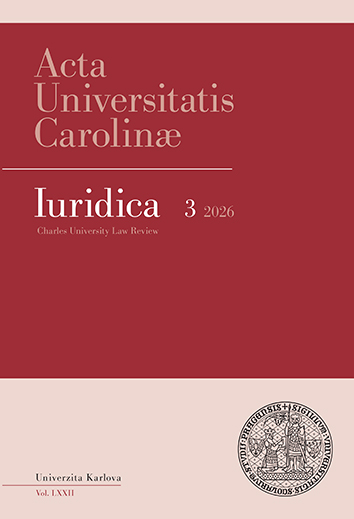
Acta Universitatis Carolinae Iuridica (AUCI) is the main journal of the Faculty of Law of Charles University. It has been published since 1954 and is one of the traditional law journals with a theoretical focus.
As a general law journal, it publishes longer studies and shorter articles on any relevant issues in legal theory and international, European and national law. AUCI also publishes material relating to current legislative issues. AUCI is a peer-reviewed journal and accepts submissions from both Czech and international authors. Contributions by foreign authors are published in their original language – Slovak, English, German, French.
AUCI is a theoretical journal for questions of state and law. It is published by Charles University in Prague, Faculty of Law, through Karolinum Press. It is published four times a year, the dates of publication can be found here.
Articles published in AUCI undergo an independent peer review process, which is anonymous on both sides. Reviewers from the field give their opinion on the scientific quality of the paper and the suitability of publication in the journal. In the case of comments, the opinion is sent back to the author with the possibility of revising the text (see Guidelines for Authors – Per Review Process for more details).
The AUCI journal (ISSN 0323-0619) is registered in the Czech National Bibliography (kept by the National Library of the Czech Republic) and in the Index to Foreign Legal Periodicals (kept by the American Association of Law Libraries). AUCI has been assigned a periodical registration number MK E 18585.
In 2021 the journal AUCI was the first journal of the Faculty of Law of Charles University to be included in the prestigious international database Scopus. This Elsevier database is the largest abstract and citation database of peer-reviewed literature in the world. The editors of the journal expect from the inclusion in the elite Scopus database not only an increase in the readership of the journal, but also an increase in interest in the publication of papers by both Czech and foreign authors.
AUCI is an open journal and all its content is published both on the faculty website and on the Karolinum Press website. Access to it is free of charge. The homepage of AUCI is on the Karolinum Press website.
The AUCI journal uses the Creative Commons license: CC BY 4.0.
Long-term archiving of the digital content of the journal is provided by Portico.
AUC IURIDICA, Vol 72 No 2 (2026), 109–125
ArticleBeweisverwertungsverbote im Lichte der DSGVO
[Prohibitions on the Use of Evidence in the Context of the GDPR]
Lena Werderitsch
DOI: https://doi.org/10.14712/23366478.2026.95
published online: 29. 05. 2026
abstract
The admissibility of unlawfully obtained evidence has long been a subject of controversy, and the General Data Protection Regulation (GDPR) has recently intensified this debate. Under the prevailing Austrian “principle of separation”, a distinction is drawn between the (substantively) unlawful acquisition of evidence and its admissibility in procedural law. This article analyses the extent to which the GDPR and the current case law of the CJEU call this concept into question.
keywords: GDPR; unlawfully obtained evidence; civil procedure; CJEU
references (34)
1. BRINKMANN, M. Die Verwertbarkeit rechtswidrig erlangter Beweismittel im Zivilprozess aus der Perspektive des Schadensrechts. Archiv für die civilistische Praxis. 2026, Jhrg. 206, Heft 5, s. 746 ff. CrossRef
2. DEIXLER-HÜBNER, A. Weitergabe personenbezogener Daten im Pflegschaftsverfahren. Interdisziplinäre Zeitschrift für Familienrecht. 2019, Heft 2, s. 117 ff.
3. EHMANN, E. - SELMAYR, M. (Hrsg.). Datenschutz-Grundverordnung. München: C. H. Beck, 2017.
4. FASCHING, H. W. Lehrbuch des österreichischen Zivilprozeßrechts: Lehr- und Handbuch für Studium und Praxis. 2. überarb. und ergänz. Aufl. Wien: Manz, 1990.
5. FASCHING, H. W. - KONECNY, A. Kommentar zu den Zivilprozessgesetzen. 3. Aufl. Wien: Manz, 2025.
6. FUHLROTT, M. "Datenschutz ist kein Tatenschutz" - Schiebt der EuGH dem einen Riegel vor? Europäische Zeitschrift für Wirtschaftsrecht. 2024, Jhrg. 35, Heft 22, s. 1033 ff.
7. GORICNIK, W. Keine Beurteilung der datenschutzrechtlichen Zulässigkeit von Prozesshandlungen in einem (nachträglichen) Parallelverfahren. Wirtschaftsrechtliche Blätter. 2019, Heft 10, s. 587 ff. CrossRef
8. KLICKA, T. Beweis(verwertungs)verbote im Arbeitsrecht? Zeitschrift für Arbeits- und Sozialrecht. 2020, Heft 1, s. 20 ff.
9. KNYRIM, A. (Hrsg.). Der DatKomm: Praxiskommentar zum Datenschutzrecht. Wien: Manz, 2023.
10. KODEK, G. E. Die Verwertung rechtswidriger Tonbandaufnahmen und Abhörergebnisse im Zivilverfahren: Zugleich ein Beitrag zur Verwertbarkeit rechtswidrig erlangter Beweismittel (Teil I). Österreichische Jurist:innenzeitung. 2001, Heft 8, s. 281 ff.
11. KODEK, G. E. Die Verwertung rechtswidriger Tonbandaufnahmen und Abhörergebnisse im Zivilverfahren: Zugleich ein Beitrag zur Verwertbarkeit rechtswidrig erlangter Beweismittel (Teil II). Österreichische Jurist:innenzeitung. 2001, Heft 9, s. 334 ff.
12. KODEK, G. E. "Handyschnüffeln" und Videos - rechtswidrig erlangte Beweismittel im Familienrecht. Zeitschrift für Familien- und Erbrecht. 2025, Heft 6, s. 243 ff.
13. KODEK, E. G. Rechtswidrig angefertigte Videoaufnahmen - kein generelles Beweisverwertungsverbot. ecolex. 2022, Heft 12, s. 976 ff.
14. KODEK, G. E. - MAYR, P. G. Zivilprozessrecht. 2. Aufl. Wien: facultas, 2024.
15. KODEK, G. - OBERHAMMER, P. (Hrsg.). ZPO-ON. Wien: Manz, 2023.
16. KRÜGER, W. - RAUSCHER, T. (Hrsg.). Münchener Kommentar zur Zivilprozessordnung: ZPO. 7. Aufl. München: C. H. Beck, 2025.
17. LAG Niedersachsen legt dem EuGH Fragen zur Auslegung der DSGVO bei deren Anwendung auf die Tätigkeit der Gerichte vor. In: Landesarbeitsgericht Niedersachsen [online]. 18. 7. 2024 [cit. 2026-01-05]. Abrufbar unter: https://landesarbeitsgericht.niedersachsen.de/startseite/aktuelles/presseinformationen/lag-niedersachsen-legt-dem-eugh-fragen-zur-auslegung-der-dsgvo-bei-deren-anwendung-auf-die-tatigkeit-der-gerichte-vor-233858.html.
18. MESSNER-KREUZBAUER, D. Risiken und Rechtsfolgen der Verletzung der anwaltlichen Verschwiegenheit. Neue Juristische Wochenschrift. 2025, Jhrg. 78, Heft 46, s. 3321 ff.
19. MEYER-MEWS, H. Durchsuchung und Beschlagnahme. Neue Juristische Wochenschrift. 2018, Jhrg. 71, Heft 39, s. 2854 ff.
20. Mietrechtliche Entscheidungen: Band LXII: Entscheidungen des Jahres 2010 Nr. 62.000 - 62.999. Wien: Manz: 2011.
21. MUSIELAK, H.-J. - VOIT, W. Zivilprozessordnung: ZPO. 22. Aufl. München: Vahlen, 2025.
22. NEUMAYR, M. Beweisverwertungsverbote im Arbeitsrecht. Das Recht der Arbeit. 2023, Heft 5, s. 351 ff.
23. REBHAHN, R. Mitarbeiterkontrolle am Arbeitsplatz rechtliche Möglichkeiten und Grenzen. Wien: facultas, 2009.
24. RECHBERGER, W. H. - KLICKA, T. (Hrsg.). ZPO: Zivilprozessordnung: Kommentar. 5. Aufl. Wien: Verlag Österreich, 2019. CrossRef
25. Sensible Daten als Beweismittel im Pflegschaftsverfahren. Österreichische Notariatszeitung. 2019, Heft 8, s. 315 ff.
26. SCHWEIGER, M. - WERDERITSCH, L. Verwertung von Dashcam-Aufnahmen im Zivilprozess. Zivilrecht aktuell. 2018, Heft 10, s. 187 ff.
27. SPITZER, M. - WILFINGER, A. Beweisrecht. Wien: Manz, 2020.
28. STELLA, D. - WINTER, J. AN-Datenschutz: DSGVO, Strafen und Rechtsweg - zentrale Problemfelder. Zeitschrift für Arbeits- und Sozialrecht. 2020, Heft 5, s. 252 ff.
29. VON DER GROEBEN, H. - SCHWARZE, J. - HATJE, A. - TERHECHTE, J. P. (Hrsg.). Europäisches Unionsrecht. 8. Aufl. Baden-Baden: Nomos, 2026.
30. WERDERITSCH, L. DSGVO: Beweisverwertungsverbote auf Umwegen? Österreichisches Recht der Wirtschaft. 2021, Heft 4, s. 242 ff.
31. WERDERITSCH, L. Rechtswidrig erlangte Beweismittel - kein Verwertungsverbot. Zeitschrift für Familien- und Erbrecht. 2022, Heft 6, s. 285 ff.
32. WILFINGER, A. Datenschutzwidrig erlangte Beweismittel. In: KONECNY, A. - MUSGER, G. - NEUMAYR, M. - SPITZER, M. (Hrsg.). Festschrift Elisabeth Lovrek. Wien: Manz, 2024, s. 931 ff. CrossRef
33. WOLFF, H. A. - BRINK, S. (Hrsg.). BeckOK Datenschutzrecht. 37. Aufl. München: C. H. Beck, 2020.
34. ZWETTLER, A. Rechtliche Konsequenzen der Verwendung rechtswidrig erlangter Beweismittel? ecolex. 2019, Heft 1, s. 8 ff.

Beweisverwertungsverbote im Lichte der DSGVO is licensed under a Creative Commons Attribution 4.0 International License.
157 x 230 mm
periodicity: 4 x per year
print price: 65 czk
ISSN: 0323-0619
E-ISSN: 2336-6478