
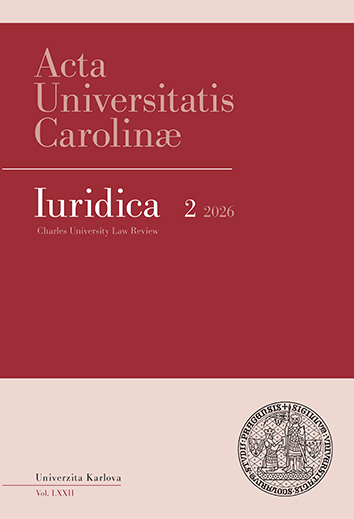
Acta Universitatis Carolinae Iuridica (AUCI) is the main journal of the Faculty of Law of Charles University. It has been published since 1954 and is one of the traditional law journals with a theoretical focus.
As a general law journal, it publishes longer studies and shorter articles on any relevant issues in legal theory and international, European and national law. AUCI also publishes material relating to current legislative issues. AUCI is a peer-reviewed journal and accepts submissions from both Czech and international authors. Contributions by foreign authors are published in their original language – Slovak, English, German, French.
AUCI is a theoretical journal for questions of state and law. It is published by Charles University in Prague, Faculty of Law, through Karolinum Press. It is published four times a year, the dates of publication can be found here.
Articles published in AUCI undergo an independent peer review process, which is anonymous on both sides. Reviewers from the field give their opinion on the scientific quality of the paper and the suitability of publication in the journal. In the case of comments, the opinion is sent back to the author with the possibility of revising the text (see Guidelines for Authors – Per Review Process for more details).
The AUCI journal (ISSN 0323-0619) is registered in the Czech National Bibliography (kept by the National Library of the Czech Republic) and in the Index to Foreign Legal Periodicals (kept by the American Association of Law Libraries). AUCI has been assigned a periodical registration number MK E 18585.
In 2021 the journal AUCI was the first journal of the Faculty of Law of Charles University to be included in the prestigious international database Scopus. This Elsevier database is the largest abstract and citation database of peer-reviewed literature in the world. The editors of the journal expect from the inclusion in the elite Scopus database not only an increase in the readership of the journal, but also an increase in interest in the publication of papers by both Czech and foreign authors.
AUCI is an open journal and all its content is published both on the faculty website and on the Karolinum Press website. Access to it is free of charge. The homepage of AUCI is on the Karolinum Press website.
The AUCI journal uses the Creative Commons license: CC BY 4.0.
Long-term archiving of the digital content of the journal is provided by Portico.
AUC IURIDICA, Vol 22 No 4 (1977), 297–306
Monopoly v Byzanci
[Monopolies in Byzantium]
Stanislav Balík
DOI: https://doi.org/10.14712/23366478.2025.637
published online: 25. 09. 2020
abstract
The Byzantine Empire was one of the mediaeval states in which the institution of monopolies developed to a great extent. The Byzantine monopolies evolved from the ancient Roman and Eastern Roman monopolies of the Dominatus period. Just as the former the latter ones resulted above all from drawn out economic, social and political crises, that kept shaking Byzantium throughout its existence as well as from the attempts of the state to control the country’s economy and to safeguard various interests of the state. Byzantium followed up the Eastern Roman tradition from the end of antiquity also in that it differentiated consistently between state and private monopolies. State monopolies were the instrument of the state’s economic policy and as such protected by the legal system. Private monopolies on the other hand were getting into conflict with the state’s economic policy (particularly in the question of prices) and were therefore being prohibited as undesirable (for inst. by Emperor Zenon’s Constitution of 483, adopted later by Justinian in the Codex). The Byzantine economics relied for centuries on a refined system of monopolies. It can be said in principle that there were in Byzantium on the one hand state monopolies embodying for various reasons (economic, political, fiscal, administrative) the most important branches of the economy and on the other corporation monopolies. Sometimes (as in the instance of silk manufacture) a characteristic symbiosis of state and corporation monopoly evolved. In this instance, too, the state retained its decisive role. The system of Byzantine monopolies collapsed with the conquest of Constantinople by the crusaders in 1204. Its remnants were finally destroyed by the conquest of the restored yet badly reduced Byzantium by the Turks in 1453.

Monopoly v Byzanci is licensed under a Creative Commons Attribution 4.0 International License.
157 x 230 mm
periodicity: 4 x per year
print price: 65 czk
ISSN: 0323-0619
E-ISSN: 2336-6478