
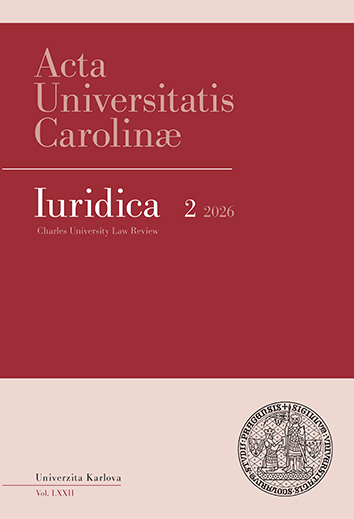
Acta Universitatis Carolinae Iuridica (AUCI) is the main journal of the Faculty of Law of Charles University. It has been published since 1954 and is one of the traditional law journals with a theoretical focus.
As a general law journal, it publishes longer studies and shorter articles on any relevant issues in legal theory and international, European and national law. AUCI also publishes material relating to current legislative issues. AUCI is a peer-reviewed journal and accepts submissions from both Czech and international authors. Contributions by foreign authors are published in their original language – Slovak, English, German, French.
AUCI is a theoretical journal for questions of state and law. It is published by Charles University in Prague, Faculty of Law, through Karolinum Press. It is published four times a year, the dates of publication can be found here.
Articles published in AUCI undergo an independent peer review process, which is anonymous on both sides. Reviewers from the field give their opinion on the scientific quality of the paper and the suitability of publication in the journal. In the case of comments, the opinion is sent back to the author with the possibility of revising the text (see Guidelines for Authors – Per Review Process for more details).
The AUCI journal (ISSN 0323-0619) is registered in the Czech National Bibliography (kept by the National Library of the Czech Republic) and in the Index to Foreign Legal Periodicals (kept by the American Association of Law Libraries). AUCI has been assigned a periodical registration number MK E 18585.
In 2021 the journal AUCI was the first journal of the Faculty of Law of Charles University to be included in the prestigious international database Scopus. This Elsevier database is the largest abstract and citation database of peer-reviewed literature in the world. The editors of the journal expect from the inclusion in the elite Scopus database not only an increase in the readership of the journal, but also an increase in interest in the publication of papers by both Czech and foreign authors.
AUCI is an open journal and all its content is published both on the faculty website and on the Karolinum Press website. Access to it is free of charge. The homepage of AUCI is on the Karolinum Press website.
The AUCI journal uses the Creative Commons license: CC BY 4.0.
Long-term archiving of the digital content of the journal is provided by Portico.
AUC IURIDICA, Vol 15 No 3 (1968), 27–49
ArticleZásada nevměšování
[The Principle of Non-Intervention]
Miroslav Potočný
DOI: https://doi.org/10.14712/23366478.2026.39
published online: 10. 02. 2021
abstract
The principle of non-intervention, as an obligation of states to refrain from any direct or indirect interference with the internal or external affairs of other states, is of extreme importance in present-day world for the independent existence of all states, in particular the smaller and newly established ones, as well as for the development of peaceful relations and co-operation among states, irrespective of their social and political systems or differences in the level of their economic and cultural development. The legal obligation of non-intervention in the affairs of other states has been a part of general international law since the last century, and important, integral element of the legal system of the United Nations since the adoption of the United Nations Charter. While in the past, this principle and obligation had been weakened by numerous exceptions and limitations, its development since the end of the Second World War has progressed towards an absolute prohibition of any interference with the internal or external affairs of other states. The obligation of non-intervention is embodied primarily in the United Nations Charter, in general customary law and in a number of important postwar international documents, such as the Declaration of Bandung, the Belgrade and Cairo Declarations of Non-Aligned Nations, the Charter of the Organization of American States and, last but not least, the Declaration of the United Nations General Assembly on the inadmissibility of intervention, adopted as Resolution No. 2131/XX in 1965. The General Assembly expressly specified the binding legal character of this Declaration when it re-affirmed on December 19, 1966, all the principles and rules embodied in the Declaration and appealed to all states to implement their obligations proceedings from the Charter and the provisions of the Declaration on Non-Intervention (Resolution No. 2225/XXI). Intervention is to be understood as any imposition of the will of one state on another state, regardless of whether the intervening state does so openly, with a threat of force, armed force, economic or other pressure, or whether it does so under cover, by supporting opposition groups in the other state, by secretly financing its press, etc. The prohibition of intervention does not relate to collective action by the Security Council against violators of international peace, undertaken in accordance with Chapter VII of the Charter, consideration of questions of racial discrimination, apartheid, genocide or gross violations of human rights in the United Nations, assistance to nations and territories under colonial rule in their fight for independence, normal diplomatic intervention in another state, consultations with another state, negotiations with such a state, conclusion of international agreements, mediation or good services, provided that the parties fully respect the principle of sovereign equality and other generally recognized rules of international law. The external and foreign affairs of a state, in which no other state should intervene, include primarily the free choice of its social and governmental system, including its form of government, internal order and political organization of society and public administration, its socio-economic basis, organization of its economy, system of representative bodies, judiciary, national defence and conduct of foreign affairs. On the other hand, questions concerning the fulfilment of obligations ensuing from mandatory rules of international law and obligations assumed in treaties and customary rules are not to be considered as being internal matters of a state. The prohibited forms of intervention include primarily armed intervention and all other forms of interference or attempts at threat directed against a state as an entity or its political, economic and cultural components. Also prohibited by international law are economic, political or any other measures aimed at forcing another state to subject the exercise of its sovereign rights to the intervening state or at acquiring any privileges. A no less dangerous form of unlawful intervention is the organization, assistance to, incitement, financing, encouragement or non-suppression of subversive, terroristic and armed activities aimed at the forcible overthrow of the regime in another state, as well as intervention in the civil war taking place in another country. Just as unlawful is any attempt to impose on the people of another country a certain social or political system by force and from the outside. Attempts at a forcible acquisition of advantages which would result in a privileged status of foreign nationals as against the nationals of the other state are another modern form of intervention, typical of neo-colonialism. Another such special form of intervention is the policy of preventing another state to dispose freely of its natural wealth and national resources. Yet another example of prohibited intervention is a situation where a state prevents another state to adopt and implement legislation on matters falling within the latter’s jurisdiction. Finally, threats to break off diplomatic relations with another state with the aim of forcing it not to recognize a third state must also be considered as a form of intervention. International law, which previously permitted intervention for purposes of reprisal, protection of one’s own nationals abroad, at the request of the other state either ad hoc or under a previously concluded treaty, maintenance of the existing dynasty or regime, for humanitarian reasons or for reasons of self-defence, today categorically prohibits intervention for any reason whatsoever and considers this prohibition to be absolute.

Zásada nevměšování is licensed under a Creative Commons Attribution 4.0 International License.
157 x 230 mm
periodicity: 4 x per year
print price: 65 czk
ISSN: 0323-0619
E-ISSN: 2336-6478