
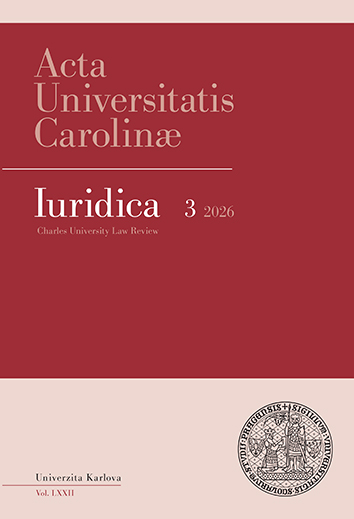
Acta Universitatis Carolinae Iuridica (AUCI) is the main journal of the Faculty of Law of Charles University. It has been published since 1954 and is one of the traditional law journals with a theoretical focus.
As a general law journal, it publishes longer studies and shorter articles on any relevant issues in legal theory and international, European and national law. AUCI also publishes material relating to current legislative issues. AUCI is a peer-reviewed journal and accepts submissions from both Czech and international authors. Contributions by foreign authors are published in their original language – Slovak, English, German, French.
AUCI is a theoretical journal for questions of state and law. It is published by Charles University in Prague, Faculty of Law, through Karolinum Press. It is published four times a year, the dates of publication can be found here.
Articles published in AUCI undergo an independent peer review process, which is anonymous on both sides. Reviewers from the field give their opinion on the scientific quality of the paper and the suitability of publication in the journal. In the case of comments, the opinion is sent back to the author with the possibility of revising the text (see Guidelines for Authors – Per Review Process for more details).
The AUCI journal (ISSN 0323-0619) is registered in the Czech National Bibliography (kept by the National Library of the Czech Republic) and in the Index to Foreign Legal Periodicals (kept by the American Association of Law Libraries). AUCI has been assigned a periodical registration number MK E 18585.
In 2021 the journal AUCI was the first journal of the Faculty of Law of Charles University to be included in the prestigious international database Scopus. This Elsevier database is the largest abstract and citation database of peer-reviewed literature in the world. The editors of the journal expect from the inclusion in the elite Scopus database not only an increase in the readership of the journal, but also an increase in interest in the publication of papers by both Czech and foreign authors.
AUCI is an open journal and all its content is published both on the faculty website and on the Karolinum Press website. Access to it is free of charge. The homepage of AUCI is on the Karolinum Press website.
The AUCI journal uses the Creative Commons license: CC BY 4.0.
Long-term archiving of the digital content of the journal is provided by Portico.
AUC IURIDICA, Vol 14 No 1 (1967), 83–105
ArticlePolitický systém Indické republiky a základní tendence jeho vývoje
[The Political System of the Republic of India an Basic Trends of Its Development]
Vlasta Baudyšová
DOI: https://doi.org/10.14712/23366478.2025.782
published online: 10. 02. 2021
abstract
The study deals, in the first place, with the social factors determining and influencing the political structure of the Republic of India. The plurality of Indian society stems both from its social stratification with intermingled elements of modern and traditional social structure, and from its religious, national (linguistic) and racial heterogeneity. All these social elements act in the political life of India either as isolated political movements or as pressure groups. The political structure which is not yet stabilized is taking the shape of a political system of many political parties with the “Indian National Congress” party exercising its leadership over the whole country. The Congress Party is a heterogenous political party and as a result of the pluralism of Indian society there exist within this Party different trends, fractions and dissident groups. The right and left wing groups and groups standing in the centre each take a different ideological approach to the social, economic and political problems of India. But the influence of different religious communities, various castes, linguistic or national groups is even stronger on the level of lower organizations of the Congress Party, or the influence of these elements intermingles. The study deals further with the organizational structure of the Congress Party and with its leadership stressing that after D. Nehru’s death the power to take political decisions is passing from the All-India organs of the Congress Party to the organs of this party in the individual states of the Union of India. The intelligentsia which until now has been the leading nucleus of the Congress Party is being replaced by the groups of owners, especially by the rural bourgeoisie. In connection with the election system the study deals with the possibility of establishing a two-party system in India. The author’s opinion is that for the time being the conditions do not exist in India for splitting the Congress Party either into two independent political parties of a homogeneous structure (with conservative, liberal or social democratic views), or into political parties of the American type. Nor are there effective conditions for the integration of those parties which stand in opposition. However, because the Congress Party still holds strong positions in the Indian countryside it is likely that this party will keep its leading position in the Union of India and there is unlikely to be an early change in the political structure of India.

Politický systém Indické republiky a základní tendence jeho vývoje is licensed under a Creative Commons Attribution 4.0 International License.
157 x 230 mm
periodicity: 4 x per year
print price: 65 czk
ISSN: 0323-0619
E-ISSN: 2336-6478