
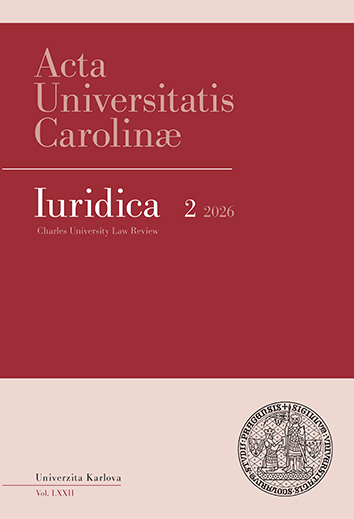
Acta Universitatis Carolinae Iuridica (AUCI) is the main journal of the Faculty of Law of Charles University. It has been published since 1954 and is one of the traditional law journals with a theoretical focus.
As a general law journal, it publishes longer studies and shorter articles on any relevant issues in legal theory and international, European and national law. AUCI also publishes material relating to current legislative issues. AUCI is a peer-reviewed journal and accepts submissions from both Czech and international authors. Contributions by foreign authors are published in their original language – Slovak, English, German, French.
AUCI is a theoretical journal for questions of state and law. It is published by Charles University in Prague, Faculty of Law, through Karolinum Press. It is published four times a year, the dates of publication can be found here.
Articles published in AUCI undergo an independent peer review process, which is anonymous on both sides. Reviewers from the field give their opinion on the scientific quality of the paper and the suitability of publication in the journal. In the case of comments, the opinion is sent back to the author with the possibility of revising the text (see Guidelines for Authors – Per Review Process for more details).
The AUCI journal (ISSN 0323-0619) is registered in the Czech National Bibliography (kept by the National Library of the Czech Republic) and in the Index to Foreign Legal Periodicals (kept by the American Association of Law Libraries). AUCI has been assigned a periodical registration number MK E 18585.
In 2021 the journal AUCI was the first journal of the Faculty of Law of Charles University to be included in the prestigious international database Scopus. This Elsevier database is the largest abstract and citation database of peer-reviewed literature in the world. The editors of the journal expect from the inclusion in the elite Scopus database not only an increase in the readership of the journal, but also an increase in interest in the publication of papers by both Czech and foreign authors.
AUCI is an open journal and all its content is published both on the faculty website and on the Karolinum Press website. Access to it is free of charge. The homepage of AUCI is on the Karolinum Press website.
The AUCI journal uses the Creative Commons license: CC BY 4.0.
Long-term archiving of the digital content of the journal is provided by Portico.
AUC IURIDICA, Vol 13 No 1 (1966), 83–105
ArticleK vývoji bytového družstevnictví v Československu
[The Development of the Housing Cooperatives in Czechoslovakia]
Věra Čížkovská
DOI: https://doi.org/10.14712/23366478.2025.770
published online: 10. 02. 2021
abstract
The first part of the study contains a brief historical survey of the main principles, forms and juridical regulations concerning the Czechoslovak housing cooperatives, since the beginning of the movement in question at the end of the last century, up to the present time. The development of the movement of housing cooperatives can be divided, from the point of view of its economical conditions, of its juridical forms and of the principles on which it was based, into three phases: 1. The phase since the foundation of the first building and housing associations at the end of the 19th century, up to the political, economical and legal reorganization of the housing cooperatives in the years fifty. 2. The phase during which the popular housing cooperatives were the unique form of the Czechoslovak housing cooperatives. 3. The phase since the beginning of the cooperative housing construction and the creation of the building and housing cooperatives, representing a new juridical form of the Czechoslovak housing cooperatives; this phase is still lasting. In the second part of her study, the author concentrates her interest, as far as the involved problems of civil law are concerned, on two problems: on the qualification of the membership relation and on the juridical position of the member of the cooperative towards the housing fund of the cooperative. As far as the qualification of the membership relation is concerned, this relation is considered either as being predominantly or exclusively a property relation, or as being predominantly or exclusively a political one, in accordance with the nature of the housing cooperative and determined by the object of the activities of the cooperative. From this standpoint of view a comparison is drawn between the housing cooperatives created according to the section 70/1873 of the imperial code and the popular housing cooperatives regulated by the Act No. 53/54 C. of L. and the building and housing cooperatives, founded according to the Act No. 27/59 C. of L., concerning the cooperative housing construction and newly regulated by the Economical Code No. 109/64 C. of L. While the housing cooperatives, created on the basis of the Act No. 70/1873 of the imperial code, concerning societies, were exclusively property associations, the popular housing cooperatives and the building and housing cooperatives are predominantly, but not exclusively, property associations. Besides their fundamental economical activities, which consist in the building, the consumption and the maintenance of the housing fund, they fulfil also certain cultural and political tasks as voluntary social organizations of the working people. After an analysis of the cooperative membership relation under the aspects of its origin and its extinction, as well as under the aspect of the rights and duties constituting its content, the author arrives to the conclusion, that the membership relation in the housing cooperatives, created on the basis of the Act No. 70/1873 of the imperial code, was exclusively a property relation, whereas, as far as the popular housing cooperatives and the building and housing cooperatives are concerned, this relations is predominantly, but nor exclusively, a property relation. The author qualifies this relation, as far as the legal aspect is concerned, as a civil juridical relation. The examination of the legal position of the members of the cooperative towards the cooperative housing fund leads the author to the conclusion that, differently as it was in the case of the housing cooperatives, created on the basis of the Act No. 70. 1873 of the imperial code, the member of a building and housing cooperative becomes, according to the regulations until now in force, only user of his apartment, because the valid Czechoslovak legal rules do not admit the so called property housing cooperatives. The right of the member to his apartment is based on the relation of personal cooperative use of the apartment, which is qualified as constituting a specific institution of civil law.

K vývoji bytového družstevnictví v Československu is licensed under a Creative Commons Attribution 4.0 International License.
157 x 230 mm
periodicity: 4 x per year
print price: 65 czk
ISSN: 0323-0619
E-ISSN: 2336-6478