
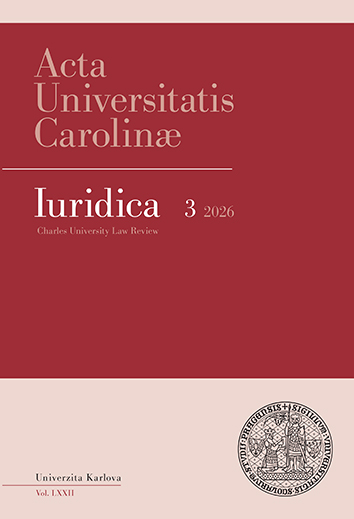
Acta Universitatis Carolinae Iuridica (AUCI) is the main journal of the Faculty of Law of Charles University. It has been published since 1954 and is one of the traditional law journals with a theoretical focus.
As a general law journal, it publishes longer studies and shorter articles on any relevant issues in legal theory and international, European and national law. AUCI also publishes material relating to current legislative issues. AUCI is a peer-reviewed journal and accepts submissions from both Czech and international authors. Contributions by foreign authors are published in their original language – Slovak, English, German, French.
AUCI is a theoretical journal for questions of state and law. It is published by Charles University in Prague, Faculty of Law, through Karolinum Press. It is published four times a year, the dates of publication can be found here.
Articles published in AUCI undergo an independent peer review process, which is anonymous on both sides. Reviewers from the field give their opinion on the scientific quality of the paper and the suitability of publication in the journal. In the case of comments, the opinion is sent back to the author with the possibility of revising the text (see Guidelines for Authors – Per Review Process for more details).
The AUCI journal (ISSN 0323-0619) is registered in the Czech National Bibliography (kept by the National Library of the Czech Republic) and in the Index to Foreign Legal Periodicals (kept by the American Association of Law Libraries). AUCI has been assigned a periodical registration number MK E 18585.
In 2021 the journal AUCI was the first journal of the Faculty of Law of Charles University to be included in the prestigious international database Scopus. This Elsevier database is the largest abstract and citation database of peer-reviewed literature in the world. The editors of the journal expect from the inclusion in the elite Scopus database not only an increase in the readership of the journal, but also an increase in interest in the publication of papers by both Czech and foreign authors.
AUCI is an open journal and all its content is published both on the faculty website and on the Karolinum Press website. Access to it is free of charge. The homepage of AUCI is on the Karolinum Press website.
The AUCI journal uses the Creative Commons license: CC BY 4.0.
Long-term archiving of the digital content of the journal is provided by Portico.
AUC IURIDICA, Vol 13 No 1 (1966), 61–82
ArticleNěkolik teoretických úvah nad úpravou předcházení škodám v novém občanském zákoníku ČSSR
[Some Theoretical Considerations Concering the Regulation of the Prevention of Damage in the New Czechoslovak Civil Code]
Jiří Švestka
DOI: https://doi.org/10.14712/23366478.2025.769
published online: 10. 02. 2021
abstract
During the process of creation and consolidation of socialist relations between people and during the completion of the construction of an advanced socialist society, an important place and an important task incomb also to the Czechoslovak civil law and within its frame to the civil system of prevention and of responsibility, principally as far as the regulation of the prevention of damages and the property responsibility for caused damages are concerned. The regulation in civil law of the prevention of damages, as well as of the responsibility for caused damages, secures and guarantees the protection of civil juridical relations, that means first of all the protection of juridical property relations, based on the utilization of the categories of merchandise and money, as well as the protection of the personal juridical relations, which are closely connected with the juridical property relations (they are similar); this aim is attained by a double way: 1. first of all by means of a general, as well as of a concrete (specific) prevention and 2. in case of disturbances occurring in these relations, by means of the reparation event, of the satisfaction. The principle of prevention has become also in the new Civil code one of the outstanding principles which govern the whole domain of the legal regulation of the civil juridical relations. It is however necessary to mention the fact that the new Civil code has brought about, in comparison with the previous juridical situation, a considerable material (concerning its content) and formal stressing and amplification of the prevention. The aim being that all participants in civil juridical relations should behave always so as to take duly into consideration the justified necessities and tasks of the prevention, the new regulation of the prevention and of the responsibility in civil law contributes to this aim essentially in two ways: 1. by acting in such a way as to divert in general the citizens and the organizations from violating the legal obligations, which is precisely often accompanied by the occurrence of damages (the so-called general prevention in the domain of civil law); 2. by acting in such a way as to bring about the realization of a concrete and specific measure designed to turn off an imminent damage in a concrete case (the so called concrete and specific prevention in the domain of civil law). Ad 1. The operating of the civil juridical regulation in the sense of the general civil juridical prevention is effectuated principally: a) by fixing directly the obligation of every participant in civil juridical relations “to behave in such a way as to avoid damages concerning health and property”; b) indirectly, by means of the proper regulation of the responsibility of caused damages, because precisely in the socialist law the questions of reparation (satisfaction) are closely connected with the questions concerning prevention. The new regulation of the civil responsability of damages is justly not limited to the operating in the sense of the general prevention. According to circumstances, the special duty of prevention may consist either a) in the duty of everyone to draw the attention of the competent organs to the imminent serious damage (the so-called preventive liability to notify) or b) in the duty of everyone to interfere in order to divert the imminent serious damage (the so-called preventive liability to interfere). One may suppose that the imposition of both forms of this special duty of prevention not only upon the endangered persons, but also upon all the other third persons (citizens as well as organizations), is able to contribute in its proper way to the overcoming of the apathy and indifference manifested even to-day by many citizens as far as the endangered interests of the society or of the other fellow-citizens are concerned. The fulfilment of the duty of prevention cannot, of course, be an unconditional one, because different reasons and considerations make it necessary that at the same time a sufficiently wide liberation of this duty should be admitted. The duty of prevention is therefore not supported by anybody: aa) who is kept from the fulfilment of the duty by some serious circumstances or bb) who would, by his notification, expose to a serious danger either himself or a person near to him. It would be in fact unjust and incongruous to persist even in such circumstances unconditionally on the fulfilment of the duty in question; such attitude would be even contrary to the rules of the socialist co-existence. It is because of this reason that even the law does not impose this duty unconditionally. A third person (a citizen), who has not fulfilled his duty of prevention, without having been kept from the fulfilment in question by some of the before mentioned causes of liberation, can be affected, under certain circumstances, even by a sanction having the form of a contribution to be paid to the injured person, in order to cover a damage which otherwise would not be compensated. Whereas the idea to impose a special duty of prevention upon all third persons has been in the whole accepted positively during the codification works, in consideration of the necessity of a further intensification of the social as well as individual interests, the question, whether a violation of this duty of prevention by third persons has to be sanctioned or not, did not find, on the contrary, during the respective discussions, a completely univocal solution. The fact that a civil juridical responsibility of third persons for the violation of the special duty of prevention should be founded in a case, where a socially important damage is about to occur, has to be considered in principle as justified from the juridical and political, as well as from the theoretical point of view. If a duty of prevention, imposed upon third persons, has already been fixed in the Civil code, it is consequential and correct, principally considering the effective observance of the said duty, that the violation of this duty should be in principle sanctioned. On the other hand, one cannot leave out of account the fact that, considering the special character of those cases (the third persons did not cause themselves by their behaviour the damage, but only did not prevent by their passivity – omission the immediate origin of the damage, although this has been within their possibilities and within their forces), the violation of the duty of prevention by a third person cannot be sanctioned in a mechanical and equal way, like any other violation of juridical obligations. The new Civil code has respected all these juridical, political, theoretical and finally also practical postulates. It is why, according to the regulation in force, it is possible to impose upon a citizen an adequate contribution to the reparation of damages only under the condition that the citizen in question has not in the absence of any important circumstance and of any serious menace which would have threatened him or a person near to him, fulfilled his duty of prevention (though he would have, aby fulfilling the duty in question, prevented the immediate origin of the damage) and under the condition that the damage in question cannot be covered in any other way. The court must also take into account such circumstances as the social importance of the caused damage, the personal and property situation of the citizen who has not fulfilled his duty and the causes because of which he has not fulfilled his duty.

Několik teoretických úvah nad úpravou předcházení škodám v novém občanském zákoníku ČSSR is licensed under a Creative Commons Attribution 4.0 International License.
157 x 230 mm
periodicity: 4 x per year
print price: 65 czk
ISSN: 0323-0619
E-ISSN: 2336-6478