
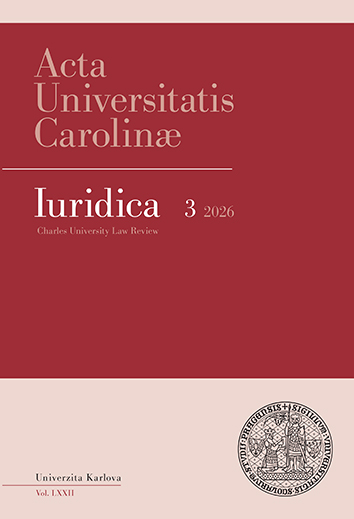
Acta Universitatis Carolinae Iuridica (AUCI) is the main journal of the Faculty of Law of Charles University. It has been published since 1954 and is one of the traditional law journals with a theoretical focus.
As a general law journal, it publishes longer studies and shorter articles on any relevant issues in legal theory and international, European and national law. AUCI also publishes material relating to current legislative issues. AUCI is a peer-reviewed journal and accepts submissions from both Czech and international authors. Contributions by foreign authors are published in their original language – Slovak, English, German, French.
AUCI is a theoretical journal for questions of state and law. It is published by Charles University in Prague, Faculty of Law, through Karolinum Press. It is published four times a year, the dates of publication can be found here.
Articles published in AUCI undergo an independent peer review process, which is anonymous on both sides. Reviewers from the field give their opinion on the scientific quality of the paper and the suitability of publication in the journal. In the case of comments, the opinion is sent back to the author with the possibility of revising the text (see Guidelines for Authors – Per Review Process for more details).
The AUCI journal (ISSN 0323-0619) is registered in the Czech National Bibliography (kept by the National Library of the Czech Republic) and in the Index to Foreign Legal Periodicals (kept by the American Association of Law Libraries). AUCI has been assigned a periodical registration number MK E 18585.
In 2021 the journal AUCI was the first journal of the Faculty of Law of Charles University to be included in the prestigious international database Scopus. This Elsevier database is the largest abstract and citation database of peer-reviewed literature in the world. The editors of the journal expect from the inclusion in the elite Scopus database not only an increase in the readership of the journal, but also an increase in interest in the publication of papers by both Czech and foreign authors.
AUCI is an open journal and all its content is published both on the faculty website and on the Karolinum Press website. Access to it is free of charge. The homepage of AUCI is on the Karolinum Press website.
The AUCI journal uses the Creative Commons license: CC BY 4.0.
Long-term archiving of the digital content of the journal is provided by Portico.
AUC IURIDICA, Vol 12 No 2 (1965), 99–124
ArticleK některým vývojovým tendencím úlohy ústředních státních orgánů v současném období
[Remarks on Some Evolutional Tendencies of the Task of Central State Organs in the Actual Period]
Vladimír Delong, Lubomír Houska, Iva Tomsová
DOI: https://doi.org/10.14712/23366478.2025.763
published online: 10. 02. 2021
abstract
The article in question examines the task and the function of the central State organs (government, functional organs of the government, ministeries and other central administrations) from three points of view: from that of the objective necessity of a central State direction, from the point of view of the present evolution and from the point of view of the concrete demands which are put before the central organs by the main principles of the new system of management of national economy, adopted by the plenary session of the Central Committee of the Communist Party of Czechoslovakia, in January 1965. On the basis of this examination, the authors draw some general conclusions concerning the further evolution of the task and the function of the central State organs, their appropriate arrangement and mutual relations, as well as their relations with economic organs and organizations. As far as the objective necessity of a central management is concerned, the article arrives to the conclusion that the task and the content of the activities of the central State organs consist in the realization of the policy of the Communist Party. This conception means on the one hand that the central State organs are fully responsible for the immediate realization of this policy and that they are not substituted, as far as that responsibility is concerned, by the Party organs and on the other hand this conception leads to the limitation of the central management of economy and of other spheres of social life to a scope comprising only political decisions and decisions of an administrative character, involving questions of power (for instance in economic matters), which concern the society as a whole and are taken on a nation-wide scale. If the central State management has to increase its qualitative level, the central organs must get rid of problems concerning the current and operative daily management; these functions must be taken over in the different branches, departements and sections by the “khozrazchot” unities (in the sphere of economy) or by organizations, usually based on the budget (the sphere of the cultural construction). The analysis of the present evolution of the task of the central State organs in the Czechoslovak Socialist Republic shows, first of all, that the central organs exercised a series of functions of daily operative management of the branches and departments in the field of economic and cultural construction and that the fulfilment of these tasks weakened their character of State organs which have to secure by their activities of management the social, political and power interests of the working people and of the society as a whole. The central organs had also to fulfil functions of a power control of the maintenance of the State and general public interests, as well as the functions (overwhelmingly functions of direction) resulting from the observance and the securing of juridical relations between citizens and organizations; it is necessary to consecrate in future a greater attention also to the fulfilment of these tasks. From the point of view of the horizontal division of labour between the central State organs, there appear problems concerning the structure and the activities, which are connected with the overcoming of the functional and departmental method of management. The functional system is, on one side, the consequence of a too great number of operative and executive functions which incomb in the sphere of economy to central governmental organs, superior to the individual departments, but is caused also by the existence of a great number of central functional organs of the government. As far as the departmental system of management is concerned, it was influenced, besides by the general conditions of central management and the non differentiation between the State management (political and nation-wide) and the current and operative management, also by the existence of a great number of central branch organs and the unsufficient harmonization of the system composed of these organs. As far as the examination of the tendencies of a further development of the central State organs, is concerned the greatest importance is to be attributed in the present period to the concrete demands resulting from the realization of the principle of a new system of management of national economy. The conception of the linking of the plan with market relations within this system predetermines a further development of democratic centralism and first of all a correct orientation of the managing competence of the central organs as far as their decisions on economic matters are concerned. In the new system, the central organs will be responsible for the elaboration of the perspectives of evolution of national economy, for the harmonization of the fundamental proportions of this evolution and for the entire sphere containing the determination of rules or scope of relatively autonomous economic activities and relations between the economic organizations. They have to decide also on questions concerning the basic structure of Czechoslovak economy, the proportions in the distribution and utilization of the national income, the balance in the fundamental economic relations, the disposition of productive forces, as well as some other tasks (for instance those necessary for the security of the State). The new system of management of national economy is based further on the fact that the lower degrees in the system of management decide on many economic matters with definitive validity and that they have a great space left for their initiative and independent activity. In order to be able to maintain the basic proportions, determined by the plan, the central organs should have in their hands principally such instruments as are the policy of salaries, of prices, the deductions of the basic founds, the credit and the interest. On the basis of an examination of the central State organs from the mentioned aspects, the authors resume some of the tendencies of a further evolution in the Czechoslovak Socialist Republic, principally from the aspect of the demands for an improved planified management of national economy, the principles of which have been approved in January 1965. At the same time they emphasize however that, in the course of the further edification of central organs, one should have in view that their system should lead to an improvement of the central management even as far as other spheres of social life and other branches of State administration are concerned, principally that all the central State organs should fulfil more effectively the functions which are theirs and which consist in the control by the State power of the protection of all State and public interests, fixed by juridical regulations and that they should, far more than it is actually the case, respect and secure the rights, the justified interests and obligations of the citizens and of the organizations a that they should fulfil, within the scope of their competence, the functions of a general State administration. In connection with the new system of economic management of national economy, the article proposes to proceed on the governmental level to an appropriate concentration of the existing organs of government, so as to create greater unities, principally in the sphere of the perspective evolution and also in the sphere of the realization of these perspectives. The problem of the structure of the central branch organs can be resolved either by a system of different, relatively autonomous central organs, or by a system of more complex branch formations (f. i. in the sphere of industrial management). The final part of the article gives also a brief characteristic of the task and of the work of the government, of the governmental organs and of the central branch organs of the State administration. Hereby is emphasized the principle that the central State organs are fully responsible for the execution of the economic policy within the branch they have to care for and for the fulfilment of other society-wide political functions, but not for the activities of every single subordinated unity taken as a whole.

K některým vývojovým tendencím úlohy ústředních státních orgánů v současném období is licensed under a Creative Commons Attribution 4.0 International License.
157 x 230 mm
periodicity: 4 x per year
print price: 65 czk
ISSN: 0323-0619
E-ISSN: 2336-6478