
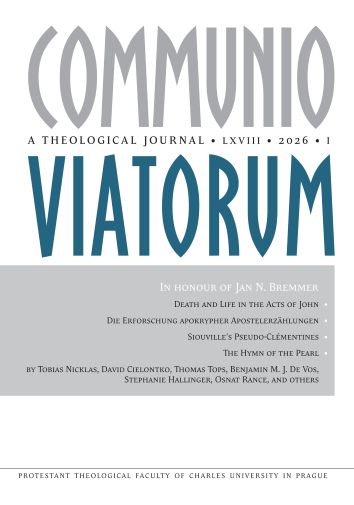
Communio viatorum is a theological journal from Central European perspectives founded in 1958 by J. L. Hromádka and J. B. Souček, published by the Protestant Theological Faculty of Charles University in Prague three times a year.
Communio Viatorum seeks to promote research and scholarly debate in all theological disciplines. Since its foundation special attention has been paid to both biblical studies and Czech Protestant history. The journal is also interested in articles that reflect new accents within the field of theology as well as relevant challenges from neighbouring disciplines, developments in the Church worldwide as well as new moves within society. It seeks to promote an ongoing process of theological debate from a specific Central European Protestant background, but open to authors from all around the world and all denominations who wish to engage in such a conversation.
As of 2024, the journal Communio Viatorum has transitioned to an open-access publication, issued by Charles University Karolinum Press.
Articles published here are indexed in the ATLA Religion Database® and are included in the full-text ATLASerials® (ATLAS®) collection. They are also indexed and abstracted in the Web of Science – Arts and Humanities Citation Index® of Clarivate Analytics, in Scopus, in CEEOL, and in ERIH PLUS.
The previous journal homapage with an archive of published issues
COMMUNIO VIATORUM, Vol 68 No 1 (2026), 160–185
ArticleFixing the Name, Shaping the Saint: The Mother of the Maccabees in Jewish and Christian Reception
Osnat Rance, Stephanie Hallinger
DOI: https://doi.org/10.14712/30296374.2026.12
published online: 01. 09. 2026
abstract
The Mother of the Seven Maccabean Martyrs offers a striking case of interreligious transformation in Late Antiquity. Anonymous in 2 Maccabees 7 and philosophically expanded in 4 Maccabees, she became a powerful symbolic figure in both Jewish and Christian traditions. This paper traces her reception from deliberate anonymity in Greek patristic texts – where she functions typologically as martyr, image of the Church, and Marian prefiguration – to the Syriac tradition, where she acquires the name Shamuni and a fully articulated martyrdom. Byzantine liturgy and art later stabilize the name Salomone, reflecting processes of saintly individualization and canonization. Meanwhile, Jewish adaptations in Midrash Lamentations Rabbah and b. Gittin reframe her story within post-Temple discourse, even renaming her Miriam in a context shaped by Marian devotion. Her evolving name and role reveal a dynamic field of entangled Jewish-Christian traditions in which martyrdom, motherhood, and identity are continuously renegotiated.
keywords: The Mother of the Maccabees; Maccabean Martyrs; Motherhood; Identity; Name; Shamuni

Fixing the Name, Shaping the Saint: The Mother of the Maccabees in Jewish and Christian Reception is licensed under a Creative Commons Attribution 4.0 International License.
148 x 210 mm
periodicity: 3 x per year
print price: 500 czk
ISSN: 0010-3713
E-ISSN: 3029-6374