
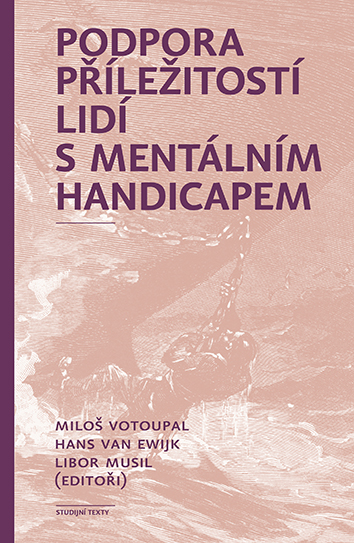

Podpora příležitostí lidí s mentálním handicapem
[Promoting Opportunities for People with Mental Disabilities]
Votoupal, Miloš – van Ewijk, Hans – Musil, Libor (ed.)
subjects:
social work
series:
SLON – Study Texts
coedition with: Masarykova univerzita – Nakladatelství Munipress
paperback, 246 pp., 1. edition
published: november 2022
ISBN: 978-80-246-5451-5
recommended price: 320 czk
summary
The book is dedicated to the efforts to fulfil the wishes of people with mental disabilities to live and spend time among the people in the community they live in. The authors draw on the experience that opportunities for independent decision-making about family life, about one’s own privacy or independent living, about whether and how to spend time in public space are less accessible to people with mental disabilities. Moreover, many people believe without thinking about it that this is right. The aim of the book is to help reduce the limits to their opportunities so that people living with the stigma of mental disability can participate in everyday life in the community as they wish, spontaneously and without fear of not being accepted. The book offers theoretical and social work practice-based ideas that people with mental disabilities are worthy human beings who deserve respect and dignity and have the personal strength needed to take advantage of the opportunities that are a normal part of life for most people. Therefore, the authors of the book do not consider mental disability as a biologically determined characteristic of an individual "with a disability", but as a result of the interaction between society and the person, whose personal strength is usually greater than the people in his or her social environment can admit. People with mental disabilities are simply considered human, and the addendum "with MD" is added just to draw attention to the fact that society makes life difficult for them with this stigmatizing labels. The book offers both theoretical perspectives (dignity and rights of people with disabilities, social inclusion of people with mental disabilities, socially oriented conceptions of disability, etc.) and practical steps (deinstitutionalization, community work, self-advocacy, involvement in sports club work, involvement in research on the importance of meeting places with local community residents, deep listening, etc.), which allow for the organisation of interactions between people with mental disabilities and people in the local community in a way that reduces barriers and improves the acceptance of people with mental disabilities and the opportunities available to them to engage spontaneously in relationships and activities in the local community.
newest releases in the series
Kvalitativní výzkum se zaměřením na polostrukturovaný rozhovor

Svoboda, svědomí, soužití