
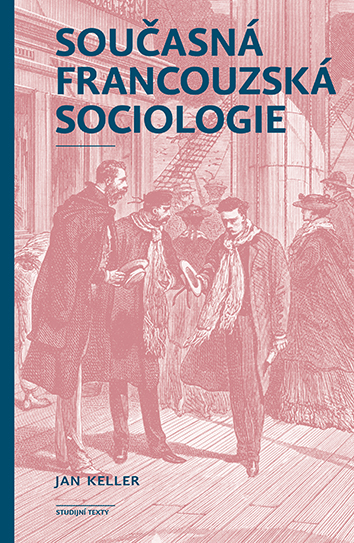

Současná francouzská sociologie
[Contemporary French Sociology]
subjects:
sociology
series:
SLON – Study Texts
e-book, 1. edition
published: january 2023
ISBN: 978-80-246-5381-5
e-book formats PDF
recommended price: 320 czk
summary
The book traces the principal developments in French sociological thought from the mid-20th century to the present day. In this context, it follows the transition from industrial to post-industrial society, from national to global society, and from modernity to postmodernity. These transformations are analysed from a theoretical perspective as well as in a way to reflect the happenings in society and everyday life. Not only does the book track how social reality itself is changing, but it also presents the fundamental disputes and discussions that have been getting underway in French sociology in this context.
Indeed, French sociology has the most suitable parameters for such an analysis. It is the only national sociology that has had a tool for tracking changes in social structure since the mid-20th century. Having the form of “socio-professional categories,” it makes it possible to follow trends in the development of the professional structure and paths of social mobility associated therewith. Within this framework, changes in the world of labour and employment, the operation of formal organisations in the private and public sectors, and changes in the field of education are explained. Other topics include family sociology, which reflects significant changes in relationships between spouses and partners and between parents and children, and urban sociology, where ongoing discussions focus on social segregation and disadvantaged neighbourhoods, addressing topics such as sources of violence in urban environments or residential mobility of various categories of inhabitants.
In the two final sections of the book, these partial analyses are used to formulate answers to the questions raised in the introduction. It is shown how French sociology addresses the tension between the traditional emphasis on social integration and current trends that increase the risk of social exclusion. Moreover, the concluding chapters demonstrate how the issue of social regulation is approached in an environment of increasing individualization. It is apparent that the adequacy of the answers to these questions has a fundamental impact on further development of French and Czech sociology. It also significantly influences the prospects of sociology as a recognized scientific discipline in general.
newest releases in the series
Kvalitativní výzkum se zaměřením na polostrukturovaný rozhovor
Svoboda, svědomí, soužití