

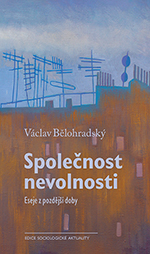
Zaslepená společnost
Eseje z doby těsně před koncem
[A Blind Society]
subjects:
philosophy, sociology
series:
SLON – Sociological News
e-book, 1. edition
published: november 2025
ISBN: 978-80-246-6229-9
e-book formats PDF
recommended price: 290 czk
summary
All the essays in this collection revolve around the question of what ethics, what political culture, and what form of government are appropriate for the Anthropocene – the age of human responsibility for planet Earth.
If we simplify our ideas about democracy, it can be defined as a form of government that maximizes the likelihood that people will choose change over catastrophe. In every free society, there is a competition in the public sphere between those who seek to accelerate change in order to avert impending disaster and those who declare the prophets of doom to be dangerous radicals intimidating “ordinary people” and stubbornly defend the status quo. The debate over climate change is an instructive example of this.
When “public intellectuals” draw attention to fateful issues and these begin to resonate in the public sphere, majority and minority “opinion groups” are formed. However, these are not just clusters of hobbies and preferences. Opinions are what has been subjected to public debate, has stood the test, and has thus gained weight in the public sphere.
In the era that has been called the Anthropocene since around 2000, the struggle for Nomos Earth is a fateful question: Will it be possible to enshrine in a “constitution for all terrestrials” the planetary limits that humanity must not exceed in building its world, so as not to irreparably endanger the habitability of its home planet?
The transformation of slow public space into a fast-paced media sphere has brought with it the threat that elections will produce “majorities” whose formation will be significantly influenced by disinformation and conspiracy theories. Their rule would be a democratic paradox: it would be legitimate by virtue of the title, but illegitimate by virtue of the manner. They would have a legitimate title to rule, but the manner of their rule would be illegitimate because it would be contrary to liberal democratic ideals.
All regimes – even democratic ones – have their mainstream normalization dictionaries. However, it would be an endless tragedy for democracy if the Western tradition of public use of reason (Kant) were reduced, out of fear of media anarchy, to one of the normalization dictionaries: critical reason would begin to warn against “distrust of the system” instead of spreading argumentation based on vigilance towards all systems – those “brothers in lies.”
Distrust of the system, conceived as a syndrome of pathological civic consciousness, would thus definitively end the long tradition of free-thinking public use of reason, from whose nonconformity Euro-American democracies have drawn their contagious radical reformist energy for centuries.
Hopefully, it is not just an old man’s delusion to believe that this collection of essays can contribute to its defense.
Related events
newest releases in the series

Zaslepená společnost
Společnost nevolnosti